
By Adrian Cole | aireviewcore.com | Updated: July 2026
Table of Contents
The best free AI essay grader for teachers with rubric support in 2026 has changed what grading actually costs — not in dollars, but in hours.
Every teacher knows the feeling: 30 essays, a Sunday afternoon, and a red pen that runs out before you do. That calculation is changing fast. Free AI essay graders with real rubric functionality now cut grading time by 60 to 80 percent — without sacrificing the quality of feedback students need to actually improve.
This guide covers five tools that deliver on that promise across different classroom contexts. Each is evaluated on rubric quality, free plan functionality, LMS integration, and the kind of classroom it actually fits — not just the marketing copy.
💡 Quick Answer: EssayGrader is the strongest free AI essay grader for teachers with rubric support for written assignments. CoGrader AI is the best choice if your workflow runs through Google Classroom. Jump to the comparison table to match your context.
What Is a Free AI Essay Grader for Teachers with Rubric?
A free AI essay grader for teachers with rubric support is software that uses large language models to evaluate student writing against your specific rubric criteria — and return scored, criterion-by-criterion feedback — at no cost or on a functional free plan.
The key distinction from generic AI writing tools is the rubric layer. Generic tools give general feedback. A rubric-based AI grader evaluates each submission against the exact criteria you define: argument quality, evidence use, coherence, and whatever specific standards your assignment requires. The feedback maps to your rubric, not to a one-size-fits-all template.
What teachers call an AI marking tool — more common in the UK and Australia — is the same category. The tools in this guide function as both essay graders and marking tools, depending on the assignment type.
Can AI Help Teachers with Grading? What the Research Shows
Yes — with a specific condition. AI grading tools deliver consistent time savings when the rubric is detailed and the assignment type matches the tool’s design. When those two conditions are met, the results are significant:
- Teachers who use AI tools weekly save an average of 5.9 hours per week, according to the 2025 Gallup–Walton Family Foundation Teaching for Tomorrow study — equivalent to six full weeks per school year.
- A separate 2025 Learnosity survey of 258 U.S. teachers found that teachers spend 9.9 hours per week on grading — more than a full workday — with 75% saying they would use AI if it could cut that burden in half.
- The RAND 2025 State of the American Teacher survey found teachers work 49 hours per week on average — 10 hours above contracted hours — with grading accounting for the largest share of that gap.
The tools that fail to deliver share a single flaw: vague rubric criteria. Detailed, criterion-specific rubrics with clear level descriptors produce feedback quality that teachers consistently rate as comparable to their own first-pass evaluation. The tool is not the variable — the rubric is.
The 70/30 Rule in Teaching — And How a Free AI Essay Grader Fits In
The 70/30 rule in teaching is a pedagogical guideline suggesting that 70 percent of classroom time should be student-centered — active learning, discussion, collaborative problem-solving — while 30 percent involves direct teacher instruction.
AI essay graders support this balance by recovering grading hours that currently consume planning capacity outside the classroom. A teacher who spends 9.9 hours per week on marking and recovers 6 of those hours through AI-assisted grading does not just save time. They recover the mental energy needed to design better student-centered activities for that 70 percent.
The free AI essay graders in this guide do not replace teacher judgment — they handle the repetitive first-pass evaluation so teachers can spend their limited time on the feedback conversations and instructional decisions that AI cannot replicate.
The 5 Best Free AI Essay Graders for Teachers with Rubric in 2026
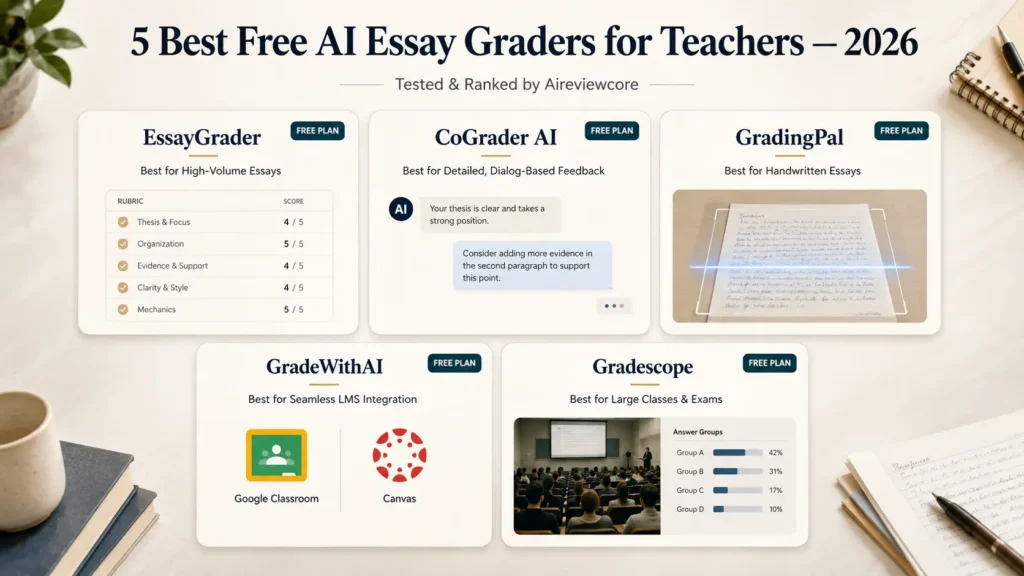
1. EssayGrader — Best Free AI Essay Grader for High-Volume Written Work
EssayGrader is trusted by more than 100,000 teachers across 1,000 schools and colleges. Its free plan includes access to the full rubric builder — the feature that makes it the strongest free AI essay grader for teachers with rubric support in this guide.
The rubric builder is fast to set up and applies your criteria uniformly to every submission. A 30-essay batch that previously took three hours is consistently completed in under 45 minutes. The consistency argument is strongest here: unlike human graders, EssayGrader does not experience fatigue effects after the 10th or 20th paper — the 30th essay gets the same evaluation quality as the first.
The feature that separates EssayGrader from every other tool in this guide is integrated academic integrity — built-in AI writing detection and plagiarism checking run in the same grading pass. In 2026, when AI-generated student writing is a concern in most classrooms, that integrated approach is not optional. It is practical necessity.
| #1 — EssayGrader | |
| Best For | High-volume essay & writing assignments |
| Free Plan | ✅ Available (limited submissions) |
| Paid Plan | From $9.99/month |
| LMS Integration | Google Classroom, Canvas |
| AI Detection | ✅ Built-in AI detection + plagiarism check |
| Handwritten Work | ❌ Optimized for typed text |
| ⭐ Verdict | The default choice for any teacher whose grading load is dominated by written work. Strongest free rubric builder in this guide, plus integrated academic integrity — no separate subscription needed. |
2. CoGrader AI — Best Free AI Essay Grader for Google Classroom Users
CoGrader AI is the free AI essay grader for teachers with rubric support that learns your grading style rather than imposing its own. After you manually grade a minimum of three submissions, the AI trains on how you evaluate work — tone, emphasis, and which criteria you prioritize most.
The feedback CoGrader generates after training is described consistently by teachers as sounding like their own voice. For teachers who have tried AI grading tools and abandoned them because the feedback felt generic, CoGrader AI is the tool that changes that experience.
For Google Classroom users, the native integration is the deepest in this category. Assignments sync in, submissions arrive automatically, and grades return to the gradebook without manual export cycles. If your entire teaching workflow runs through Google Classroom, CoGrader slots into that infrastructure rather than adding a parallel system.
| #2 — CoGrader AI | |
| Best For | Essay grading with personalized feedback via Google Classroom |
| Free Plan | ✅ 100 submissions/month |
| Paid Plan | $15/month (annual) |
| LMS Integration | Google Classroom (native) |
| AI Detection | ❌ Requires separate tool |
| Handwritten Work | ✅ Supported on paid plans |
| ⭐ Verdict | The right choice for teachers who prioritize feedback quality over raw speed. The style-learning system is unique in this category, and the Google Classroom integration is the smoothest available. |
3. GradingPal — Best Free AI Grader for K-12 Mixed Assignment Types
GradingPal is the most complete option for K-12 teachers who grade essays alongside handwritten worksheets, quizzes, and mixed formats. Its OCR capability handles handwritten student work reliably — the kind of mixed-format grading that trips up every other tool in this guide.
The rubric system supports drag-and-drop creation with pre-built templates aligned to Common Core, NGSS, and TEKS. Import existing rubrics, customize them, and reuse them across assignments without rebuilding from scratch each time. Real teachers report grading full class sets of STAAR practice tests, history packets, and economics worksheets in minutes rather than hours.
| #3 — GradingPal | |
| Best For | K-12 teachers grading essays, worksheets, quizzes, and handwritten work |
| Free Plan | ✅ 100 submissions/month |
| Paid Plan | Lite $14/mo · Pro $26/mo (annual) |
| LMS Integration | Google Classroom (native) |
| AI Detection | ❌ |
| Handwritten Work | ✅ Full OCR support |
| ⭐ Verdict | The strongest all-round choice for K-12 teachers with diverse assignment types. The free tier is enough to grade one full class set and validate the tool before committing to a paid plan. |
4. GradeWithAI — Best Free AI Grader Across Multiple LMS Platforms
GradeWithAI handles essays, handwritten work, Google Forms assignments, and Canvas submissions with rubric-based feedback. Its core advantage over the other tools in this guide is platform flexibility — it is the only free AI essay grader that integrates natively with both Google Classroom and Canvas without requiring institutional licensing.
With 48.59K monthly visits and a user base built around a single value proposition — grade faster without sacrificing rubric consistency — GradeWithAI is the strongest option for teachers whose students submit across more than one platform.
| #4 — GradeWithAI | |
| Best For | Teachers using both Google Classroom and Canvas |
| Free Plan | ✅ Limited |
| Paid Plan | Contact for pricing |
| LMS Integration | Google Classroom, Canvas, Google Forms |
| AI Detection | ❌ |
| Handwritten Work | ✅ Supported |
| ⭐ Verdict | The best choice for teachers who split submissions across multiple LMS platforms. The free tier is more limited than CoGrader or GradingPal but the dual-platform integration is unique. |
5. Gradescope — Best Free AI Essay Grader for Universities and Large Classes
Gradescope, now part of Turnitin, operates at a different scale than the other tools in this guide. Its defining feature is auto-grouping — the system clusters similar student answers together so you can grade one response and apply that evaluation to every similar submission at once. For a professor running a 200-student course, this changes the grading math fundamentally.
Individual K-12 teachers will find better value and faster setup with GradingPal or CoGrader. Gradescope’s free individual account is limited — full LMS integration and team grading require institutional licensing. It is infrastructure for departments, not a solo teacher tool.
| #5 — Gradescope | |
| Best For | Universities, large secondary programs, TA-managed grading |
| Free Plan | ✅ Limited individual accounts |
| Paid Plan | $1–3/student/course · Institutional licensing |
| LMS Integration | Canvas, Blackboard, Google Classroom (institutional) |
| AI Detection | ❌ |
| Handwritten Work | ✅ Full support |
| ⭐ Verdict | The strongest grading infrastructure for higher education — but not the right tool for K-12 teachers working solo. Individual teachers should start with EssayGrader or GradingPal. |
Free AI Essay Grader for Teachers — Quick Comparison Table
| Tool | Free Plan | Starting Price | AI Detect | LMS | Best For |
| EssayGrader | ✅ Yes | $9.99/mo | ✅ Built-in | GC · Canvas | High-vol essays |
| CoGrader AI | ✅ 100/mo | $15/mo | ❌ Separate | Google Classroom | Personalized feedback |
| GradingPal | ✅ 100/mo | $14/mo | ❌ | Google Classroom | K-12 all formats |
| GradeWithAI | ✅ Limited | Contact | ❌ | GC · Canvas · Forms | Fast turnaround |
| Gradescope | ✅ Individual | $1–3/std | ❌ | Canvas · Blackboard | Universities |
Which Free AI Essay Grader with Rubric Is Right for You?
The teachers who abandon AI grading tools within a month almost always chose based on features instead of fit. Use this decision table to identify the right tool for your specific classroom context:
| Your Situation | Recommended Tool |
| Essays & long-form writing | EssayGrader or CoGrader AI |
| Mixed K-12 + handwritten work | GradingPal |
| University / large classes | Gradescope |
| Multiple LMS platforms | GradeWithAI |
| Need built-in AI detection | EssayGrader only |
| Already in Google Classroom | CoGrader AI (deepest integration) |
| Grading solo, tight budget | EssayGrader free plan |
| Team of TAs | Gradescope answer-grouping |
What to Look for in a Free AI Essay Grader with Rubric Support
Rubric Flexibility
The most important feature in any free AI essay grader for teachers with rubric support is how the rubric system works. Look for: criterion-by-criterion scoring, customizable level descriptors, and the ability to import or reuse rubrics across assignments. Tools that only offer generic feedback templates without true rubric customization will not produce consistent, actionable results.
LMS Integration Depth
A tool that requires manual file downloads and uploads for every grading cycle will be abandoned within two weeks. Prioritize tools with native LMS integration that handles assignment sync, submission intake, and grade return automatically. The friction of file management is the silent killer of AI grading adoption.
Free Plan Substance
There is a meaningful difference between a trial-limited free plan and a genuinely functional one. EssayGrader and GradingPal both offer free plans that cover real classroom use — not just a demo. CoGrader AI’s 100 submissions per month is enough to grade one full class set. Gradescope’s individual free account is more limited and better suited to evaluation than regular use.
Academic Integrity Features
In 2026, AI-generated student writing is a concern in most essay-grading contexts. EssayGrader is the only free AI essay grader for teachers with rubric support in this guide that includes both AI writing detection and plagiarism checking in the same grading workflow. For teachers where academic integrity is a regular concern, this integrated approach eliminates the need for a separate subscription.
Frequently Asked Questions — Free AI Essay Grader for Teachers
What is the best AI grading tool for teachers?
The best AI grading tool for teachers depends on what you grade most often. For essay-heavy classrooms, EssayGrader leads in 2026 — it combines rubric-based feedback with built-in AI detection and plagiarism checking. For K-12 mixed formats including handwritten work, GradingPal is the most complete platform. For Google Classroom users who want feedback that sounds like their own voice, CoGrader AI leads the category. The best tool is the one built for your assignment type, not the one with the most features.
Can AI help teachers with grading?
Yes. AI grading tools consistently reduce grading time by 60 to 80 percent for teachers who integrate them fully into their workflow. The 2025 Gallup-Walton Family Foundation study found that teachers using AI tools weekly save an average of 5.9 hours per week — equivalent to six full weeks per school year. The key condition for reliable results is rubric specificity: detailed, criterion-specific rubrics produce feedback quality comparable to a human first-pass review.
What is the best AI tool for teachers overall?
For grading specifically, EssayGrader and CoGrader AI lead the free tier in 2026. For broader productivity — including lesson planning, communication, and differentiation — the category has expanded significantly. The best AI tool depends on whether your primary bottleneck is grading, planning, or student communication. For grading, the five tools in this guide represent the strongest options currently available for teachers who need rubric-based essay evaluation.
What is an AI teacher marking tool?
An AI teacher marking tool is software that uses artificial intelligence to evaluate student work against a rubric or set of criteria and return scored, criterion-specific feedback. The term ‘marking tool’ is more common in the UK and Australia. Modern marking tools assess argument structure, evidence quality, coherence, and rubric-specific criteria at a level that functions as a genuine first-pass review. Tools like GradingPal, EssayGrader, and CoGrader AI all function as AI teacher marking tools.
What is the best free AI tool for grading?
EssayGrader offers the most functional free plan for essay grading with rubric support — access to the rubric builder, consistent criterion-based feedback, and integrated AI writing detection are all available without a paid subscription. CoGrader AI and GradingPal both offer 100 free submissions per month — enough to grade one to two full class sets. For K-12 teachers grading mixed formats, GradingPal’s free tier is the strongest starting point.
What is the 70/30 rule in teaching?
The 70/30 rule in teaching is a pedagogical guideline suggesting that approximately 70 percent of classroom time should be student-centered — active learning, discussion, collaborative problem-solving, and independent practice — while 30 percent involves direct teacher instruction. AI essay graders support this balance indirectly by recovering grading hours from outside the classroom, freeing up the cognitive capacity teachers need to design richer student-centered activities.
How accurate are free AI essay graders with rubric support?
Accuracy varies by rubric quality, not by tool. For structured, criterion-specific rubrics with clear level descriptors, AI essay graders consistently produce feedback that teachers rate as comparable to their own first-pass evaluation. For vague rubrics with broad criteria, accuracy drops and feedback becomes generic. Invest 20 minutes building a detailed rubric before your first AI-graded batch, and every subsequent grading cycle benefits automatically.
Do free AI essay graders comply with FERPA?
GradingPal is fully FERPA-compliant. EssayGrader and CoGrader AI follow standard data protection practices for educational software. Gradescope, as a Turnitin product, operates under institutional data agreements. Always verify current compliance documentation directly with any tool before deploying it with student data in a school or district environment.
Your Action Plan: From Manual to AI-Assisted Grading This Week
The transition from manual grading to AI-assisted grading works best when it starts with one assignment type, in one tool, with one rubric you already know well.
- Sign up for EssayGrader’s free plan (essays) or GradingPal’s free plan (mixed K-12 formats). Both require no credit card for the free tier.
- Build your rubric before submitting any student work. Spend 15 minutes defining criteria and level descriptors. This investment improves the accuracy of every subsequent grading cycle automatically.
- Run your next real class set through the tool — not a test batch, a real one. Compare the AI feedback against how you would have graded manually. The first real batch tells you everything about whether the tool fits your classroom.
- Review before finalizing. AI grading is a first pass, not a final verdict. Your professional judgment is the last step — the tool removes the repetitive work, not the teacher.
- Scale after your first successful cycle. Once feedback quality is validated in your context, integrate the tool into your regular workflow. Time savings compound — each grading cycle is faster than the one before.
🔗 Related Reading: For a full comparison of AI grading platforms including institutional options → Best AI Grading Tools for Teachers in 2026 (Tested & Ranked) on aireviewcore.com
Adrian Cole is a professional AI technology reviewer at aireviewcore.com, covering AI tools for educators, content creators, and digital professionals.
© 2026 aireviewcore.com — All rights reserved