
An Independent Technical Assessment — By Adrian Cole | aireviewcore.com
Published: July 4, 2026 | Data sourced from Anthropic’s official launch documentation and system card
Table of Contents
Anthropic did something unusual on June 30, 2026. Rather than launching a flagship model, it launched a mid-tier model that, for most users, makes the flagship optional.
Claude Sonnet 5 — codenamed Fennec internally — is now the default model on every Free and Pro plan worldwide. It scores 63.2% on SWE-bench Pro, 81.2% on OSWorld-Verified, and 1,618 on the GDPval-AA v2 knowledge work benchmark, where it edges past Claude Opus 4.8’s 1,615. It does this at introductory pricing of $2 per million input tokens and $10 per million output tokens — less than half the cost of Opus 4.8’s $5/$25 rate.
The question this review answers is whether those numbers translate into a practical upgrade for the developers, writers, and business users who will interact with Sonnet 5 as their default Claude experience going forward.
The short answer is yes — with two caveats that most launch coverage has not addressed clearly.
What Claude Sonnet 5 Actually Is
Claude Sonnet 5 is the sixth generation of Anthropic’s mid-tier model line, sitting between Haiku 4.5 (fast and inexpensive) and Opus 4.8 (maximum capability). It replaces Sonnet 4.6, which launched in February 2026, and represents the most significant architectural shift in the Sonnet line since Sonnet 3.7.
The positioning is deliberate. As of the Sonnet 5 launch, Claude Fable 5 and Mythos 5 remain under US export controls imposed June 12, 2026. That makes Sonnet 5 effectively the best Claude model available to most users globally right now — with Opus 4.8 as the only higher-capability alternative that is still generally accessible. Anthropic built Sonnet 5 to close the gap to Opus 4.8 at a price that makes the larger model optional for the majority of real-world workloads.
Three architectural changes define Sonnet 5 relative to its predecessor.
Adaptive thinking is now on by default. On Sonnet 4.6, requests without a thinking field ran without reasoning. On Sonnet 5, identical requests trigger adaptive thinking automatically — the model decides when to reason through a problem and when to respond directly. This is the primary driver of the benchmark gains and the primary source of higher token consumption per request.
A new tokenizer. Sonnet 5 uses the same updated tokenizer introduced with Opus 4.7. The same text that produced 100 tokens on Sonnet 4.6 produces roughly 100 to 135 tokens on Sonnet 5, depending on content type. Anthropic set introductory pricing at $2/$10 rather than $3/$15 specifically to make the migration roughly cost-neutral for most existing workloads during the evaluation window.
Effort levels are now selectable. Developers can set reasoning effort to low, medium, high, max, or xhigh. At xhigh, Sonnet 5 approaches Opus 4.8 performance on OSWorld-Verified and BrowseComp, but at that setting the cost can exceed Opus 4.8 at medium effort for equivalent quality output. The practical sweet spot for most production workloads is medium to high effort.
The Benchmark Numbers — What They Mean in Practice
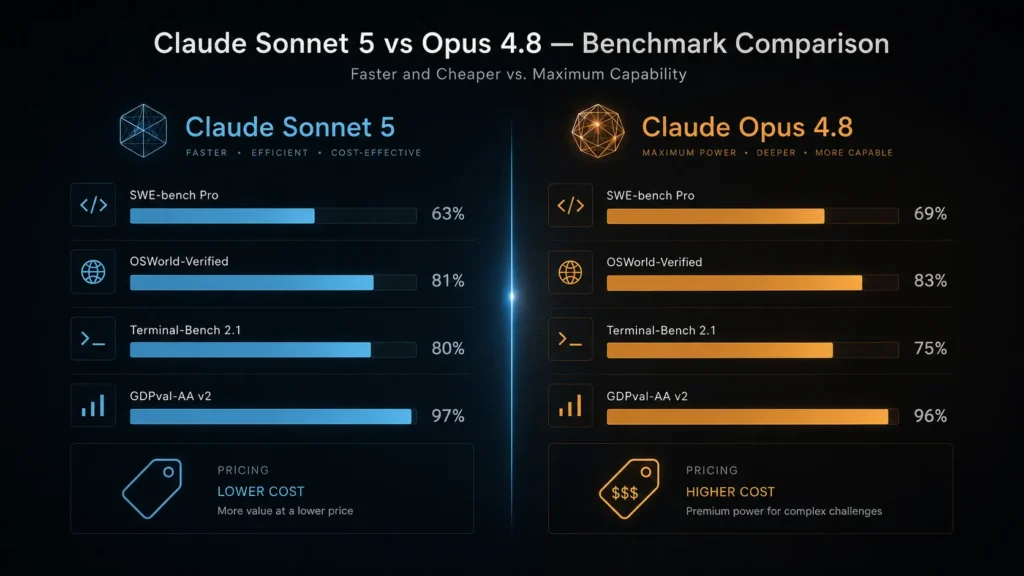
SWE-bench Pro: 63.2%
Sonnet 4.6 scored 58.1%. Opus 4.8 scores 69.2%. For software engineering tasks — real-world GitHub issues resolved autonomously — Sonnet 5 is a 5-point improvement over its predecessor but remains 6 points behind Opus 4.8. For developers running complex, multi-repository agentic coding workflows where accuracy on difficult edge cases is the primary requirement, Opus 4.8 still has a measurable lead.
For developers running the broad middle of software engineering work — bug fixes, documentation, test generation, diff review, small refactors, and multi-file code understanding — Sonnet 5 is the more practical daily model. The cost difference between $2/$10 and $5/$25 adds up to real money at production scale.
OSWorld-Verified: 81.2%
Sonnet 4.6 scored 78.5%. Opus 4.8 scores 83.4%. For computer use — navigating real software interfaces autonomously — Sonnet 5 is a genuine improvement over Sonnet 4.6 and within 2.2 percentage points of Opus 4.8. At xhigh effort, Sonnet 5 reaches Opus 4.8’s performance range on this benchmark.
Terminal-Bench 2.1: 80.4%
This is the benchmark where Sonnet 5 does something no previous Sonnet has done: it beats Opus 4.8, which scored 74.6%. For CLI-heavy, terminal-driven workflows — executing shell pipelines, running database migrations, orchestrating Docker environments — Sonnet 5 is now the stronger model in the Claude lineup. This benchmark result directly challenges the previous framing that agentic terminal work required the Opus tier.
GDPval-AA v2: 1,618 vs. Opus 4.8’s 1,615
Sonnet 5 outperforms Opus 4.8 on the knowledge work benchmark that measures business and professional task performance. The margin is narrow — 3 points on a scale that runs to several thousand — but it is the right direction for a model priced at less than half of Opus 4.8.
Humanity’s Last Exam with tools: 57.4% vs. Opus 4.8’s 57.9%
On the most demanding reasoning benchmark Anthropic publishes, Sonnet 5 is within half a percentage point of Opus 4.8. Six months ago, matching Opus 4.8 on HLE would have required a flagship-tier model. That is the structural shift Sonnet 5 represents.
Pricing — The Full Picture
Introductory pricing (through August 31, 2026): $2 per million input tokens, $10 per million output tokens.
Standard pricing (from September 1, 2026): $3 per million input tokens, $15 per million output tokens.
Opus 4.8 for comparison: $5 per million input tokens, $25 per million output tokens.
The introductory window matters. September 1 is the date to build toward, not the date to ignore. At standard pricing, Sonnet 5’s per-token rate matches Sonnet 4.6 exactly — $3/$15 — but the new tokenizer means equivalent tasks consume roughly 30% more tokens. The effective cost per completed task at standard pricing is higher than Sonnet 4.6 for most workloads, not lower. The introductory discount compensates for that difference during the evaluation period. After August 31, measure cost per completed task rather than per-token rate.
Prompt caching and batch processing partially offset the tokenizer effect for specific use cases. Prompt caching reduces costs when long system prompts, documents, or codebase context are reused across requests. Batch processing lowers costs for non-real-time workloads — evaluations, document processing pipelines, and offline agent runs. For workloads that qualify for either, the effective standard-rate cost is more competitive than the raw token price suggests.
The Two Caveats Most Coverage Has Not Addressed
Caveat one: the tokenizer effect is real and needs to be measured, not estimated.
The 30% token increase is an average. The actual increase for a specific workload depends on content type. Large codebase prompts, long agent transcripts, repeated browser observations, and tool-call histories can produce larger increases than the average. Long-form prose in natural language tends to sit near the lower end of the range. Before migrating a production workload from Sonnet 4.6 to Sonnet 5, recount token consumption on representative tasks. Do not reuse cost estimates from Sonnet 4.6.
Caveat two: adaptive thinking changes the default behavior in ways that matter for production.
On Sonnet 4.6, a request without a thinking field returned a direct response without reasoning overhead. On Sonnet 5, the same request triggers adaptive thinking by default. This affects latency, token consumption, and output structure for workloads that were calibrated to Sonnet 4.6’s behavior.
To disable thinking: thinking: {type: “disabled”}.
For workloads that previously ran with manual extended thinking (budget_tokens), that parameter no longer exists on Sonnet 5. The replacement is adaptive thinking mode with selectable effort levels. Remove extended thinking parameters before migrating; they return a 400 error on Sonnet 5.
Similarly, setting temperature, top_p, or top_k to non-default values returns a 400 error. Remove these parameters and use system-prompt instructions to guide model behavior instead.
Who Should Switch to Sonnet 5 Now
Developers running Claude Code or agentic coding pipelines. Sonnet 5 is the new default in Claude Code and the clear daily-driver choice for the broad middle of software engineering work. The Terminal-Bench 2.1 result — Sonnet 5 leading Opus 4.8 on terminal-driven CLI work — is a direct recommendation for infrastructure and DevOps workflows.
Teams using Claude for browser automation and computer use. At 81.2% on OSWorld-Verified, Sonnet 5 is close enough to Opus 4.8 that the price difference makes it the default starting point. Escalate to Opus 4.8 on the specific tasks where Sonnet 5 stalls.
Business users on Free and Pro plans. Sonnet 5 is already the default. The question is not whether to switch — the switch happened automatically on July 1. The question is whether to notice the adaptive thinking behavior, which produces more thorough reasoning on complex tasks at the cost of slightly higher response time on simple ones.
Writers, researchers, and content professionals. The knowledge work benchmark lead over Opus 4.8 is meaningful here. For extended document analysis, research synthesis, and long-form writing, Sonnet 5’s 1 million token context window — available without a long-context pricing premium — makes it the most cost-effective choice in the Claude lineup for content-intensive workloads.
Who Should Stay on Opus 4.8
The accuracy-critical edge cases. On SWE-bench Pro, Opus 4.8 leads by 6 percentage points. For difficult, non-routine engineering problems where the stakes of an incorrect output are high — production incidents, security-sensitive refactors, complex architectural decisions — Opus 4.8’s accuracy ceiling is still worth the price premium. Sonnet 5 at xhigh effort approaches Opus 4.8 quality on this benchmark, but at that effort level, cost can exceed Opus 4.8 at medium effort for similar output.
Cyber and security-specific workloads. Sonnet 5 was deliberately trained without offensive cybersecurity capability and produced zero working exploits in Anthropic’s Firefox testing. This is by design — the same safeguards used in Opus 4.8 are applied to Sonnet 5, but without the underlying capability. For sanctioned security research, red-teaming, or defensive tooling that requires the model to reason about offensive techniques, Opus 4.8 remains the appropriate choice.
The Practical Recommendation
Use Sonnet 5 as your daily driver. Escalate to Opus 4.8 on the specific tasks where Sonnet 5 falls short.
The introductory pricing window through August 31 is the right time to run this evaluation. Identify the tasks in your workflow that matter most, run Sonnet 5 against them, document the quality and cost, and build an escalation logic that moves those specific tasks to Opus 4.8. Everything else runs on Sonnet 5 at the lower rate.
For the majority of users — developers writing and reviewing code, business professionals analyzing documents, writers working on long-form content, and automation builders orchestrating multi-step workflows — Sonnet 5 covers the workload at a price that makes Opus 4.8 genuinely optional for the first time in the Sonnet model line’s history.
That is the honest verdict on Claude Sonnet 5: not a replacement for Opus 4.8 on the hardest tasks, but the right default for everything else — which, for most users, is most of the work.
Specifications at a Glance
| Claude Sonnet 5 | Claude Opus 4.8 | |
| Release date | June 30, 2026 | May 28, 2026 |
| Introductory pricing | $2/$10 per MTok (through Aug 31) | — |
| Standard pricing | $3/$15 per MTok | $5/$25 per MTok |
| Context window | 1M tokens | 1M tokens |
| Max output | 128K tokens | 128K tokens |
| SWE-bench Pro | 63.2% | 69.2% |
| OSWorld-Verified | 81.2% | 83.4% |
| Terminal-Bench 2.1 | 80.4% | 74.6% |
| GDPval-AA v2 | 1,618 | 1,615 |
| Adaptive thinking | Default on | Default on |
| API model ID | claude-sonnet-5 | claude-opus-4-8 |
| Available on | Anthropic, Bedrock, Vertex, Azure | Anthropic, Bedrock, Vertex, Azure |
Frequently Asked Questions
Is Claude Sonnet 5 better than Opus 4.8? On most benchmarks, no — Opus 4.8 leads on SWE-bench Pro (69.2% vs 63.2%) and OSWorld-Verified (83.4% vs 81.2%). On knowledge work (GDPval-AA v2) and terminal coding (Terminal-Bench 2.1), Sonnet 5 leads Opus 4.8 by narrow margins. For most everyday professional workloads, Sonnet 5 is close enough to Opus 4.8 that the lower price makes it the better practical choice.
How much does Claude Sonnet 5 cost? Introductory pricing through August 31, 2026 is $2 per million input tokens and $10 per million output tokens. Standard pricing from September 1 is $3/$15. Note that the new tokenizer produces roughly 30% more tokens for equivalent text, so effective cost per task may differ from simple per-token estimates.
Is Claude Sonnet 5 free? Sonnet 5 is the default model on Claude’s Free plan and requires no payment. API access requires an Anthropic account and is billed at introductory pricing through August 31, 2026.
What is the difference between Claude Sonnet 5 and Sonnet 4.6? Sonnet 5 adds adaptive thinking on by default, a new tokenizer, selectable effort levels (low to xhigh), 1M context window, and significantly stronger agentic coding and computer use performance. Manual extended thinking (budget_tokens) is removed and returns a 400 error. Temperature, top_p, and top_k parameters also return 400 errors and must be replaced with system-prompt instructions.
Will the US government restrict Claude Sonnet 5 like Fable 5? It is unlikely. Fable 5 was restricted because of its advanced cybersecurity capabilities. Sonnet 5 was deliberately trained without offensive cybersecurity capability and produced zero working exploits in testing. This was a design decision by Anthropic, not an oversight — and it is the primary structural reason Sonnet 5 is unlikely to face the same export-control action.
Data in this review sourced from Anthropic’s official Claude Sonnet 5 launch documentation, the Sonnet 5 system card, and the Claude Platform developer documentation. All benchmark figures are from Anthropic’s June 30, 2026 launch.
For a full comparison of Claude’s pricing tiers and subscription plans, see our Claude AI Pricing guide.
For a head-to-head comparison of Claude Opus 4.8 against GPT-5.5, see our Claude Opus 4.8 vs GPT-5.5 review.
Adrian Cole is a technology reviewer at aireviewcore.com covering AI model releases, benchmarks, and practical guidance for developers and professionals choosing between AI tools.
© 2026 aireviewcore.com — All rights reserved.