
No Benchmark Padding. Just the Real Answer. | By Adrian Cole | aireviewcore.com
Table of Contents
Claude Opus 4.8 vs GPT-5.5 is the most important AI model comparison of mid-2026 — and the answer depends entirely on what you actually do with AI.
On May 28, 2026, Anthropic shipped Claude Opus 4.8 and did something no Claude model had done in over a month: it took the number one spot on the Artificial Analysis Intelligence Index at 61.4, just ahead of GPT-5.5 at 60.2. The headline writes itself. But the headline is not the whole story.
These two models are separated by 1.2 points on the aggregate index — close enough that the ranking alone tells you almost nothing useful. What matters is where they diverge, and they diverge sharply by task. Claude Opus 4.8 dominates real-world software engineering and agentic reliability. GPT-5.5 holds the lead on terminal-driven coding and runs leaner with fewer turns and lower verbosity.
This guide is not a benchmark dump. It is a decision framework: which model should a writer use, which should a developer use, which should a business team use, and what does the pricing actually mean at realistic usage levels. If you are paying for one of these models — through a subscription or an API — you deserve an honest answer about which one earns its cost for your specific situation.
What These Models Actually Are
Claude Opus 4.8 launched May 28, 2026 as Anthropic’s fifth Opus release in seven months. It is a point release over Opus 4.7 — same 1 million token context window, same $5 per million input tokens and $25 per million output tokens pricing — but with measurable gains in coding, knowledge work, math, and alignment. Anthropic describes it as 4x less likely than Opus 4.7 to ship code with unflagged flaws. A new Fast Mode runs 2.5x faster at one third of the standard tier’s cost for latency-sensitive production workloads.
GPT-5.5 launched April 23, 2026, codenamed Spud internally, as OpenAI first fully retrained base model since GPT-4.5. It is natively omnimodal, built for agentic multi-tool orchestration, and described by OpenAI as 23% more likely to be factually correct on individual claims than GPT-5.4, with responses containing factual errors 3% less often. Pricing sits at $5 per million input tokens and $30 per million output tokens — $5 more expensive per million output tokens than Claude Opus 4.8.
Both are available through their respective platforms and APIs. Claude Opus 4.8 is additionally available through AWS Bedrock, Google Cloud Vertex AI, and Microsoft Azure. GPT-5.5 is available through OpenAI’s API and OpenRouter.
The Benchmark Reality — What the Numbers Actually Mean
Benchmarks matter, but only the ones that correspond to real work. Here is what the honest comparison looks like across the areas that affect everyday professional use.
Coding and Software Engineering
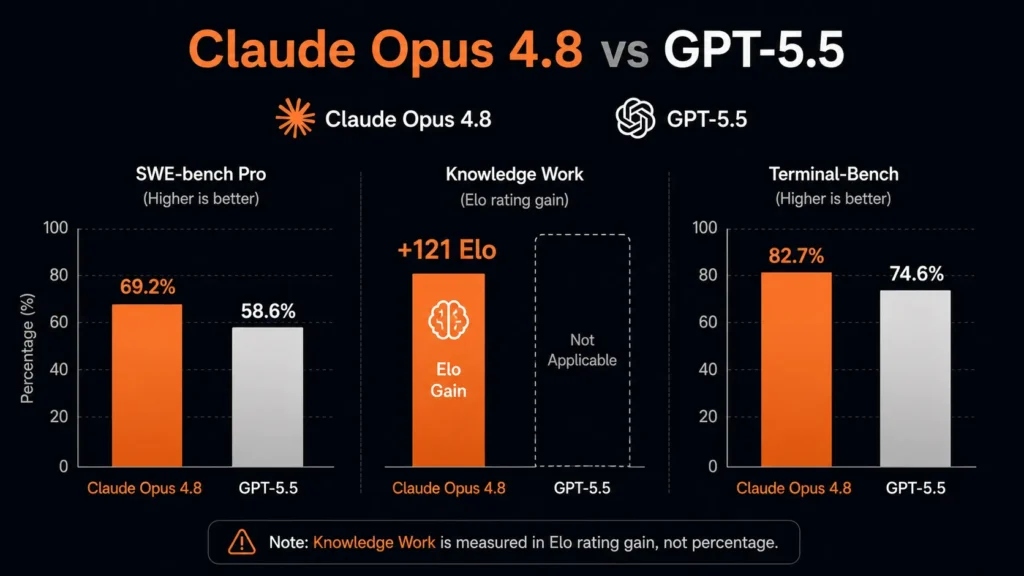
Claude Opus 4.8 leads SWE-bench Pro at 69.2% versus GPT-5.5 at 58.6% — a 10.6 point gap that is large enough to matter in real production workflows. On SWE-bench Verified, Claude Opus 4.8 scores 88.6% versus GPT-5.5 at 82.6%, a 6 point lead. For the specific task of software engineering — the one most technically demanding and most economically consequential for development teams — Claude Opus 4.8 is the stronger model by a clear margin.
GPT-5.5 holds the lead on Terminal-Bench 2.0 at 82.7% versus Claude Opus 4.8 at 74.6%. For CLI-heavy, terminal-driven development workflows where the model is primarily operating through command-line interfaces, GPT-5.5 performs more reliably. This specific advantage matters most for infrastructure and DevOps work.
Knowledge Work and Business Tasks
Claude Opus 4.8 leads on GDPval-AA, the knowledge work benchmark that measures performance on business and professional tasks, by 121 Elo points. On OfficeQA Pro, which tests document processing and office productivity scenarios, Claude Opus 4.8 scores 66.2% versus GPT-5.5 at 54.1% — a 12 point gap.
Claude Opus 4.8 also set the highest recorded score on Harvey’s Legal Agent Benchmark, becoming the first model to break 10% on its all-pass standard. For legal, compliance, and professional services workflows, this is a significant differentiator.
Agentic Tasks and Multi-Step Workflows
GPT-5.5 holds a narrow lead on agentic tasks at 81.5% versus Claude Opus 4.8 at 80.1% on the aggregate agentic category. GPT-5.5 is specifically stronger on structured tool-use and customer-workflow tasks. Claude Opus 4.8 is stronger on open web navigation and computer use scenarios.
The practical implication: for autonomous AI agents that need to orchestrate multiple tools in a structured enterprise workflow, GPT-5.5 has a marginal advantage. For agents that operate in less structured environments — browsing, research, computer use — Claude Opus 4.8 performs more reliably.
Factual Accuracy and Honesty
Both models are measurably more accurate than their predecessors. GPT-5.5’s system card reports factual errors 3% less often than GPT-5.4 on user-flagged conversations. Claude Opus 4.8 shows significant improvement on GPQA Diamond, which tests graduate-level scientific reasoning. Neither model has fully solved hallucination, but both have reduced it meaningfully compared to mid-2025 baselines.
Who Should Use Claude Opus 4.8
Writers, researchers, and content professionals get the strongest daily-use performance from Claude Opus 4.8. Its knowledge work benchmark lead translates directly into longer, more coherent document production, better research synthesis, and more natural writing assistance. The 1 million token context window — which Claude Opus 4.8 uses more reliably than GPT-5.5 across long documents — means you can paste an entire research paper, a full manuscript, or months of notes and work with them in a single conversation.
Software developers working on complex codebases will find Claude Opus 4.8’s SWE-bench Pro lead to be the most directly relevant benchmark difference. The model’s ability to understand large repositories, make multi-file changes coherently, and catch its own errors before presenting them makes it the stronger choice for anything beyond simple code generation tasks.
Legal and compliance professionals benefit from Claude Opus 4.8’s Harvey Legal Agent Benchmark performance — the first model to break 10% on the all-pass standard suggests a meaningful step up in the ability to handle complex multi-step legal reasoning tasks.
Teams already on Claude have a simple migration path. Opus 4.8 is a config-only change from Opus 4.7 in most production deployments — same API, same context window, same pricing, measurably better performance on the tasks where it leads.
Expert Workflow for Claude Opus 4.8: Use Extended Thinking Mode for tasks that benefit from multi-step reasoning — complex analysis, legal review, architectural decisions. The mode produces measurably more reliable outputs on tasks where the intermediate reasoning steps matter, not just the final answer. For high-volume production workloads where cost and latency matter, Claude Opus 4.8’s Fast Mode at 2.5x speed and approximately one-third the standard cost delivers the model’s intelligence at a price point that makes large-scale deployment economically viable.
Who Should Use GPT-5.5
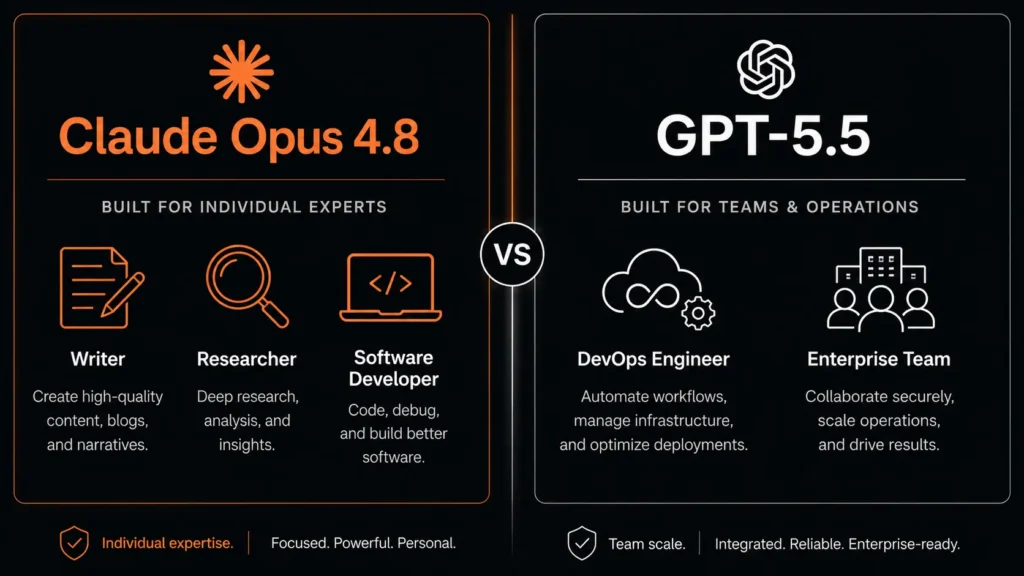
Developers working in terminal-heavy, CLI-first workflows will find GPT-5.5’s Terminal-Bench 2.0 lead relevant and practically meaningful. Infrastructure engineering, DevOps automation, and system administration tasks that run primarily through command-line interfaces benefit from GPT-5.5’s stronger terminal-centric performance.
Teams building structured multi-tool agentic systems where the agent needs to orchestrate specific enterprise tools in a defined sequence — CRM updates, ticketing systems, structured approval workflows — will find GPT-5.5’s narrow agentic lead translates into more reliable task completion in these constrained environments.
Users already invested in the OpenAI ecosystem who use ChatGPT Plus or Pro and have built workflows around OpenAI’s tool suite will experience GPT-5.5 as the natural continuation of that investment. The model’s token efficiency — using fewer turns and less verbosity to complete equivalent tasks — also means lower practical costs in high-volume usage scenarios despite the higher per-token output price.
Teams with strict factual accuracy requirements in structured business contexts — financial modeling, investment banking, structured data extraction — benefit from GPT-5.5’s reported performance on internal financial benchmarks, where OpenAI claims 88.5% accuracy on investment-banking modeling tasks.
Expert Workflow for GPT-5.5: Leverage GPT-5.5’s token efficiency by being concise in your instructions rather than verbose. The model is specifically optimized to complete tasks in fewer turns than its predecessor — working with that optimization rather than against it by providing tight, specific prompts produces faster and more cost-effective results than the exhaustive prompt engineering that older models sometimes required. For agentic workflows, define the tool set explicitly at the start of each session rather than letting the model discover available tools through exploration.
Pricing — What You Actually Pay
The pricing difference between these two models is real and matters at scale.
| Claude Opus 4.8 | GPT-5.5 | |
| Input (per million tokens) | $5.00 | $5.00 |
| Output (per million tokens) | $25.00 | $30.00 |
| Fast Mode input | $10.00 | N/A |
| Fast Mode output | $50.00 | N/A |
| Context window | 1 million tokens | 272K tokens (input) |
| Subscription access | Claude Pro $20/mo · Max $100-200/mo | ChatGPT Plus $20/mo · Pro $200/mo |
The $5 per million token output difference adds up to real money at production scale. A team generating 10 million output tokens per month pays $250 more for GPT-5.5 than Claude Opus 4.8 at API rates. At 100 million output tokens per month — a reasonable volume for a mid-size SaaS product with AI features — the difference is $2,500 per month, or $30,000 per year.
For subscription users, both models are accessible at the same entry price point: $20 per month for ChatGPT Plus or Claude Pro. The practical difference at the subscription level is usage limits rather than per-token cost — Claude Max at $100 to $200 per month provides access to Claude Opus 4.8 at significantly higher usage volumes for power users who regularly hit Pro limits.
The context window difference is meaningful for specific use cases. Claude Opus 4.8’s 1 million token context reliably handles book-length documents, large codebases, or extended research in a single session. GPT-5.5’s 272K input context covers most professional tasks but requires chunking for very long documents.
The Honest Head-to-Head Summary
| Task Category | Claude Opus 4.8 | GPT-5.5 | Winner |
| Software engineering (SWE-bench Pro) | 69.2% | 58.6% | Claude Opus 4.8 |
| Terminal and CLI coding | 74.6% | 82.7% | GPT-5.5 |
| Knowledge work (GDPval-AA) | +121 Elo | Baseline | Claude Opus 4.8 |
| Office productivity (OfficeQA Pro) | 66.2% | 54.1% | Claude Opus 4.8 |
| Agentic multi-tool tasks | 80.1% | 81.5% | GPT-5.5 (narrow) |
| Legal reasoning (Harvey Benchmark) | First to break 10% | Below 10% | Claude Opus 4.8 |
| Context window | 1M tokens | 272K tokens | Claude Opus 4.8 |
| Output pricing | $25/M tokens | $30/M tokens | Claude Opus 4.8 |
| Overall Intelligence Index | 61.4 | 60.2 | Claude Opus 4.8 (narrow) |
The aggregate picture is clear: Claude Opus 4.8 leads more categories, leads by larger margins in the categories it wins, and costs less per output token. GPT-5.5 wins on terminal coding and holds a narrow edge on structured agentic workflows. For the majority of professional use cases — writing, research, software development, business analysis, legal work — Claude Opus 4.8 is the stronger model in June 2026.
Frequently Asked Questions
Which is better overall, Claude Opus 4.8 or GPT-5.5? Claude Opus 4.8 leads the Artificial Analysis Intelligence Index by 1.2 points and wins more individual benchmarks by larger margins — particularly on software engineering, knowledge work, and legal reasoning. For most professional use cases, Claude Opus 4.8 is the stronger choice in June 2026. GPT-5.5 is specifically stronger for terminal-heavy coding and structured multi-tool agentic workflows.
Is Claude Opus 4.8 worth the price compared to GPT-5.5? At API rates, Claude Opus 4.8 is actually cheaper — $5 less per million output tokens. At the subscription level, both start at $20 per month. For users who need higher volume, Claude Max at $100 to $200 per month provides access to Claude Opus 4.8 at significantly higher usage limits than ChatGPT Plus.
When did Claude Opus 4.8 launch? Claude Opus 4.8 launched on May 28, 2026 — five weeks after GPT-5.5’s April 23, 2026 launch. It is Anthropic’s fifth Opus release in seven months, reflecting a strategy of frequent incremental updates rather than infrequent major launches.
Which model is better for coding? It depends on the type of coding. For complex software engineering involving real-world repositories, multi-file changes, and autonomous code review, Claude Opus 4.8 leads SWE-bench Pro by 10.6 percentage points. For terminal-driven, CLI-first workflows, GPT-5.5 leads Terminal-Bench 2.0 by 8 percentage points. Choose based on where your actual development work happens.
Can I use both models? Yes — and many professional users do. Claude Opus 4.8 for writing, research, document analysis, and complex software engineering. GPT-5.5 for terminal-heavy coding and structured enterprise tool orchestration. The specific task, not brand loyalty, should drive which model you reach for on any given workflow.
What is Claude Opus 4.8 Fast Mode? Fast Mode is a new Claude Opus 4.8 tier that runs 2.5x faster than the standard mode at approximately one third of the cost — $10 per million input tokens and $50 per million output tokens, compared to $5 and $25 for standard mode. It is designed for latency-sensitive production workloads where speed matters more than maximum capability.
The Bottom Line: Which One Should You Pay For?
The Claude Opus 4.8 vs GPT-5.5 decision is simpler than the benchmark coverage suggests. If you do most of your AI-assisted work in writing, research, software engineering, document analysis, or legal and professional services, Claude Opus 4.8 is the stronger model on the tasks that define your workflow — and it costs less per output token at API rates.
If your work is specifically terminal-driven infrastructure coding or structured multi-tool enterprise agentic workflows, GPT-5.5 holds a meaningful edge in exactly those categories.
For the majority of professionals reading this guide, Claude Opus 4.8 is the right answer in June 2026. Not because it wins every benchmark — it does not — but because it wins the benchmarks that correspond to the work most people actually do, at a price that is not higher than the alternative.
For a full breakdown of Claude’s subscription plans and which tier makes sense at different usage levels, see our complete guide on Claude AI Pricing in 2026.
Adrian Cole is a professional AI technology reviewer and creative technologist at aireviewcore.com, covering AI model comparisons, language model benchmarks, and practical guides for professionals choosing between AI tools.
© 2026 aireviewcore.com — All rights reserved.