
The Complete Business Guide for Creators and Marketers — By Adrian Cole | aireviewcore.com
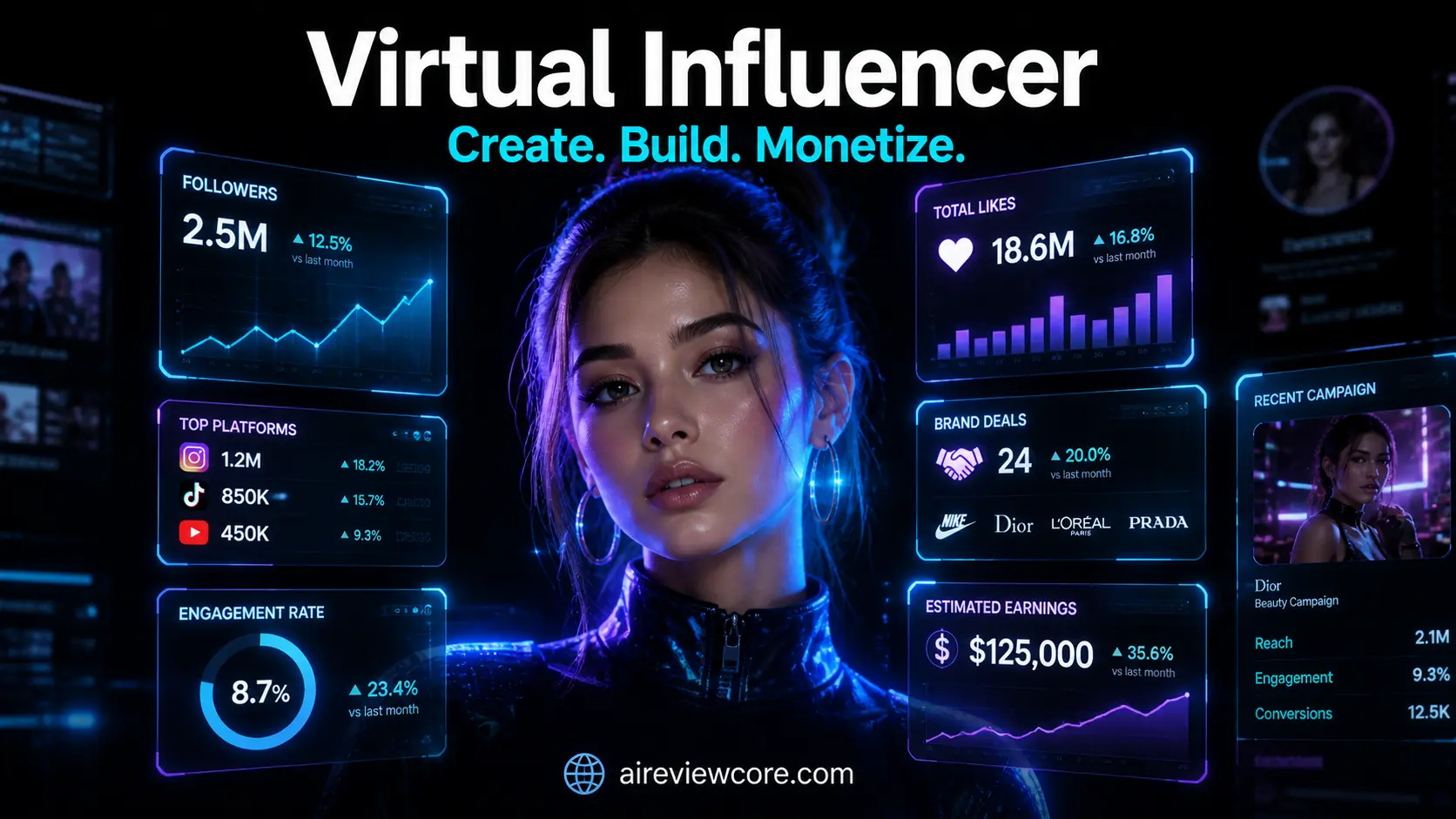
The best AI tools to create virtual influencers 2026 have made something remarkable possible — a persona with no real face is posting daily content, landing brand deals, and earning passive income while its creator sleeps. That is not a future scenario. It is already happening at scale.
The best AI tools to create virtual influencers 2026 have made something remarkable possible — a persona with no real face is posting daily content, landing brand deals, and earning passive income while its creator sleeps. That is not a future scenario. It is already happening at scale.
The global virtual influencer market reached $11.74 billion in 2026, up from $6.06 billion in 2024. 68% of consumers now follow at least one virtual influencer, and CMOs are allocating 30% of their influencer marketing budgets to virtual creators — a number that would have seemed absurd three years ago.
The business case is simple. Virtual influencer campaigns achieve average engagement rates of 5.9% compared to just 1.9% for human influencer campaigns. They never cancel a brand deal, never have a PR crisis, and can post in 47 languages simultaneously. And the tools to build one yourself have never been more accessible or affordable.
This guide covers the best AI tools to create virtual influencers 2026, how to monetize across five revenue streams, and the step-by-step workflow to get from zero to publishing.
What Is a Virtual Influencer — And Why 2026 Is Different
A virtual influencer is an AI-generated persona that exists entirely online — posting content, engaging audiences, and generating revenue without a human face behind the camera.
What changed in 2026 is not the concept. It is the cost and complexity of execution. What previously required a 3D animation studio and a six-figure budget can now be done with $50/month in AI subscriptions and a clear character concept. The barrier between the idea of a virtual influencer and a live, monetizing one has collapsed.
Lil Miquela, one of the original virtual influencers, has generated approximately $11 million in career earnings across brand partnerships with Prada, Calvin Klein, Samsung, and Liquid IV. That benchmark took years and significant production investment to build. In 2026, creators are hitting meaningful revenue milestones in months using the tools in this guide.
The opportunity is real. The question is which tools actually belong in your stack.
The 5 Best AI Tools to Create Virtual Influencers in 2026
APOB AI is the most complete virtual influencer creation platform available in 2026. It is purpose-built for character-driven content — not repurposed from a general image generator or video tool — and the depth of that specialization shows in every part of the workflow.
What it actually does: Upload 3 to 10 reference photos of your character concept and APOB AI handles image generation, video animation, voice cloning, face swap, and lip sync from a single unified dashboard. You are not managing four separate tools with four separate interfaces — the entire production pipeline lives in one place.
The built-in revenue sharing program is the feature that separates APOB AI from every other tool in this list. The platform has its own monetization ecosystem where creators can earn directly from their virtual influencer content without needing to set up external subscription platforms. For beginners who want to start monetizing before building a large audience elsewhere, this is a significant structural advantage.
The free plan is genuinely the most generous in this category. Most competing tools offer limited credits that run out within a day of active testing. APOB AI’s free tier gives you enough to validate your character concept, generate a reference pack, and produce your first piece of content before committing to a paid plan.
- Start with character consistency, not content volume. Before producing any publishable content, use APOB AI to generate 8 to 10 variations of your character across different expressions — neutral, smiling, serious, surprised — and two to three angles. This reference pack becomes the input for every video and image you produce afterward. Consistency across posts is what builds recognizable personal brand for a virtual influencer.
- Use voice cloning before your first video. Record two minutes of yourself — or source a voice actor — speaking naturally in your character’s intended tone. Feed this to APOB AI’s voice cloning feature. Every subsequent video uses this cloned voice, ensuring audio consistency matches visual consistency.
- Batch generate, not one at a time. The most efficient APOB AI workflow produces a week’s worth of content in a single session. Define your content themes, generate all images and videos in sequence, then move to scheduling. This reduces the per-piece production time significantly compared to producing content day by day.
Pricing
| Plan | Price | Key Features |
| Free | $0/month | Character generation, limited credits, basic video |
| Starter | ~$19/month | Unlimited images, voice cloning, face swap |
| Pro | ~$49/month | Full video generation, priority rendering, revenue sharing access |
Expert Verdict: APOB AI is the right starting point for any creator building a virtual influencer from scratch its all-in-one workflow, generous free tier, and native monetization program eliminate the tool-stacking complexity that derails most beginner production pipelines.
If APOB AI is the character creation engine, Creatify is the production tool for the content that brands actually pay for. It specializes in creating AI avatar videos for sponsored content, UGC-style ads, and brand campaign deliverables — with a workflow optimized for speed and volume rather than character development.
What it actually does: Creatify generates complete video ads from a product URL, a script, or a creative brief. It has a library of 300+ avatars that can represent your virtual influencer persona, with lip sync, natural movement, and background customization. For creators who have landed a brand deal and need to deliver polished video content fast, Creatify compresses the production timeline from days to hours.
The brand campaign workflow is where Creatify earns its position. A brand sends you a product brief and a usage deadline. You input the brief, select your virtual influencer’s closest avatar match, generate three to five variations with different hooks, and deliver a complete set of review-ready ad variations — often within the same afternoon you received the brief. That turnaround speed is what keeps brands coming back.
Honestly, the quality variance is its biggest weakness. Creatify’s output ranges from very convincing to obviously AI-generated depending on the complexity of the script and the avatar used. Experienced users generate five versions and select the strongest — never submit the first generation without reviewing alternatives.
- Always generate three hook variations, not one. The hook — the first three seconds of any video — determines whether viewers continue watching. Generate the same script with a curiosity hook, a pain-point hook, and a bold claim hook. Test all three. The winning hook tells you more about your audience than any single video ever could.
- Match your avatar to your target demographic, not your brand aesthetic. Creatify’s avatar library filters by age, gender, ethnicity, and energy level. The conversion data consistently shows that viewers respond better to avatars that look like them. If your virtual influencer targets women 25 to 35, select avatars in that profile regardless of what your brand colors suggest.
- Export raw and add captions externally. Creatify does not have a built-in caption editor. Export the raw video and run it through CapCut for animated captions. Burned-in captions increase view-through rates by 30 to 40% for short-form content.
Pricing
| Plan | Price | Key Features |
| Free | $0/month | Limited credits, watermarked output, basic avatars |
| Starter | $39/month | 100 credits, 1080p export, no watermark |
| Pro | $79/month | Unlimited credits, 300+ avatars, API access |
| Enterprise | Custom | White-label, custom avatar creation, dedicated support |
Expert Verdict: Creatify is the right tool once you have brand deal inquiries to fulfill — its speed and avatar quality make it the most practical production tool for the UGC ad deliverables that represent the highest-value revenue stream for most virtual influencer creators.
MakeInfluencer.ai occupies a specific position in the virtual influencer stack: it is purpose-built for creators who want to manage everything — image generation, video, face swap, lip sync, and motion control — from a single dashboard without assembling separate subscriptions for each capability.
What it actually does: Unlike APOB AI, which is optimized for a single character, MakeInfluencer.ai is designed for creators running multiple virtual personas simultaneously. Each persona gets its own workspace with independent reference libraries, style settings, and content history. A creator managing three distinct virtual influencer brands — each targeting a different niche — can switch between them without friction.
The multi-model architecture means MakeInfluencer.ai routes different production tasks to different AI models depending on which performs best for that specific task. Image generation uses one model, video uses another, face swap uses a third. The platform handles the routing automatically. For creators who have experimented with individual tools and know their quality differences, this orchestration approach produces stronger overall output than any single model can deliver alone.
The limitation is consistency depth. For a creator building one primary virtual influencer brand, APOB AI’s deeper character consistency tools produce more reliable results than MakeInfluencer.ai’s broader multi-tool approach. The multi-model platform earns its premium for creators with multiple personas, not for those focused on a single character.
- Set up separate workspaces for each persona before starting production. The workspace isolation feature is the platform’s strongest consistency mechanism. Configure character settings, reference libraries, and style parameters for each persona in isolation before generating any content. Cross-contamination between personas is the most common quality issue in multi-persona workflows.
- Use the platform’s model routing as a quality audit tool. When a specific type of content is consistently underperforming, ask which model the platform routed it to and whether an alternative model is available for that task. The routing is automatic but adjustable — and the adjustment often produces meaningful quality improvements.
| Plan | Price | Key Features |
| Limited Free | Free | Trial access, watermarked output |
| Starter | $29/month | Single persona, full feature access |
| Pro | $59/month | Multiple personas, priority rendering |
| Agency | Custom | White-label, team access, API |
Expert Verdict: MakeInfluencer.ai is the right choice for creators managing multiple virtual influencer brands who need one dashboard rather than multiple subscriptions — its multi-model architecture and workspace isolation make it the most efficient multi-persona management tool in the category.
Higgsfield AI solves a problem that every other tool in this guide leaves open: it combines cinematic-quality video production with a built-in monetization system — Higgsfield Earn — that turns content directly into revenue without requiring a separate platform setup.
What it actually does: Higgsfield’s AI Influencer Studio generates Hollywood-grade animated video from reference images, with physics-aware motion, cinematic lighting, and character consistency that is visually distinct from the output of consumer-grade video generators. The technical quality difference is most visible in movement — fabric behaves correctly, lighting shifts naturally, facial expressions hold character identity across frames in ways that cheaper tools cannot sustain.
Higgsfield Earn is the native monetization feature that makes this tool strategically different. Creators can turn content produced in Higgsfield directly into income through the platform’s own revenue programs — without needing to build a following on a third-party platform first. For a new virtual influencer creator who has not yet established distribution, this built-in earning mechanism provides an early revenue path that accelerates the learning cycle.
The $9/month entry point is the lowest paid starting price of any tool in this guide — and it covers legitimate production-quality output. The free plan is more limited than APOB AI’s, but the paid tier value is strong.
- Use Higgsfield for hero content, APOB AI for volume. Higgsfield’s production quality justifies its use for the flagship pieces — the content you pitch to brands, the profile-defining videos that establish your character’s visual identity. For the daily posting volume that keeps the algorithm fed, the faster workflow of APOB AI or Creatify is more practical.
- Leverage the Higgsfield Earn program as your earliest revenue test. Before you have significant social media following, the Earn program gives you data on whether your virtual influencer concept resonates commercially. Treat it as paid market research, not just income.
- Study the physics settings before your first serious production session. Higgsfield’s physics-aware motion is its strongest differentiator — but it requires prompt input that specifies movement type, wind conditions, and environmental context to produce its best output. Generic prompts produce generic motion. Specific physical descriptions produce the cinematic quality the tool is capable of.
| Plan | Price | Key Features |
| Limited Free | $0/month | Trial credits, basic generation |
| Basic | $9/month | Full generation, standard quality |
| Pro | $29/month | Cinematic quality, Higgsfield Earn access, priority rendering |
| Studio | $79/month | Team features, commercial license, advanced animation |
Expert Verdict: Higgsfield AI is the right tool for the production quality ceiling of your virtual influencer stack — use it for flagship content and brand pitches, and leverage the Higgsfield Earn program as your earliest revenue proof point before scaling distribution.
Overchat AI’s dedicated Influencer Studio rounds out the stack with a focus on operational management at scale — photorealistic photoshoots, product placement integration, and multi-persona management from a single operational dashboard.
What it actually does: Beyond content generation, Overchat AI handles the operational side of running virtual influencer accounts — content calendar organization, persona-specific brand guidelines, product placement workflows, and the dashboard management that becomes necessary when you are operating more than one virtual influencer simultaneously.
The product placement feature is its most commercially relevant capability. Brands send Overchat AI their product visuals, and the platform integrates them naturally into your virtual influencer’s generated content — the persona appears to hold, use, or wear the product in contextually appropriate ways. For creators pitching product-focused brand deals, this feature significantly elevates the quality of the deliverable.
- Use Overchat AI for brand deal production, not character creation. The Influencer Studio excels at branded content workflows. Use APOB AI or Higgsfield to establish your character identity first, then bring that character into Overchat AI for the commercial content production that brand deals require.
- Set up the content calendar integration before your first posting week. Overchat AI’s scheduling tools only deliver value if you build the habit of planning content in weekly batches. Establish this discipline during your first week of active use.
| Plan | Price | Key Features |
| Free | $0/month | Limited credits, basic persona generation |
| Starter | $19/month | Unlimited images, basic video, single persona |
| Pro | $49/month | Multiple personas, product placement, priority rendering |
| Agency | Custom | White-label, team management, API access |
Expert Verdict: Overchat AI is the right operational layer for creators managing multiple virtual influencer brands and producing regular brand deal content — its product placement capabilities and multi-persona dashboard make it the strongest commercial production tool for established virtual influencer businesses.
Free vs Paid — The Honest Comparison
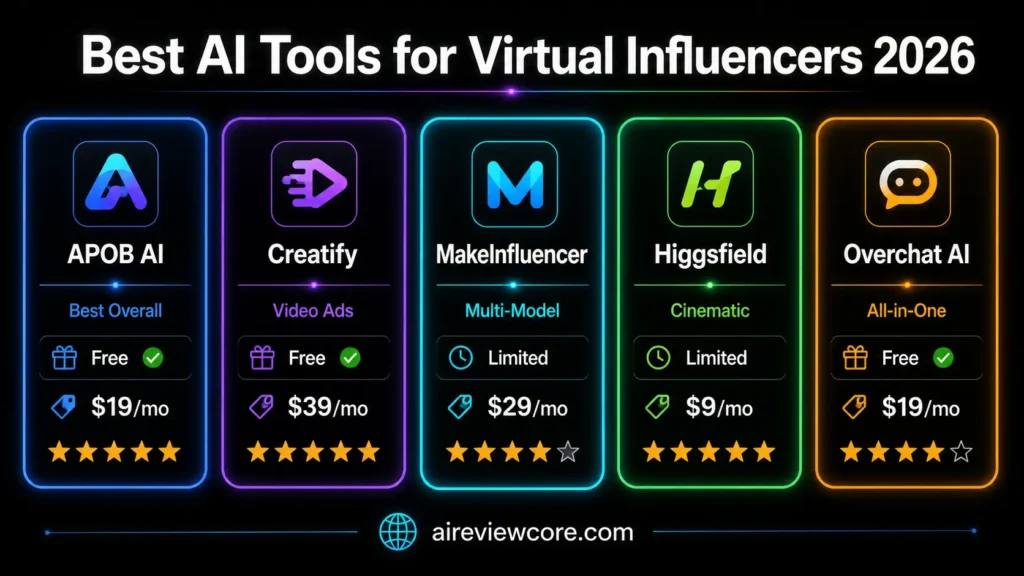
| Tool | Free Plan | Starting Price | Best For |
| APOB AI | ✅ Most generous | ~$19/month | Best overall — character creation + monetization |
| Creatify | ✅ Limited | $39/month | Video ads and brand campaign deliverables |
| MakeInfluencer.ai | Limited | $29/month | Multiple personas, multi-model production |
| Higgsfield AI | Limited | $9/month | Cinematic quality + native earning program |
| Overchat AI | ✅ Yes | $19/month | Brand deal production, multi-persona management |
The recommended starting stack: Begin with APOB AI’s free plan to build and validate your character concept. Once you are publishing consistently, add Higgsfield AI for production quality on flagship content and brand pitches. Add Creatify when you have brand deals to fulfill at volume.
Total cost at the recommended starting setup: under $30/month. Total cost at full production scale: under $80/month.
How to Monetize Your Virtual Influencer in 2026 — 5 Revenue Streams
This is the highest-value revenue stream for most virtual influencer creators. Brands pay for AI-generated content because they can reuse it in paid ads without additional licensing fees — which makes the per-piece value significantly higher than standard influencer posts.
AI-generated virtual influencers now account for $1.37 billion in annual brand spending, and the typical per-piece rate for UGC-style content ranges from $200 to $2,000+ depending on content complexity and usage rights. Pitch directly to brands in your niche via email outreach, or list your virtual influencer on creator marketplace platforms like AspireIQ and Creator.co.
The key pitch element: brands do not primarily care whether the influencer is real. They care about content quality, audience fit, and usage rights. Lead with those three elements in every outreach.
Expert Workflow:
- Build a media kit before your first outreach — rate card, engagement data (even from small accounts), and three to five sample pieces of content that demonstrate production quality
- Pitch usage rights explicitly — most brands will pay a premium for content they can reuse in paid ads
- Start with smaller brands in your niche to build a track record, then use those case studies to pitch larger accounts
TikTok’s Creator Rewards Program and YouTube Shorts monetization both pay based on views regardless of whether your creator is human or AI. Virtual influencers that post consistently can qualify and earn passive income from platform ad revenue — and consistency is the structural advantage that virtual influencers hold over human creators.
The qualification thresholds vary by platform and change periodically — verify current requirements directly on each platform before building your strategy around specific numbers. What remains consistent is that posting frequency and engagement rate are the primary variables, and virtual influencers can optimize both without the scheduling constraints that affect human creators.
Expert Workflow:
- Post daily for the first 60 days to build algorithmic momentum before the growth curve flattens
- Use platform analytics to identify which content formats generate the highest watch time, then concentrate production on those formats
- Apply to monetization programs as soon as you hit the threshold — do not wait for a round number
Fanvue has positioned itself as the AI-first subscription platform in 2026, designed specifically for virtual creators with features that generic subscription platforms do not offer — including AI chatbot integration that lets followers interact directly with your virtual persona.
The content pyramid model: free lifestyle content on TikTok and Instagram drives followers to a paid Fanvue subscription ($5 to $20+/month) for exclusive content and direct persona interaction. The AI chatbot feature means your virtual influencer can maintain thousands of subscriber conversations simultaneously without manual management.
Expert Workflow:
- Set your subscription price at the lower end initially to build subscriber volume, then increase it as your content library grows
- Promote the Fanvue subscription in every piece of free social content with a clear value proposition — what do subscribers get that free followers do not?
- Use the AI chatbot interaction as a retention tool, not just a novelty — subscribers who interact with the persona directly have dramatically higher retention rates
Every link click that converts earns a commission. This is the lowest barrier monetization method and pairs naturally with review content — your virtual influencer tests, reviews, and recommends products in your niche, with affiliate links in every post description and bio.
The highest-performing affiliate categories for virtual influencers in 2026 are AI tools, beauty, fashion, fitness, and digital products — all categories where the virtual influencer format reads as authentic rather than incongruous.
Expert Workflow:
- Join affiliate programs in your niche before you start creating content — build the monetization infrastructure before the audience, not after
- Create dedicated review content for your top three affiliate products rather than spreading affiliate links across all posts — depth converts better than breadth
- Track conversion rates by content format and concentrate affiliate promotion on the formats that produce the highest click-through
Your virtual influencer handles awareness. You handle fulfillment once. Ebooks, online courses, Notion templates, presets, and prompt libraries are the most common digital products paired with virtual influencer brands — created once and sold indefinitely through the persona’s content.
The virtual influencer format works particularly well for digital product promotion because the persona can demonstrate the product’s value in generated content without requiring real-world photography or video production of the product in use.
Expert Workflow:
- Create the digital product before you launch the virtual influencer — use the first 30 days of content to build demand for something that is already available to purchase
- Price digital products at $17 to $97 for the highest conversion volume — below $17 feels low-value, above $97 requires a longer trust-building cycle than most new virtual influencer accounts have established
- Use a simple email capture funnel: free content → email opt-in → product offer, rather than pitching the product directly from social media posts
Step-by-Step: Launch Your Virtual Influencer in 5 Steps
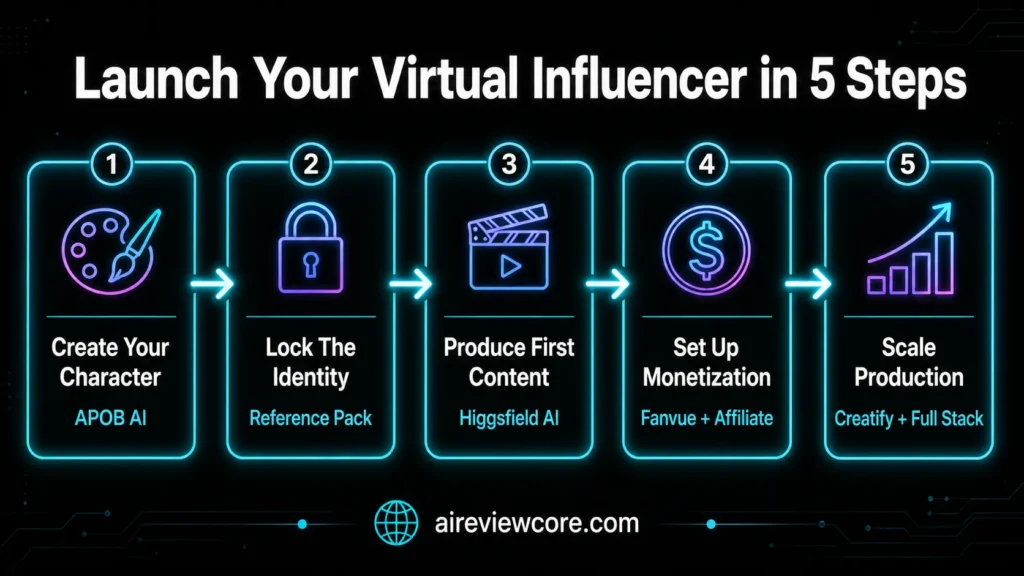
Step 1: Create your character Sign up for APOB AI (free) and upload 5 to 10 reference images to generate your virtual persona. Define the name, niche, personality, and visual identity before generating anything — the clearer the brief, the more consistent the output.
Step 2: Lock the identity Generate 6 to 8 variations across expressions and angles. This reference pack is the input library for every piece of content you produce going forward. Do not skip this step — character consistency is what makes a virtual influencer brand recognizable.
Step 3: Produce your first content Use Higgsfield AI for your first two to three flagship videos — the ones that define your character’s visual standard. Use APOB AI for the daily posting volume. Publish consistently from day one.
Step 4: Set up monetization before you need it Register on Fanvue, join two to three affiliate programs in your niche, and set up your brand deal rate card. Having monetization infrastructure in place means you capture revenue from your first wave of followers rather than scrambling to set it up after the fact.
Step 5: Scale the production Once you have 10+ pieces of content published and initial audience data, apply to TikTok Creator Rewards, begin brand outreach using your early content as case studies, and add Creatify to your stack for brand deal video production.
For the full cinematic production workflow — including Flux.1, Kling 3.0, HeyGen, and Grok AI — read our complete guide: Best AI Influencer Tools 2026.
Frequently Asked Questions
Is it legal to create a virtual influencer? Virtual influencers are legal. Most platforms require disclosure that content is AI-generated — always verify the current disclosure requirements for each platform before publishing. FTC guidelines in 2026 require clear disclosure of AI-generated content in sponsored posts, regardless of whether the influencer is virtual or human.
How much does it cost to start? You can start for free using APOB AI and Overchat AI’s free tiers. A production-ready setup — APOB AI Starter plus Higgsfield Basic — costs under $30/month. A full professional stack with all five tools costs under $80/month.
Can I make money with a virtual influencer using only free tools? Yes. TikTok and YouTube pay based on views regardless of creator type, and affiliate marketing requires zero platform investment. Start free, validate the concept, and reinvest your first earnings into paid tools that improve production quality.
How long does it take to start earning? The timeline varies significantly based on niche, posting consistency, and content quality. Affiliate income can start from the first week if you have relevant traffic. Platform monetization typically requires 60 to 90 days of consistent posting to qualify. Brand deals typically require a small but engaged audience — some creators land their first deal within 30 days by pitching directly before reaching platform monetization thresholds.
Do I need to show my face or reveal that I am behind the virtual influencer? No. Many successful virtual influencer creators remain entirely anonymous. The business model works because the persona, not the creator, is the brand. Disclosure that content is AI-generated is becoming a platform requirement — but disclosure of the specific human behind the persona is not.
The Bottom Line
The best AI tools to create virtual influencers 2026 — and monetize them — have made this business model genuinely accessible. have made this business model genuinely accessible. The virtual influencer market is valued at $15.9 billion in 2026 and projected to reach $62.67 billion by 2030 — and the creators capturing that market now are not waiting for better tools. The tools are already here.
Start with APOB AI’s free plan. Build your character reference pack. Publish your first week of content. Set up monetization infrastructure before you think you need it.
The window between “accessible technology” and “saturated market” is always shorter than it looks. In 2026, virtual influencer creation is accessible. The saturation has not arrived yet.
Adrian Cole is a professional AI technology reviewer and creative technologist at aireviewcore.com, covering AI tools for content creators, marketers, and digital entrepreneurs.
© 2026 aireviewcore.com — All rights reserved.