

If you are looking for an AI detector for teachers, you have probably hit the same wall as everyone else: a stack of essays that read suspiciously smooth, and no reliable way to know who wrote them. Here is the honest version of this guide. Some detectors are useful, several have free tiers, and none of them can prove that a student used AI. Used carefully, a detector is a signal that tells you where to look. Used as a verdict, it can hurt an innocent student.
Short answer: GPTZero is the best free starting point for most teachers. Pangram has the strongest evidence for avoiding false accusations, but its free tier is small. Turnitin is the one to use if your school already pays for it. And if you want evidence instead of a guess, Grammarly Authorship records the writing process for free.
Quick comparison
| Tool | Best for | Free tier (reported Nov 2026) | Paid from | Main catch |
|---|---|---|---|---|
| GPTZero | Free first look | About 10,000 words/month (some pages cite less) | Roughly $10–15/mo | False-flag rates vary a lot by test |
| Pangram | Fewest false flags | 2,000 words per day | About $20/mo | Free tier too small for a class |
| Turnitin | Schools that already have it | None for individuals | School license only | Scores under 20% are unreliable |
| Copyleaks | AI plus plagiarism, LMS | Varies by source | About $17/mo personal; education by quote | LMS plugin is education-plan only |
| Originality.ai | Pay-per-scan checks | Limited or none | About $15/mo or credits | Built for web publishers |
| Grammarly Authorship | Process evidence | Free | Free in Free and Pro | Not a detector; students must turn it on |
How we checked
We read current pricing and free-tier information for each tool in November 2026 and compared it with published research and independent write-ups. We also ran our own small check in November 2026: six texts through GPTZero’s free scan (see “What we found when we tested GPTZero ourselves” below). We did not test Pangram, Turnitin, Copyleaks or Originality.ai ourselves — Pangram’s free check requires an account, Turnitin needs a school license, and the other two are paid — so we do not claim accuracy numbers for those as our own. Where sources disagree, we say so. One more disclosure: many comparison sites that rank detectors are run by detector vendors or by companies that sell AI humanizers, so treat any single vendor-published benchmark as one signal, not gospel. Free tiers change often, so confirm limits on each tool’s official page before you rely on them.
What we found when we tested GPTZero ourselves
On the night of November 6–7, 2026, we ran six texts through GPTZero’s free Basic Scan: three human-written excerpts from our own published articles (about special education tools and Claude pricing) and three AI-written samples, one of them hand-edited afterwards. The result surprised us — and it is the reason this guide keeps saying a score is not proof.
| Text | What it was | GPTZero verdict |
|---|---|---|
| Human excerpt 1 (507 words) | From our published special education guide | AI 100% — all 24 sentences highlighted |
| Human excerpt 2 (423 words) | From our published Claude pricing guide | AI 100% — all 21 sentences highlighted |
| Human excerpt 3 (419 words) | From our published special education guide | AI 100% — all 21 sentences highlighted |
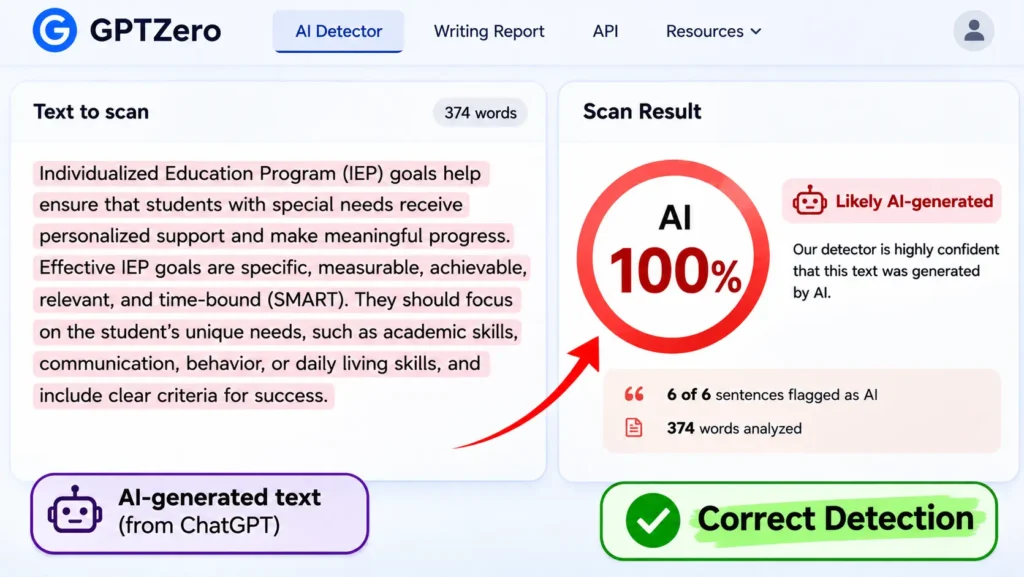
| AI sample 1 (374 words) | Raw AI output about IEP goals | AI 100% |
| AI sample 2 (371 words) | Raw AI output about detectors | AI 100% |
| AI sample 3 (388 words) | AI output, then hand-edited | AI 100% |
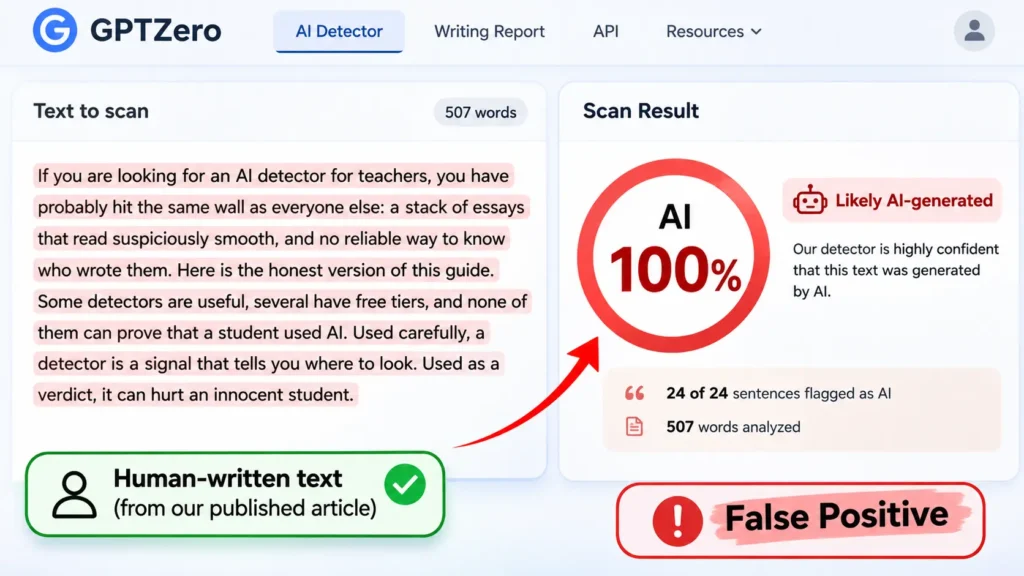
Every text scored AI 100%, including all three human-written excerpts — GPTZero flagged our own published writing as AI-generated, sentence by sentence. That is a false positive on every human sample we tried, and it matches the Stanford finding above: formal, structured writing is exactly what detectors struggle with. It does not prove GPTZero is useless — it caught all three AI samples too — but it proves a teacher cannot act on a GPTZero score alone.
Two honest limits of our check. First, the free tier did not behave as advertised: GPTZero’s homepage promises about 10,000 free words a month, but without an account the scan stopped after three texts and demanded a free account to continue, so we could not read the sentence-level detail for the three AI samples. Second, this was a small check — six texts, one tool, one night — not a benchmark. Detector models change often, and GPTZero itself labelled the first three scans with a different model version than the last three.
What an AI detector can and can’t tell you
AI detectors estimate how likely a piece of text is to be machine-written, based on statistical patterns such as how predictable the word choices are. That produces a probability, not proof. Three limits matter most for teachers:
False positives. Human writing gets flagged as AI. The risk is higher for non-native English writers and for plain, formal or highly structured writing.
False negatives. AI text that has been edited or run through a paraphrasing tool often slips through. One University of Maryland researcher has said detectors are little better than a guess on paraphrased AI text.
Short and non-prose text. Bullet lists, tables, code and very short submissions are unreliable inputs.
For context, OpenAI retired its own AI-text classifier in 2023 because of low accuracy. That is a useful reminder of how hard this problem is.
The 6 tools
Free: a permanent free plan, reported at about 10,000 words a month. Some pages cite lower caps and GPTZero’s own pricing page loads dynamically, so check the current number. At that level, it covers roughly 20 essays of 500 words each.
Paid: plans are reported from about $10–15 a month depending on billing, with higher tiers for more words.
Why it ranks first: it was built for educators, highlights suspicious sentences, and you can start without paying. For a teacher who wants to look at a handful of flagged papers, nothing else is as easy to try.
The catch: accuracy claims vary widely. GPTZero reports false positives around 1%, while some independent-style tests report anywhere from roughly 6% to 18% on human writing. Those tests are small and some are run by competitors, but the spread itself is a warning. Do not use a GPTZero score alone to accuse anyone.
Best for: a free first look at specific papers.
Free: about 2,000 words per day, with a Chrome extension and Google Docs integration reported on the free plan.
Paid: an individual plan is reported at about $20 a month for 600 credits. Education pricing is not clearly public.
Why it’s second: a 2025 University of Chicago Booth working paper (BFI WP 2025-116, Jabarian & Imas, Aug 2025; plain summary: Chicago Booth Review), as summarized by several comparison sites, found Pangram had the lowest false-positive rate of the detectors tested and was the only one to stay under a strict 0.5% cap while still catching AI text.
The catch: 2,000 free words a day will not cover a class, and the company is a vendor, so its marketing numbers deserve the same skepticism as any other.
Best for: teachers who prioritize avoiding false accusations and can pay for a seat.
Individual teachers generally can’t buy Turnitin; it comes through a school or district license. If you have it, the AI indicator appears inside the Similarity Report, and Turnitin has been unusually open about its limits (see the section below on reading the score). Turnitin’s own guidance: Using the AI Writing Report and AI writing detection FAQs.
The catch: scores under 20% are less reliable, the detector needs a minimum of 300 words, and it is built for English prose, not lists, tables or code. Turnitin’s sentence-level false-positive rate is about 4%, so a highlighted sentence can be human-written.
Best for: schools with an existing license that want an LMS-integrated workflow.
Free: reports conflict. Some pages say there is no free plan, others describe a limited one, so confirm before you sign up.
Paid: a personal plan is reported from about $17 a month. LMS plugins for Canvas, Moodle and similar systems sit in education plans, which are priced by quote.
The catch: most accuracy claims for Copyleaks come from vendor-run benchmarks, and the free-tier picture is unclear.
Best for: schools and departments that want AI and plagiarism checks together.
Pricing: reported from about $15 a month or pay-as-you-go credits; sources disagree on the exact figures. There is no clear permanent free plan.
The catch: it comes from the web-publishing world and now offers an academic model for student writing. Independent comparisons are mixed, and some tests report a higher false-positive rate than the leaders. It is better suited to publishers checking freelancers than to a teacher grading a class set.
Best for: teams that want shared credits and per-scan pricing.
This is not an AI detector, and that is the point. Grammarly Authorship records how a document was written (typed, pasted, or AI-assisted) while the student works in Google Docs, Microsoft Word or the Grammarly editor, and it produces a replay and a report. It is available in the free and Pro versions of Grammarly.
The catch: the student has to install Grammarly and turn Authorship on before writing, so you need to make it part of the assignment. Authorship now integrates with Canvas (launched September 2025, with Blackboard to follow), so check whether your LMS is covered: Set up Grammarly Authorship in Canvas LMS. Turnitin now sells a similar writing-process product called Clarity through schools.
Best for: any teacher who would rather look at a writing process than argue about a percentage.
Free AI detector for teachers: what you actually get
Free tiers are good for checking a few flagged papers, not for scanning every submission. Here is the realistic picture:
- GPTZero free: about 10,000 words a month, or roughly 20 essays of 500 words.
- Pangram free: about 2,000 words a day, which is a trickle across a week.
- Grammarly Authorship: free, and the only option here that gives you process evidence.
If you teach 100 or more students, a free tier won’t cover routine screening. Use it on specific papers that already concern you, or ask your school what it already licenses.
Turnitin AI detector for teachers: how to read the score
Turnitin has published guidance that every teacher should know:
- Under 20%: scores below 20% show an asterisk instead of a number, and the text isn’t highlighted, because Turnitin found a higher false-positive rate in that range. Treat these as unreliable.
- Over 20%: Turnitin says its document-level false-positive rate is under 1% in this range. That is a vendor claim, and even 1% means real students get flagged when thousands of papers are scanned.
- Sentence level: the false-positive rate is about 4%, and Turnitin reported that many falsely flagged sentences sit right next to genuinely AI-written text. A highlighted sentence is not proof about that sentence.
- Minimum length: 300 words. Shorter work isn’t reliable.
- Language and format: optimized for English prose. Lists, tables and code aren’t reliable inputs.
The score also doesn’t tell you which AI model produced the text, and it can’t tell you whether a student used AI for brainstorming versus writing.
How accurate are AI detectors really?
The numbers you see online disagree wildly, and that is the honest answer.
Stanford (2023): researchers tested seven widely used detectors on essays by U.S. eighth graders and on TOEFL essays by non-native English writers. (Full paper: Liang et al., Patterns, 2023.) The detectors did well on the eighth graders but flagged more than half of the TOEFL essays as AI, an average false-positive rate of 61.3%. All seven detectors unanimously flagged about one in five of those human-written essays. The study is from 2023 and vendors have updated their models, but we found few peer-reviewed results showing the bias is fixed.
Turnitin’s own figures: under 1% at the document level above the 20% threshold, about 4% at the sentence level.
Comparison sites in 2026: report false-positive rates from well under 1% to over 10% for the same tools. Many of these sites are vendor-run, which explains some of the spread.
What this means in practice: even a detector with a 1% false-positive rate will wrongly flag some students in a large cohort, and the risk is higher for English learners. A flag is a reason to look closer, never a conclusion.
How to use an AI detector fairly
- Decide your policy first. Tell students what AI use is allowed and how you’ll handle concerns before you scan anything.
- Use detectors on specific papers, not as a blanket sweep. Start with work that already looks different from the student’s usual writing.
- Ignore low scores and short texts. Skip anything under about 20% or under 300 words.
- Be extra cautious with English learners. A simple, clear, structured style can trigger false positives. Require corroborating evidence before any action.
- Compare with earlier work. Does the vocabulary, structure and error pattern match what the student has written in class?
- Look for process evidence. Version history in Google Docs, drafts, notes, and Grammarly Authorship reports are stronger evidence than any percentage.
- Talk to the student. Ask them to explain their argument, define a few terms they used, or rewrite a paragraph in front of you. Someone who wrote the work can usually do this.
- Never use a score as the sole evidence. Document what you saw, what the student said and what other evidence you have.
Privacy: think before you paste student work
Uploading student essays to a third-party tool means sharing student data. Check whether your district has approved the tool or has an agreement with the vendor. Don’t paste names or identifying details, and be wary of personal accounts for school work. If your district has a policy on AI tools, follow it.
Frequently asked questions
What is the best AI detector for teachers?
There is no single best. GPTZero is the easiest free starting point. Pangram has the best independent evidence on false positives. Turnitin is the practical choice if your school licenses it. Match the tool to your budget and the stakes, and use process evidence alongside any detector.
Is there a free AI detector for teachers?
Yes. GPTZero offers a permanent free plan (about 10,000 words a month, reported), and Pangram offers about 2,000 free words a day. Neither is enough to screen a full class. Grammarly Authorship is free and provides process evidence rather than a detection score.
Can teachers trust Turnitin’s AI detector?
Trust it as a signal, not a verdict. Turnitin itself warns that scores under 20% are less reliable and that individual highlighted sentences can be human-written. Never rely on the score alone.
Do AI detectors work on English learners’ writing?
They are less reliable. A 2023 Stanford study found detectors flagged more than half of non-native English essays as AI. Vendors have updated their models since, but you should require corroborating evidence before acting on any flag.
Can students get around AI detectors?
Sometimes. Paraphrasing tools and heavy editing can reduce detection, and detectors perform worse on edited AI text. Some vendors say they now detect this kind of rewriting, but no detector catches everything. That is another reason not to rely on detection alone.
What should I do if a student says they didn’t use AI?
Take it seriously. Review their process evidence, compare with earlier work, and talk with them. If you can’t find evidence beyond a detector score, you don’t have enough to act.
The verdict
An AI detector for teachers is worth having as one input and a bad idea as the only input. Start free with GPTZero for a first look, consider Pangram if avoiding false flags is your top priority and you can pay, and use Turnitin if your school provides it. Add Grammarly Authorship or Google Docs version history so you have a writing process to look at, not just a percentage. Most importantly, talk to the student before you decide anything.