

The wrong question about Claude pricing is “how much does it cost?” Claude has two bills, not one, and most of the confusion about its pricing comes from answering the wrong one. There is the subscription bill: Free, Pro at $20 a month, Max at $100 or $200 a month. And there is the API bill: pay as you go, per million tokens, starting at $0.10. Paying one buys you nothing on the other. That single fact explains most of the surprise bills, most of the “is Max worth it” arguments, and most of the Reddit threads from people who paid twice for the same model.
This comparison covers all three ways you actually pay for Claude: subscriptions, API, and Claude Code, which sits awkwardly across both. The verdict up front: Pro at $20 a month is the right plan for most individuals. Max is a usage purchase, not a quality purchase: same models, bigger multiples, plus monthly API credits. The API is for builders and heavy automation, and it is priced per token, which means your bill depends on how much you ask, not how long you subscribe. And the trap to memorize before you spend anything: a Pro or Max subscription gives you zero general API tokens, except for the monthly API credit that comes with Max. For how Sonnet 5 stacks up against Opus 4.8, see the Sonnet 5 review.
Quick picker
| Route | Best for | Price | What you actually get |
|---|---|---|---|
| Free | Trying Claude | $0 | Chat on web, desktop and mobile, web search, file creation, Artifacts, up to 5 Projects |
| Pro | Most individuals | $20/mo ($17/mo annual) | Everything in Free, more usage, Claude Code, Projects, more models, Claude in Chrome and Microsoft 365 |
| Max 5x | Heavy daily users | $100/mo | 5x Pro usage per 5-hour session, priority access, $100/mo in API credits |
| Max 20x | Power users and teams of one | $200/mo | 20x Pro usage per 5-hour session, priority access, $200/mo in API credits |
| API | Builders and automation | From $0.10 per million input tokens | Pay per token, any current model, batch API at half price, prompt caching |
| Claude Code | Coding in the terminal | Included in paid plans | Shares your plan’s usage pool; heavy use can switch to pay-as-you-go API credits |
How we checked
One line, because the method matters more than the process story: Claude pricing figures were verified on Anthropic’s official pages (claude.com/pricing and the API pricing docs) on October 25, 2026. Team seat prices are the exception: the official page’s Team cards did not render in our fetch, so those figures come from multiple independent sources that cite the official page, and the text flags them as reported. Prices are in US dollars before tax, and Anthropic states they can change.
Subscriptions: Free, Pro, Max, and the rest
The free plan costs nothing and needs no card. You get chat on web, desktop and mobile, web search, file creation, code execution, memory across conversations, connectors, Artifacts, and up to 5 Projects. It is a genuine trial of the product, not a demo with a countdown timer, and its limit is usage, not features locked behind a paywall you cannot see.
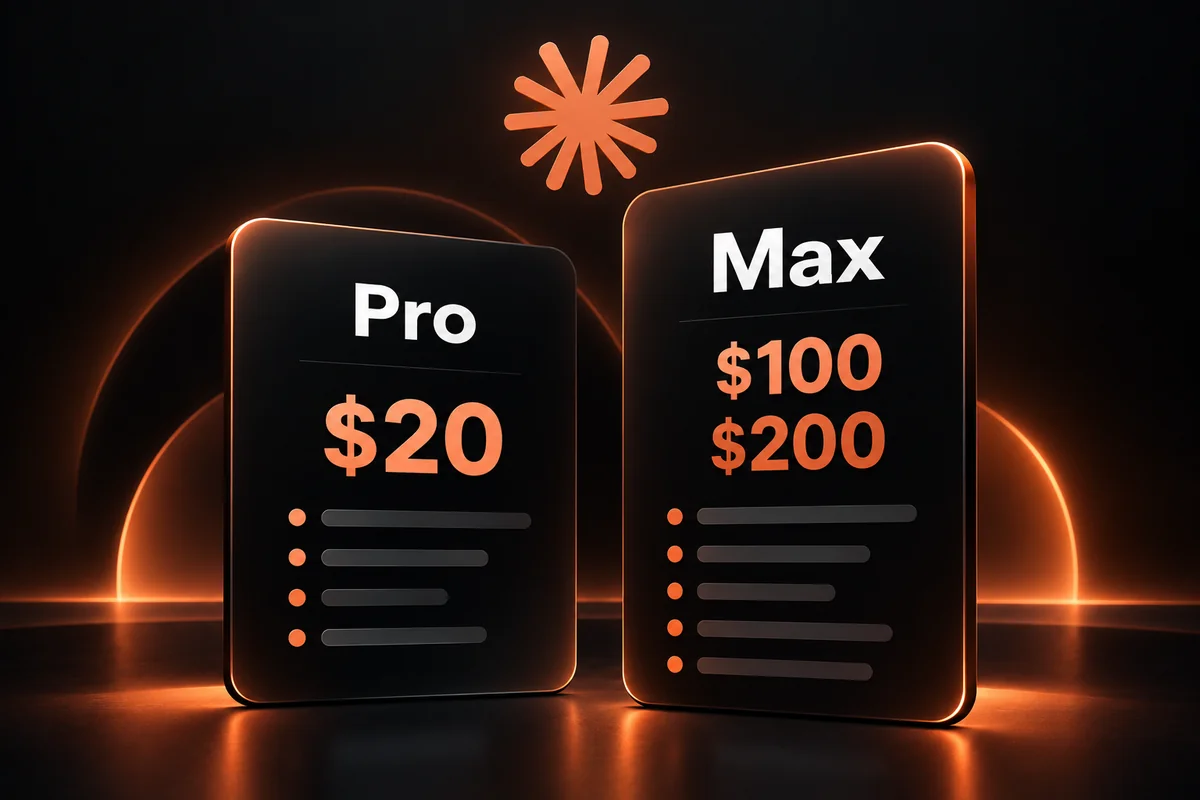
Pro costs $20 a month, or $17 a month billed annually ($200 up front). It adds more usage, task handoff and scheduling, Claude Dashboards in beta, Claude Science, Projects, more models, and Claude in Chrome and Microsoft 365. Critically, it includes Claude Code. The official line on usage is that Pro gives at least 5x the free plan’s usage per 5-hour session.
Max comes in two sizes and both are monthly only, no annual discount. Max 5x costs $100 a month for 5x Pro usage per 5-hour session, higher output limits, early access to advanced features, priority access at peak times, and $100 a month in API credits. Max 20x costs $200 a month for 20x Pro usage and $200 a month in API credits. The API credit is the Max plan’s most misunderstood feature, and it is the only case where a subscription hands you API tokens. We will come back to it.
Enterprise is listed at $20 per seat per month plus usage at API rates, annual billing only, with admin controls like SCIM, audit logs, custom data retention and role-based access. Read that headline carefully: the $20 is a floor, not the bill, because metered usage sits on top of it. Team plans are reported by multiple pricing trackers at $25 per seat per month monthly or $20 annual for Standard, and $125 monthly or $100 annual for Premium with 5x Standard usage, for 2 to 150 seats, with pooled API credits reported up to $500 a month total. Treat those Team figures as reported, not officially confirmed, until they are checked against the Team section of the pricing page directly.
Usage limits: the 5-hour window that governs everything
Every plan’s usage runs on a rolling 5-hour session window, and paid plans add weekly limits on top. Web, desktop, mobile and Claude Code all draw from one pool. There is no fixed message count: what you can do depends on conversation length and complexity, the model you use, and the features you turn on. Pro is at least 5x free per session. Max is 5x or 20x Pro per session. When you hit a limit, the official options are to wait for the reset, move to a higher plan, or, on paid plans, turn on usage credits to keep working at standard API rates. You can watch your usage in Settings, under Usage.
This is why “is Max worth it” has no universal answer. If you never hit Pro’s window, Max buys you nothing except priority access and API credits. If you hit it every afternoon, Max buys you the rest of your workday. The plan does not change which models you get. That is the next section’s most important sentence, so here it is again in plain form: Pro and Max run the same models. Max buys multiples, not intelligence.
The API: priced per token, and the cheapest model changed twice in a month
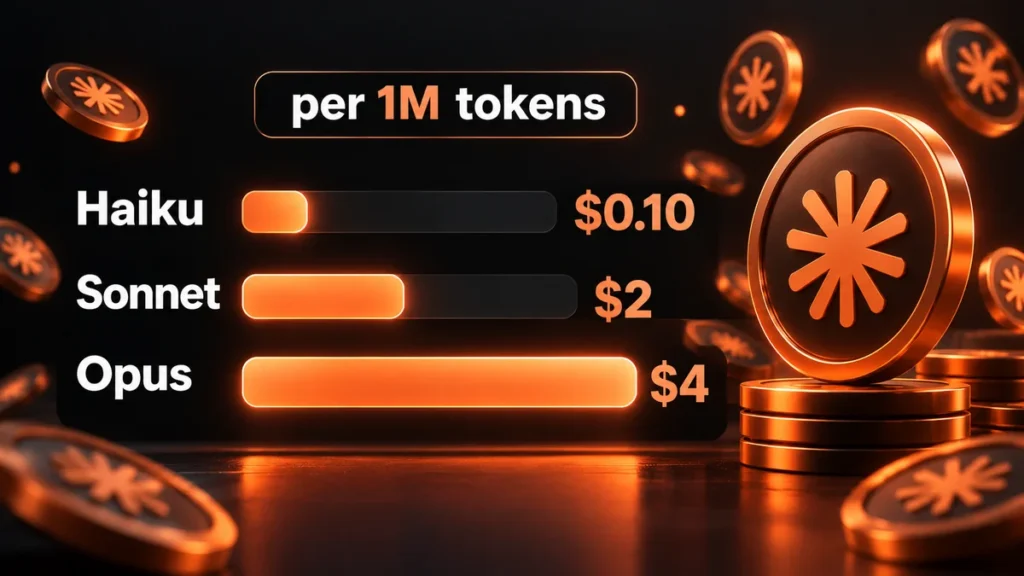
API pricing is per million tokens, and output costs 5x input on every current model. The current lineup, verified on the official docs page, looks like this.
| Model | Input per million tokens | Output per million tokens |
|---|---|---|
| Claude Opus 5.5 | $4 | $20 |
| Claude Sonnet 5.5 | $2 | $10 |
| Claude Haiku 5.5 (prompts up to 100,000 tokens) | $0.10 | $0.50 |
| Claude Haiku 5.5 (prompts over 100,000 tokens) | $0.50 | $2.50 |
| Claude Fable 5.1 | $10 | $50 |
| Claude Mythos 5.1 (invitation only) | $10 | $50 |
Three modifiers change those numbers enough to matter. First, the Batch API costs half price on input and output: Sonnet 5.5 drops to $1 and $5, Haiku 5.5 to $0.05 and $0.25 on short prompts. If your work is not urgent, batching is the single biggest discount available.
Second, prompt caching cuts repeated context dramatically: cache reads cost a fraction of input (0.05x on Opus 5.5 and Sonnet 5.5, 0.025x on Fable 5.1 and Mythos 5.1), while cache writes cost 1.25x for 5-minute cache or 2x for 1-hour cache. Third, the long-context rule: Claude 4.6 and later models except Haiku 5.5 include the full 1-million-token context window at standard pricing, so a 900,000-token request bills at the same per-token rate as a 9,000-token one. Haiku 5.5 is priced by prompt length instead, which is why its two-tier table exists.
Two warnings deserve their own paragraphs. The tokenizer warning: Claude 4.7 and later models use a newer tokenizer that produces roughly 30 percent more tokens for the same text. A rate cut can still raise your bill if your token count jumps. And the residency multiplier: US-zone inference costs 1.1x on all token categories for 4.6 and later models. Default global routing bills at standard pricing. Neither of these appears in the headline rate, and both appear on the invoice.
Older models are still listed at legacy rates if you have existing integrations: Opus 5 at $5 and $25, Sonnet 4.6 and earlier at $3 and $15, Haiku 4.5 at $1 and $5, and the oldest Opus 4 line at $15 and $75. The direction of travel is clear and worth stating: the flagship Opus fell from $5 to $4 per million input tokens, and the cheapest model fell from $1 to $0.10 in a single generation change. API prices here are falling, not rising, and any article that quotes last year’s rates is stale.
The subscription vs API trap: the section to read before you pay
Here is the trap, stated as plainly as possible. A subscription and an API account are separate products with separate billing and separate usage pools. Paying for Pro or Max gives you no general API credit. An API key gives you no subscription chat, no subscription Claude Code, and no Cowork access. The exceptions are narrow and new: Max plans include a monthly API credit ($100 on Max 5x, $200 on Max 20x), and Team plans are reported to include pooled API credits. Everything else is separate.
This produces three classic mistakes. The first is buying Pro and then wondering why API calls fail or bill separately: they were always going to, because the API was never included. The second is the reverse: loading API credits and expecting the Claude app to stop showing usage limits. It will not, because the app runs on the subscription pool. The third is specific to Claude Code and is reported rather than officially documented, so take it as a warning, not a certainty: if the ANTHROPIC_API_KEY environment variable is set, Claude Code may authenticate with it and bill your API account at token rates even while you are paying for Max. If your Code usage suddenly looks like API usage, check that variable first and unset it to use your plan.
The practical rule is one sentence: decide which pool your work lives in, and pay for that pool. Chat, Cowork and plan-based Code live in the subscription pool. API calls, Agent SDK usage and third-party app integrations live in the API pool. Max’s monthly API credit is a bridge between the two, not a merger of them.
Claude Code: included in paid plans, billed from the same pool
Claude Code is included in all paid plans and not on the free plan, and it shares the same usage limits pool as chat on web, desktop and mobile. There is no separate Code allowance. When you hit the limit, the official options are the same as everywhere else: wait, upgrade, or enable usage credits at standard API rates. Heavy sessions can also switch to pay-as-you-go API credits through a Console account, which is the same pool switch described above, in reverse.
Two reported figures help with the Max decision, and both are estimates from independent trackers, not Anthropic statements. Enterprise figures circulating in October 2026 put average API-rate cost at roughly $13 per developer per active day, with 90 percent of users under $30 on any active day, and $150 to $250 per developer per month. On that math, Max 5x at $100 breaks even against API billing at roughly 8 active days a month, and Max 20x at $200 at roughly 15. Treat those breakevens as estimates, not promises: your mileage depends on model choice and session length, which is exactly what the 5-hour window measures.
One more reported detail, included because several pricing pages still get it wrong: in June 2026 Anthropic announced separate metering and monthly credits for Agent SDK and scripted usage, then paused that change on June 15, 2026. Until further notice, Agent SDK and third-party app usage draw from normal plan limits. If a pricing page you read still describes that credit as live, the page is outdated.
One case where the plan tier does change model access, and it is the only one: Fable. On Pro, Fable is available through usage credits only. On Max plans, Fable is available up to 50 percent of weekly limits. If your work depends on Fable specifically, that single rule can decide your plan. For every other model, the plan buys usage, not access.
Who should pick what
If you chat with Claude, use Projects, and occasionally code, Pro at $20 a month is the plan. Annual billing drops it to $17 a month if you are sure you will stay a year, and the $40 saving is real but small enough that monthly is fine if you are still deciding.
If you hit Pro’s limits most days, Max 5x at $100 is the next step, and its $100 API credit softens the price if you also make API calls. Max 20x at $200 is for people who live in Claude all day or run long agentic sessions: the 20x multiple and $200 credit are the product, and if you do not use them, you are overpaying by $100 or more.
If you build products, automate workflows, or run agents, the API is the product, and your first decision is model, not plan. Haiku 5.5 at $0.10 per million input tokens on short prompts is the cheapest way to run high-volume work, Sonnet 5.5 at $2 is the balanced default, and Opus 5.5 at $4 is for the hardest reasoning. Batch anything that is not urgent and cut the bill in half. Cache anything repeated and cut it further.
If you code in the terminal, start with the plan you already have: Claude Code is included in Pro and up, sharing the plan’s pool. Move to pay-as-you-go API credits only when your sessions consistently outrun the plan, and check the API key variable before you conclude the plan is at fault.
If you run a team, get the Team figures confirmed against the Team section of the official pricing page before budgeting, because the seat prices and pooled credits in this article are reported rather than officially verified, and Enterprise adds metered usage on top of its per-seat price.
Frequently asked questions
Do I need the API if I already pay for Pro?
Only if you build with it. Pro covers chat, Projects, Cowork and plan-based Claude Code. API calls, Agent SDK usage and third-party integrations bill separately through an API account. Max plans are the exception: they include a monthly API credit, $100 on Max 5x and $200 on Max 20x.
What is the cheapest way to use Claude?
The free plan for chatting, and Haiku 5.5 through the API for building: $0.10 per million input tokens on prompts up to 100,000 tokens, or $0.05 through the Batch API. The cheapest subscription is Pro at $17 a month billed annually, $20 month to month.
Is Max worth it over Pro?
Only if you use what it buys. Max runs the same models as Pro. What it buys is usage multiples (5x or 20x per 5-hour session), priority access at peak times, higher output limits, and a monthly API credit. If you never hit Pro’s limits, Max is $80 or $180 a month for priority access and credit you may not spend.
Does Pro include Claude Code?
Yes. Claude Code is included in all paid plans, sharing the same usage pool as chat. It is not on the free plan. Heavy Code sessions can switch to pay-as-you-go API credits, but that moves billing to the API pool.
Why did my API bill jump when rates went down?
Two likely reasons, both documented. Newer models use a tokenizer that produces roughly 30 percent more tokens for the same text, so a lower rate on more tokens can still cost more. And US-zone inference carries a 1.1x multiplier on all token categories. Check your token counts and your routing before blaming the rate card.
What happens when I hit my usage limit?
You wait for the window to reset, move to a higher plan, or, on paid plans, turn on usage credits to keep working at standard API rates. Limits are visible in Settings, under Usage. There is no published message count: limits depend on conversation length, model choice and features used.
The verdict on Claude pricing
Claude’s pricing looks complicated because it answers three different buyers with three different bills, and every article that quotes a single number is hiding two of them. The subscription buyer asks what Pro and Max cost. The builder asks what tokens cost. The coder asks what Code costs, and the answer is that it depends on which pool the session draws from.
Start from your pool, not from the price list. If your work lives in chat and Code on a plan, Pro at $20 is the default and Max is a usage upgrade with an API credit attached. If your work lives in API calls, pick the model first: Haiku 5.5 for volume, Sonnet 5.5 for balance, Opus 5.5 for the hardest work, batch what is not urgent, cache what repeats. And before you pay for both a plan and API credits, check that you are not about to buy the same model twice: that is the one mistake this pricing structure makes easy, and the one this article exists to prevent.
Prices change, and Anthropic says so on the pricing page itself. Before you budget around any figure here, confirm it on claude.com/pricing and the API pricing docs. A Claude pricing article is a snapshot, and the honest ones say so.