
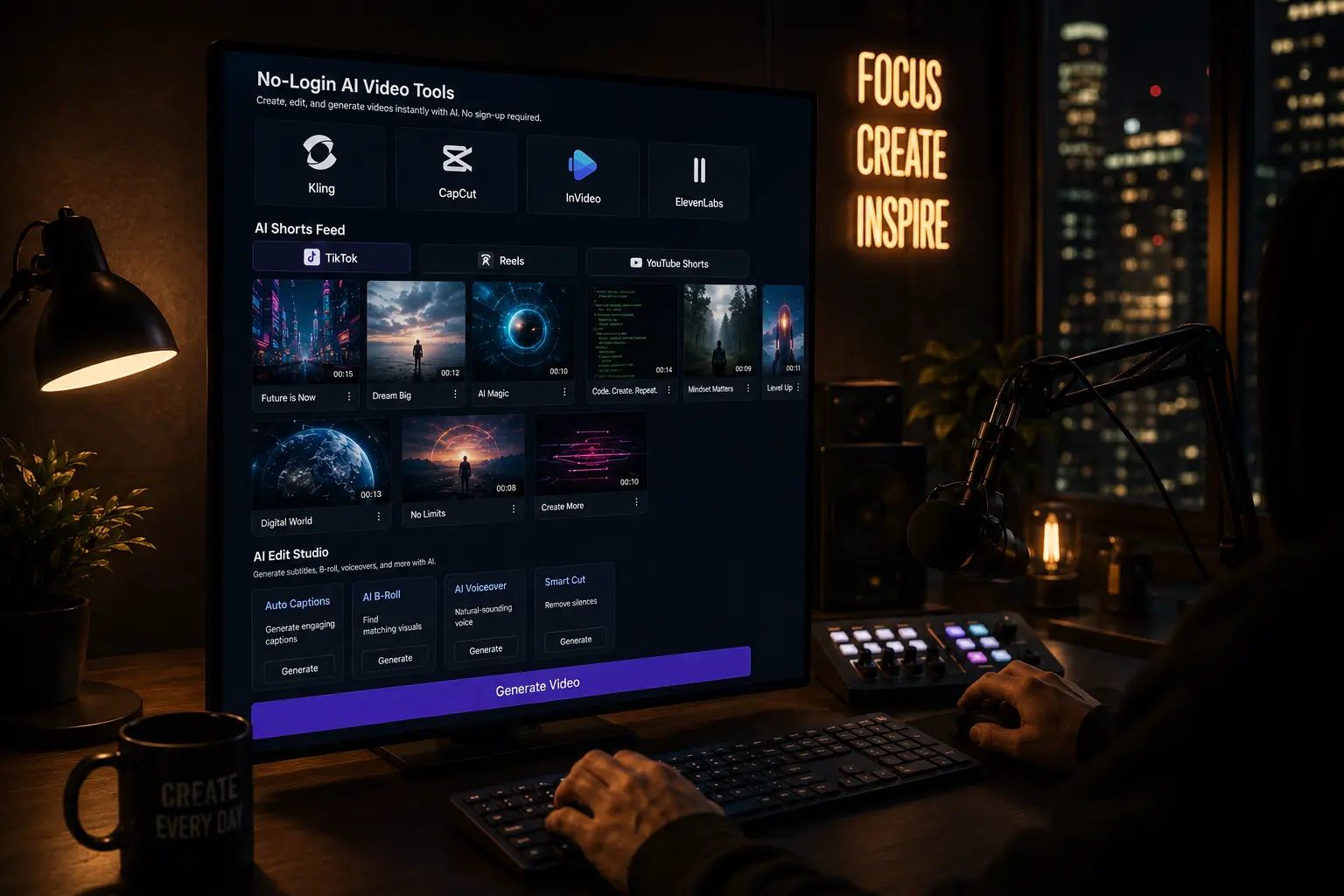
Quick take: The best no login AI video tools faceless 2026 workflow is not about using more apps — it is about completing a finished Short in under 90 minutes without hitting a paywall on step three. This guide is built around that constraint.
1. Why Creators Search “No Login AI Video Tools Faceless 2026”
If you have typed “no login AI video tools faceless 2026” into Google recently, you already know what you are looking for: a way to build a faceless short-form channel without paying for five subscriptions before you have posted a single video.
The format is real. Faceless channels on TikTok, Instagram Reels, and YouTube Shorts are among the fastest-growing creator categories in 2026. The model works because it removes every production barrier that historically stopped people from building a channel — no camera, no ring light, no confidence on screen, no studio space. A creator with a laptop and a good script can post a 45-second finance reel, wake up to 40,000 views, and never show their face once.
But there is a trap in how most guides cover this topic. They list thirty tools in a table and call it a workflow. That is not a workflow. That is a product directory.
This guide is different. We cover a focused set of no login AI video tools faceless 2026 that connect into a real daily production pipeline, explain how each one actually behaves on its free tier, and give you three ready-made stacks depending on your budget and output goals.
According to Wyzowl’s Video Marketing Statistics 2026, short-form video is now the highest-ROI content format for marketers globally, with TikTok, Instagram Reels, and YouTube Shorts collectively generating over 120 billion daily views.
2. What Changed in Faceless AI Video in 2026
Three things happened in the past twelve months that changed the practical calculus for faceless creators — and they are the reason “no login AI video tools faceless 2026” is now a high-volume search term rather than a niche query.
Sora was discontinued as a standalone product. In March 2026, OpenAI folded Sora into its broader media platform and removed the consumer-facing app. This reshuffled the top of the AI video market overnight and pushed creators toward Kling 3.0, Veo 3.1, and Runway Gen-4.5 — all of which have more accessible free tiers than Sora ever offered.
Kling 3.0 launched with a permanent free tier. When Kuaishou released Kling 3.0 in February 2026, the free tier included daily credit resets (~66 credits per 24 hours), native 4K output, 15-second clips with up to 6 camera cuts, and native audio generation — all without a credit card. For faceless creators who previously had to pay for every B-roll clip, this was a structural shift.
The script-to-video pipeline reached usable quality. In 2024, “AI video” meant an AI picked stock footage while you typed a prompt. In 2026, tools like InVideo AI and CapCut’s script-to-video feature generate rough-cut drafts with narration, auto-captions, matched B-roll, and 9:16 formatting in one pass. The outputs still need editing — but they are real starting points.
The combined result: a capable no login AI video tools faceless 2026 workflow is achievable for zero dollars, and scalable for under $30 a month.
3. What “No-Login AI” and “Faceless Workflow” Actually Mean
These two terms get blurred constantly. Before going into specific tools, clear definitions matter.
In practice, it means one of three things:
- Truly no account required — open a URL, generate, download. Rare, but tools like TwoShot offer limited no-account access for testing.
- Sign-up required, no credit card, permanent free tier — create an account with email or Google sign-in and generate real outputs without payment. This is what most creators mean when they search no login AI video tools faceless 2026, and it is the category this guide focuses on.
- Free trial — sign up, get 7 days or a credit limit, then hit a hard paywall. This is not “no-login AI” regardless of how the marketing frames it. We call this out explicitly throughout.
A faceless video channel means the creator never appears on screen. The visual identity is built through four consistent elements: voiceover personality, caption style, music bed, and visual theme. The face is replaced by these working together. On TikTok and Reels, the hook in the first 2–3 seconds carries more retention weight than any single visual — which is why the scripting step matters more than most tool comparisons acknowledge.
4. Ideation & Scripting: Where the Video Lives or Dies
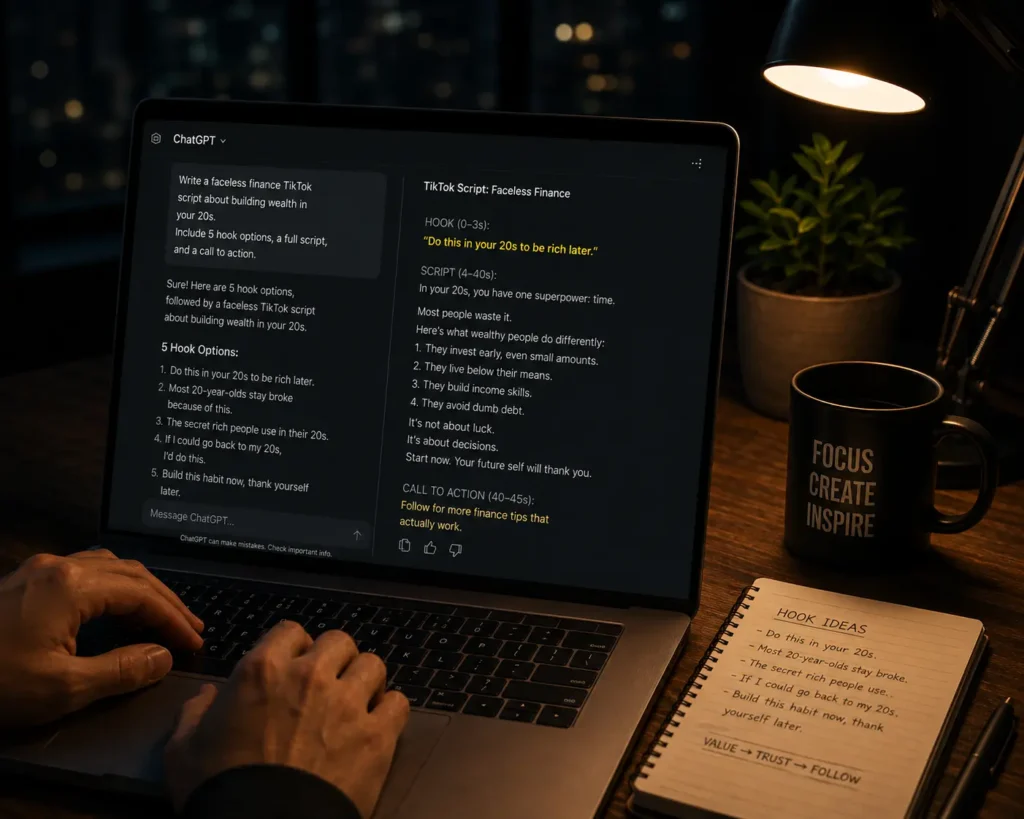
No AI video generator fixes a weak script. If your first three seconds do not stop the scroll, cinematic B-roll from Kling 3.0 will not save you. The best no login AI video tools faceless 2026 pipeline still starts with a human writing a tight hook.
Claude or ChatGPT (free tiers) are the practical workhorses. The prompt structure that consistently produces usable hooks for faceless channels: specify the platform, the niche, the target emotion (curiosity, fear of missing out, validation), and request five hook variants. Pick the one that sounds most natural when read aloud.
CapCut’s built-in AI Script feature is useful because it lives in the same app where you will edit. Type a topic, select platform and target duration, and get a structured short-form script with hook, three value points, and a call to action. The output is safe rather than sharp, but it formats for 9:16 immediately.
Hook (0–3s): “The savings account your bank recommends is quietly costing you money.”
Point 1 (4–12s): Most standard savings accounts pay 0.01% interest. High-yield accounts at online banks are currently paying 4.5 to 5.1%. On $10,000 that is a $500 annual difference before compounding.
Point 2 (13–24s): Your bank does not tell you this because the spread between what they pay you and what they earn on your deposits is their margin. The less you know, the more they keep.
Point 3 (25–36s): Moving money takes about eight minutes. You need the routing number and account number of the high-yield account. That is the entire process.
CTA (37–45s): “Follow for one money fact a day your bank hopes you won’t find out.”
This script is 148 words. At a 150-word-per-minute narration pace it runs 45–50 seconds — the proven retention window for TikTok and Reels in 2026. The hook names a specific negative consequence without clickbait phrasing. That structure consistently outperforms vague curiosity-gap titles in finance niches.
Expert Workflow: Write three to five scripts before recording any audio. Read each one aloud without recording. The script that sounds most natural when spoken — not the most clever on the page — is the one to use. AI voiceovers expose stiff writing faster than a human voice does.
5. No-Login & Low-Friction Video Generators: The Honest Field Guide
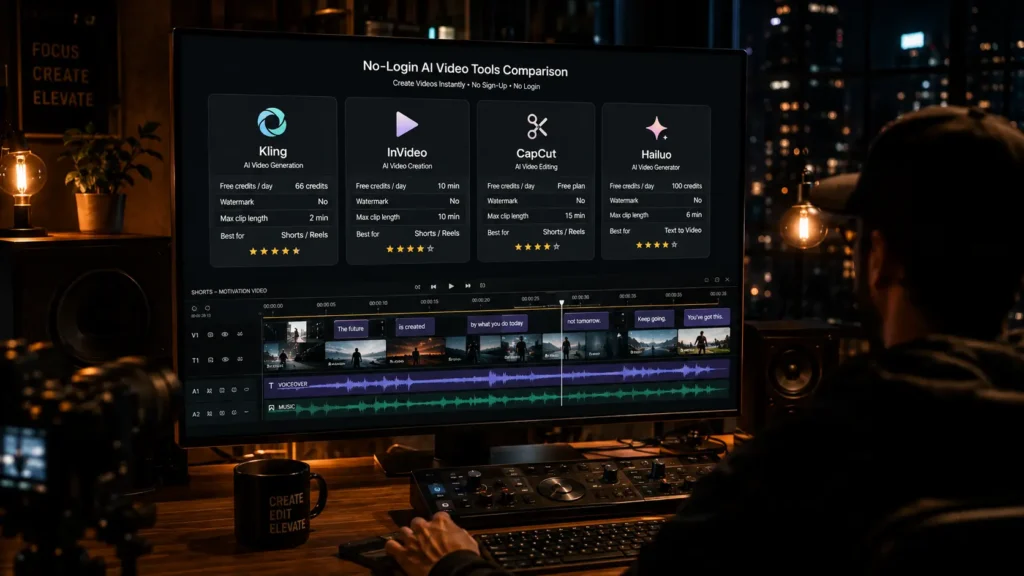
This section covers the tools that matter for generating B-roll, full draft videos, or visual assets when building a no login AI video tools faceless 2026 workflow. It excludes tools with no usable free tier or those requiring payment before you can evaluate quality.
Best for: Cinematic B-roll with realistic motion and physics. Product reveals, nature scenes, human motion sequences.
Free / No-Login Behavior: Sign-up required (email or Google). Permanent free tier with ~66 credits resetting every 24 hours. No credit card required. Limited no-account testing available on TwoShot.
Strengths:
- Native 4K at 60fps on the free tier — genuinely unusual in this space
- 15-second clips with up to 6 camera cuts in a single generation
- Native audio generation in 5 languages
- Best-in-class realistic human motion for short clips
Weaknesses:
- Daily credit cap limits you to roughly 3–6 clips at standard settings before exhausting the free tier
- Not a full faceless pipeline — generates clips, not narrated videos with captions
- 4K exports consume significantly more credits than 1080p
Expert Workflow: Use Kling 3.0 for your opening shot and any B-roll segment where visual quality is the differentiator. Write specific camera direction into your prompt: “slow dolly push in on a glass of water on a white table, morning light from the left, shallow depth of field, cinematic.” Vague prompts produce average results. Specific prompts produce clips you can actually cut into a finished Short.
Best for: Full end-to-end faceless pipeline — script, stock footage, AI voice, captions, export — in one tool.
Free / No-Login Behavior: Sign-up required. Free tier is watermarked and caps weekly AI generation minutes — enough for 3–5 test videos. Paid plans start at approximately $17–25 per month. Verify current free tier output limitations on InVideo’s pricing page before assuming clean exports.
Strengths:
- Largest bundled stock library in this category (iStock and Getty integration)
- Script-to-video workflow uses a structured form rather than one open text box — reduces bad outputs
- AI voiceover, auto-subtitles, and voice cloning in a single interface
- Templates explicitly optimized for TikTok, Reels, Shorts, Facebook, and LinkedIn aspect ratios
Weaknesses:
- Free tier watermark makes it unsuitable for channel posting without upgrading
- AI-generated copy leans toward generic phrasing — hooks from InVideo’s engine rarely outperform a well-prompted Claude
- Cloud-only rendering; no local machine option
Expert Workflow: Use InVideo AI as your assembly workspace, not your creative brain. Write the script and hook yourself, paste it into InVideo’s script-to-video flow, generate the draft, then spend 15–20 minutes replacing the weakest stock clips with Kling-generated B-roll. The result is a fully assembled, captioned faceless video in under 45 minutes. InVideo handles the editing labor; you supply the creative direction.
Best for: Fast assembly, caption styling, and exporting finished Shorts and Reels. The most usable free all-in-one editor for mobile-first creators.
Free / No-Login Behavior: App download or web sign-up required. Free tier is genuinely usable — auto-captions, script-to-video draft generation, and basic AI effects available without payment. Pro at ~$7.99/month ($4.99/month billed annually) unlocks premium templates.
Strengths:
- Auto-captions are fast, accurate, and highly styleable (bold highlights, word-by-word pop, emoji integration)
- Script-to-video generates a rough draft with auto-matched stock and AI voice in one pass
- Desktop + mobile sync — start on your phone, finish on your laptop
- Free tier is the most usable in this entire no login AI video tools faceless 2026 comparison
Weaknesses:
- Script-to-video output is a rough cut, not a finished video — plan 20–30 minutes of editing
- Not a generative video tool: uses stock footage and templates, not AI-generated cinematic clips
- Owned by ByteDance; some enterprise and government users face usage restrictions
Expert Workflow: CapCut is the final assembly stage of a smart faceless workflow, not the starting point. Generate B-roll in Kling 3.0, generate voiceover in ElevenLabs, import both into CapCut, auto-caption, style captions in bold-word format (one or two emphasized words per subtitle card), add royalty-free music at -18 to -20dB under the voice, and export at 1080p/60fps. That pipeline produces a professional Short in a single editing session.
Best for: Hero shots requiring synchronized native audio and photorealistic scenes where quality is the differentiator.
Free / No-Login Behavior: Google Flow offers 50 free credits per day in supported regions — enough for a handful of draft clips. Google account required. Full Veo 3.1 with 4K and audio requires Google AI Pro ($19.99/month) or Ultra ($249.99/month).
Strengths:
- Only AI video tool in this guide that generates dialogue, sound effects, and ambient audio natively within the clip
- Photorealistic output on human scenes, products, and environments
- Narrative control allows directing specific moments within a clip
Weaknesses:
- 8-second maximum per clip (extendable at additional credit cost)
- Full 4K and audio locked behind expensive subscription tiers
- API setup adds overhead for non-technical creators
Expert Workflow: Veo 3.1 is overkill for most standard no login AI video tools faceless 2026 workflows — the audio advantage is irrelevant if you are placing ElevenLabs voiceover over B-roll anyway. Where it earns its place is when your niche requires a “talking head” substitute: an AI character delivering your script, lip-synced, as the visual identity of the channel.
Best for: Realistic motion B-roll when Kling daily credits are exhausted.
Free / No-Login Behavior: 200 free credits on first sign-up plus daily credits for returning users. No credit card required. Available at hailuoai.video.
Strengths:
- High-quality output on human motion and product movement
- 6-second clips that match the rhythm of most TikTok and Reels cuts
- Largest one-time free credit allocation among tools in this category
Weaknesses:
- 6-second clip limit is more restrictive than Kling’s 15 seconds
- Less camera movement control than Kling or Runway
- Interface is less polished than other options
Expert Workflow: Use Hailuo as your daily backup when Kling credits run out. Rotate between Kling for hero shots and Hailuo for secondary B-roll. In a finished faceless Short where clips cut at 3–5 second intervals, the visual quality difference between the two tools is minimal to the viewer.
| Tool | Free Tier | Account Required | Clip Length | 9:16 Native | Best For | Watermark Free? |
| Kling 3.0 | 66 credits/day (permanent) | Yes (email/Google) | Up to 15s | ✅ | Cinematic B-roll | ✅ |
| Hailuo AI | 200 credits on signup + daily | Yes (email/Google) | Up to 6s | ✅ | Secondary B-roll | ✅ |
| InVideo AI | Capped weekly minutes | Yes | Full video | ✅ | End-to-end pipeline | ❌ (paid) |
| CapCut | Genuinely usable | Yes (app/web) | Full video | ✅ | Assembly + captions | ✅ |
| Google Flow (Veo 3.1) | 50 credits/day | Yes (Google account) | Up to 8s | ✅ | Photorealistic hero shots | ✅ |
| Luma Ray2 | 30 credits/month | Yes (Google/Apple) | Up to 5s | ✅ | Smooth camera movement | ❌ |
Note: Free tier credit counts and watermark policies change frequently. Verify current terms directly on each platform before building a production workflow around them.
6. Voiceover & Captions: The Hidden Identity Layer
On-camera creators are recognized by their face. Faceless channels are recognized by their voice and caption style. This is the entire brand identity system for a faceless channel built on no login AI video tools faceless 2026 workflows. Get it wrong and no amount of visual quality will build a loyal audience.
ElevenLabs is the quality benchmark. The free tier allows 10,000 characters per month (approximately 10 minutes of audio) and up to 3 voice clones, each requiring a consent verification recording. The critical limitation: commercial use rights require the Creator plan at $22/month. If you plan to monetize through TikTok Creator Fund, YouTube Partner Program, or affiliate revenue, the free tier audio cannot legally be used in monetized content on most platforms.
Practical path: use ElevenLabs free tier for your first 10–15 test videos to find your voice style, then upgrade to Creator when you reach 1,000 subscribers or your first affiliate click.
Fliki bundles voiceover with finished video assembly. If you want one tool to go from script to published Short, Fliki is the most direct path. The free tier is limited but real.
CapCut’s built-in TTS has improved significantly and is usable for channels where a slightly AI-inflected voice fits the content style. For a creator doing screen-recorded tutorials or text-over-footage formats, CapCut TTS is sufficient without a separate subscription.
Research consistently shows that 80–85% of short-form content is consumed with sound off, particularly on TikTok and Instagram Reels. In a no login AI video tools faceless 2026 workflow, auto-captions are not an accessibility feature — they are the primary delivery mechanism for your message.
The format that performs best in 2026: word-by-word highlighting, where each word lights up as spoken, with 1–2 words per sentence emphasized in a larger size or contrasting color. CapCut, InVideo AI, and most dedicated short-form tools support this natively.
Expert Workflow: Generate voiceover first, then auto-caption from the audio file — not from the script text. Caption timing derived from audio is more accurate. Review every caption card manually before export. AI auto-captions still make errors on proper nouns, numbers, and technical terms.
7. A One-Day Faceless Workflow (No-Login First)
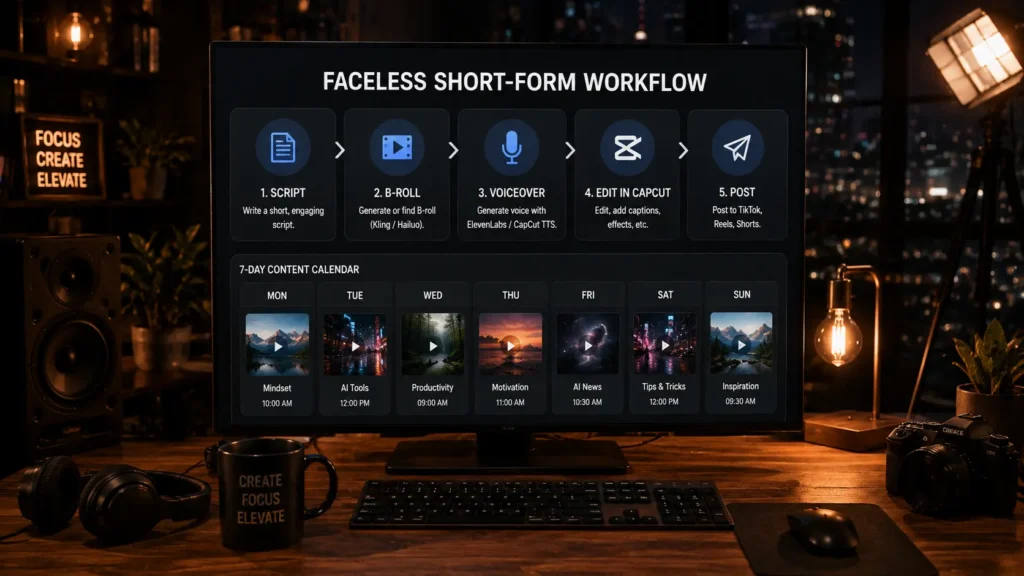
This is the realistic production timeline for one finished, publish-ready Short using the no login AI video tools faceless 2026 stack described above.
Total time: 85–105 minutes
Open Claude or ChatGPT free tier. Prompt: “I run a faceless [niche] channel on TikTok. Write 5 hook options for a 45-second video about [topic]. Each hook under 15 words, curiosity without being vague. Then write the full 140-word script for the strongest hook with a clear CTA.”
Pick the hook that sounds natural when read aloud. Edit so every sentence is under 20 words. Short sentences narrate better.
Open Kling 3.0. Plan 4–5 short clip prompts that match the beats of your script. Be specific about camera movement, lighting, and subject action. Generate in 9:16 vertical format. Download clips. If you hit the daily Kling credit limit, switch to Hailuo AI for remaining segments.
Open ElevenLabs. Paste your script. Choose a voice that matches your channel tone — calm authority for finance and psychology niches, energetic warmth for fitness and lifestyle. Adjust pacing to 0.92–0.95x speed for natural cadence. Export as MP3.
If not yet on a paid ElevenLabs plan, use CapCut TTS for test videos and upgrade when posting to monetized channels.
Import voiceover audio first. Place B-roll clips against audio, cutting at sentence breaks. No single clip should sit longer than 4–5 seconds. Add auto-captions. Style with word-by-word highlighting. Add a royalty-free music bed from CapCut’s library at -18 to -20dB. Add a text overlay reinforcing the hook in the first 3 seconds. Export at 1080p.
Watch the final video once with sound off. If the captions alone tell the story, the edit is ready. Post natively to each platform — do not cross-post via scheduler for your first 30 videos. Native uploads receive better initial distribution on TikTok and Instagram. Write the caption with 3–5 hashtags maximum.
8. Which Stack Should You Actually Use?
Three scenarios, three honest recommendations built around no login AI video tools faceless 2026 options.
| Tool | Cost |
| Script: Claude / ChatGPT free tier | $0 |
| B-Roll: Kling 3.0 free tier | $0 |
| Voiceover: CapCut built-in TTS | $0 |
| Assembly: CapCut free | $0 |
| Total | $0/month |
Honest limitation: CapCut TTS is not ElevenLabs. The voice will sound slightly AI-generated to careful listeners. Kling’s free tier limits you to ~3–5 polished clips per day. This stack is for proving your niche has traction before investing. Post 10–15 videos. If any hit organic reach, upgrade.
| Tool | Cost |
| Script: Claude Pro | $20/month |
| B-Roll: Kling 3.0 + Hailuo free tiers | $0 |
| Voiceover: ElevenLabs Creator | $22/month |
| Assembly: CapCut Pro | $5/month (annual) |
| Total | ~$47/month |
This is where quality becomes a real differentiator. ElevenLabs Creator gives you a cloned voice — your own voice or a custom AI voice — that becomes the audio identity of your channel. Once your audience recognizes the voice, it is a retention asset that compounds with every video.
| Tool | Cost |
| Script + Ideation: Claude Pro | $20/month |
| Full Pipeline: InVideo AI paid | ~$25/month |
| Hero B-Roll: Kling 3.0 free tier | $0 |
| Scheduling: Buffer | $6/month |
| Total | ~$51/month |
At this level, InVideo AI becomes the production backbone because it collapses multiple workflow steps into one platform. The time savings on assembly (30–40 minutes per video saved versus the manual CapCut workflow) justify the subscription cost at 4+ videos per week.
9. FAQ: No Login AI Video Tools Faceless 2026
Do faceless AI channels get monetized on YouTube and TikTok? Yes. YouTube applies the same criteria (1,000 subscribers + 4,000 watch hours, or 10M Shorts views) regardless of whether the creator appears on screen. The only requirement is commercial rights to all audio and visuals — use paid tiers of ElevenLabs and ensure your AI-generated clips carry commercial licenses.
Does YouTube require disclosure of AI-generated content in 2026? Yes. YouTube now requires creators to disclose AI-generated scripts, synthetic voiceovers, and AI-generated visuals using the “altered or synthetic content” toggle in YouTube Studio. Instagram has similar disclosure requirements. Failure to disclose can result in content removal or demonetization.
Will TikTok’s algorithm penalize faceless content? No. TikTok evaluates watch time, shares, comments, and replays — not whether a human face appears. Strong hooks and retention consistently outperform on-camera content in most niches. The risk is not the algorithm; it is saturation. Generic AI B-roll over generic AI voiceover is now a crowded format. Differentiation comes from script quality and a consistent channel voice.
Is the Kling 3.0 free tier genuinely permanent? As of mid-2026, yes. The Kling 3.0 free tier includes a daily credit reset that is not a promotional trial. Credits reset approximately every 24 hours. Verify the current credit table on kling.kuaishou.com before planning a high-volume session, as credit costs per generation vary by resolution and clip length.
Can I use ElevenLabs free tier audio in monetized videos? No. ElevenLabs’ terms of service restrict commercial use on the free tier. Once you are posting to monetized channels — even channels not yet qualified for partner programs — you should be on a paid plan. The Creator plan at $22/month is the minimum tier that grants commercial rights.
How many Shorts can I realistically produce per week with the Starter Stack? An experienced creator can complete one video in 90–120 minutes using the workflow above. That translates to 5–7 videos per week with weekend batching. Batching is almost always more efficient: write all scripts in one session, generate all B-roll in one session, assemble all videos in one session.
Is this no login AI video tools faceless 2026 workflow viable long-term? Yes, with one caveat: the “no-login” tools have free tiers because they are also businesses with paid plans. As you scale output and income, upgrading specific tools (voiceover first, then scripting) is the natural progression. The zero-cost stack is a starting point, not a permanent state.
10. The Bottom Line
The no login AI video tools faceless 2026 landscape is genuinely more accessible than it has ever been. Kling 3.0’s free tier, CapCut’s free editor, and Claude’s free chat interface are enough to test whether your niche works and whether you can maintain the production rhythm.
But the tools are not the differentiator. On a platform where every creator has access to the same AI generators, the faceless channels that grow are the ones with the tightest scripts, the clearest caption style, and the most consistent posting schedule. The no login AI video tools faceless 2026 workflow this guide describes saves you production time. What you do with that saved time — namely, writing better hooks — is what separates a channel that compounds from one that stagnates.
Start with Stack A. Commit to 20 videos in your chosen niche over 30 days. Judge results before spending any money.
If you get traction — even modest traction, a few videos hitting 5,000 views or building a comment thread — upgrade ElevenLabs first. Your channel voice is the single compounding asset in a faceless format. Invest in it before anything else in this stack.
Everything else is supporting infrastructure.
Related articles on AiReviewCore:
- Google Veo 3.1 vs Runway Gen-4.5: Which AI Video Tool Is Right for You?
- Kling 3.0 Full Review: Best Free AI Video Generator in 2026?
- ElevenLabs vs Murf vs Fliki: Best AI Voice for Faceless Channels
Written and tested by the AiReviewCore editorial team | All tools verified on live accounts | Last updated: August 2026
Adrian Cole is a technology reviewer at aireviewcore.com covering AI video tools, model comparisons, and practical production guides.
© 2026 aireviewcore.com — All rights reserved.