

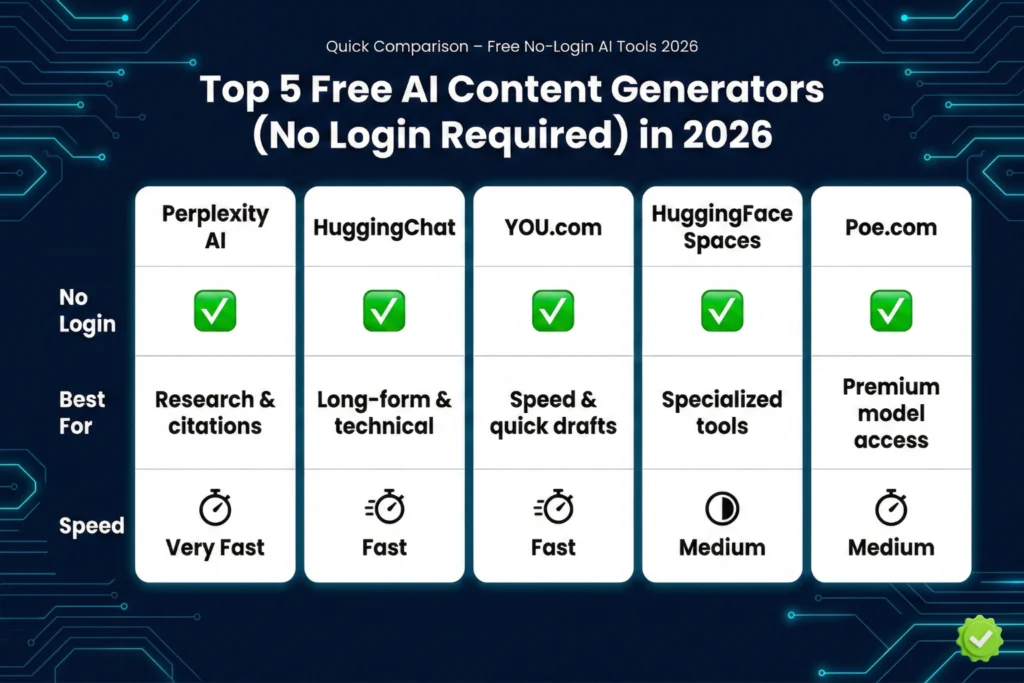
Free AI content generators no login are no longer a compromise — in 2026, they are a legitimate choice for content creators who need instant access without an account.
For years, “free AI tools” meant watered-down outputs behind aggressive signup walls. That dynamic is shifting. A maturing category of genuinely capable, no-login AI generators has emerged — built for privacy-conscious users, quick creative tasks, and anyone who needs to test an idea without surrendering their data or their inbox.
I spent the past month systematically evaluating free AI tools across output quality, speed, privacy commitments, and real-world usability. Five tools consistently delivered. These are the ones worth your time.
Table of Contents
Why Free AI Content Generators No Login Are Growing in 2026
The demand for free AI content generators with no login required isn’t driven by laziness — it’s driven by legitimate frustration.
Privacy fatigue is measurable. After repeated data breaches, opaque privacy policies, and relentless retargeting, users are applying friction selectively. The no-login AI movement is the natural response.
Three dynamics are accelerating it:
- Instant access removes creative friction. Every signup form is a conversion barrier. When you have a prompt idea at 11pm, the last thing you want is an email verification loop. No-login tools close the gap between intention and execution.
- Anonymity has functional value. For sensitive client work, competitive research, or early-stage business ideas, you may not want your prompts stored, analyzed, or linked to your identity. These tools provide that separation.
- Disposable experimentation is underrated. Testing 15 headline variations, comparing brand voice options, or stress-testing a content angle works better when you’re not burning through a paid usage quota.
The honest tradeoff: no conversation history, tighter output limits, and fewer customization options. For specific use cases, those constraints are acceptable — sometimes even preferable.
Evaluation Criteria
Each tool was assessed across five dimensions:
- Output Quality — Usability of first drafts without heavy editing
- Response Speed — Time from prompt submission to full output
- Output Length — Character and word limits per query
- Specialized Capabilities — Features beyond standard text generation
- Privacy Transparency — Clarity and specificity of data practices
I also ran a standardized test prompt across all five tools: Write a 150-word introduction for a blog post about sustainable fashion trends in 2026. The variance in outputs was more significant than expected.
After selecting your tools, refine your output strategy by exploring my full guide on how to use AI for content writing 2026.
1. Perplexity AI
Best For: Research-backed content, cited articles, and fact-heavy writing
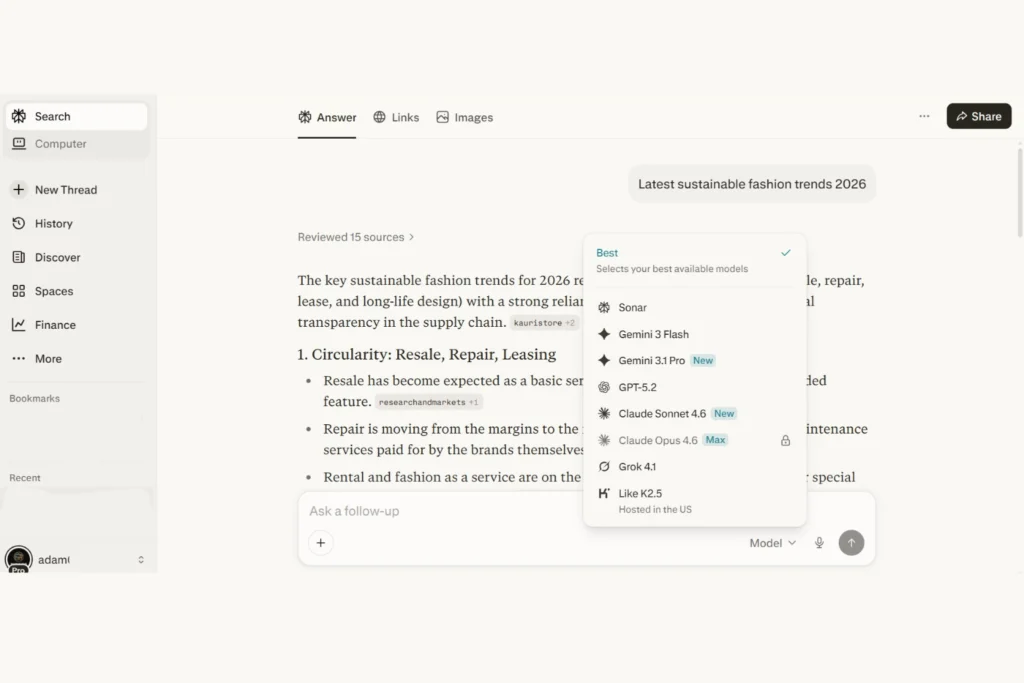
Perplexity occupies a unique position as a free AI content generator no login required. Perplexity isn’t a content generator in the traditional sense — it’s a research engine with generation capabilities, and the distinction matters.
Unlike static language models, Perplexity performs live web searches to construct its answers, pulling from multiple current sources and citing each one inline. For content creators, this changes the workflow entirely: instead of generating text and then verifying claims separately, the research and drafting happen simultaneously.
Anonymous access is available without account creation. The interface is clean, mobile-friendly, and intentionally minimal.
Where it excels:
- Data-driven articles that require current statistics or recent developments
- Research summaries where source verification is essential
- Content in fast-moving niches (technology, finance, health) where knowledge cutoffs are a liability
Where it falls short:
- Creative and narrative writing — outputs default toward informational, not expressive
- Long-form drafts — anonymous sessions have output length limitations
- Sessions don’t persist, so iterative refinement requires manual re-prompting
Privacy: Perplexity states that anonymous sessions are not used to build user profiles. Standard analytics (browser type, approximate location) are collected for performance purposes, but no personal identifiers are linked to your queries without an account.
Verdict: 9/10 for research-driven content — unmatched in this category. 6.5/10 for creative writing.
2. HuggingChat
Best For: Long-form content, technical writing, and model flexibility
HuggingChat is Hugging Face’s open-source alternative to proprietary chat interfaces. Its core differentiator isn’t a single model — it’s model selection. Users can switch between several open-source large language models depending on the task at hand.
This matters more than it sounds. Different models produce noticeably different output styles: some lean toward structured, analytical prose; others produce warmer, more conversational text. For content creators who work across multiple formats and audiences, that flexibility has real value.
Anonymous access is available, with no hard character limits on standard prompts.
Where it excels:
- Long-form blog posts and editorial content requiring depth
- Technical documentation, developer guides, and structured writing
- Prompt experimentation — running the same input across models to compare style and tone
Where it falls short:
- The model-switching interface can be disorienting for users new to open-source AI
- Output quality varies significantly between models — knowing which to choose takes experimentation
- No built-in fact-checking or source citation
Privacy: Hugging Face does not store anonymous conversations on their servers. As an open-source platform, their data practices are more transparent than most commercial alternatives. Avoid inputting confidential client or business data regardless — standard best practice for any third-party AI service.
Verdict: 9/10 for technical and long-form content. 8/10 for versatility across content types.
3. You.com AI Chat
Best For: Fast content drafts with real-time search integration
You.com positions itself at the intersection of search engine and AI assistant. The result is a tool optimized for speed and factual grounding — less suited for polished creative writing, but highly effective for quick ideation and research-backed drafts.
The interface will feel immediately familiar to anyone comfortable with a standard search engine. No learning curve. No configuration required. Because it combines search and generation, You.com is among the most efficient free AI content generators no login needed for quick research tasks.
Anonymous access is available with unlimited basic usage as of this writing — though that policy may evolve as the platform scales.
Where it excels:
- Fastest response times of any tool in this evaluation — consistently
- Brainstorming sessions where you need volume over polish
- Quick factual drafts that benefit from search-backed grounding
- Headline and intro variation testing
Where it falls short:
- Outputs tend toward generic, safe language — lacks the creative edge of HuggingChat or Perplexity
- No model selection; you work with what the platform provides
- Mobile experience is functional but not optimized
Privacy: You.com collects aggregate usage data but claims not to retain individual prompts from anonymous users. Their approach mirrors standard search engine data practices — less granular than Perplexity’s disclosure, but broadly acceptable.
Verdict: 8/10 for speed and accessibility. 6/10 for creative output quality.
4. HuggingFace Spaces
Best For: Specialized content tasks, niche writing tools, and direct model access
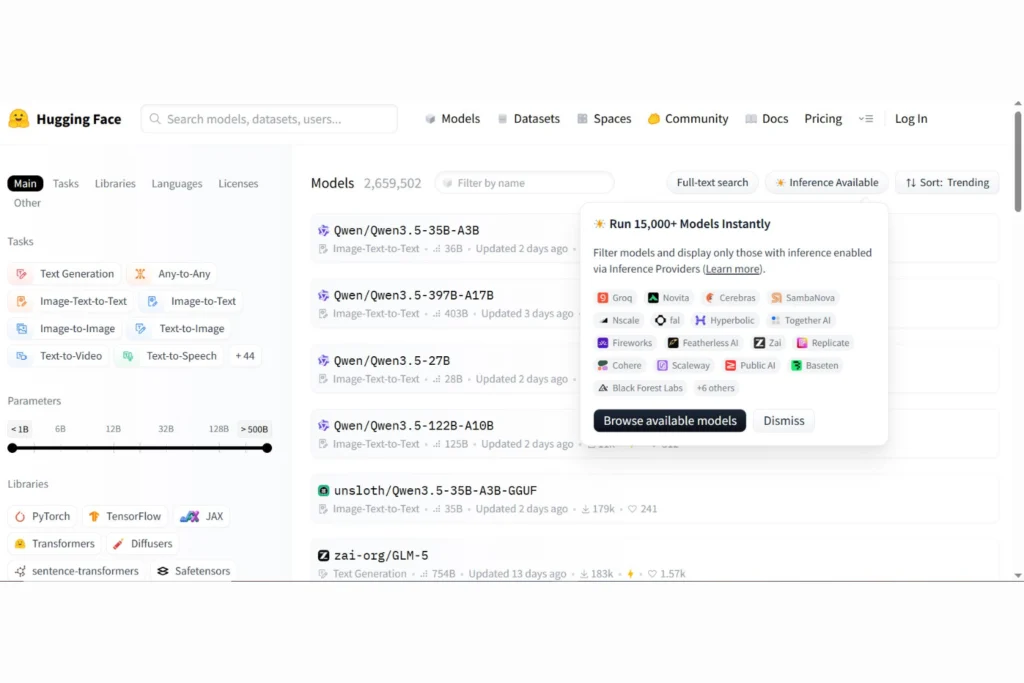
This entry requires brief clarification: HuggingFace Spaces is not a single tool — it’s a platform hosting thousands of community-built AI applications, many of which are free, no-login, and purpose-built for specific content tasks.
Within Spaces, you’ll find tools built specifically for blog post generation, SEO copywriting, product descriptions, social media content, and more. Some run on powerful open-source models; others are lightweight utilities designed for single-purpose tasks. Hugging Face Spaces is a great hub for finding free AI content generators no login required. If you need specific, task-oriented tools, Hugging Face Spaces is an unparalleled resource for finding free AI content generators no login required.
The value proposition is depth of specialization. Instead of prompting a general-purpose model to write an email subject line, you can use a fine-tuned model trained specifically on high-converting email copy.
Where it excels:
- Finding specialized tools for niche content needs
- Accessing fine-tuned models for specific formats (ads, product listings, email)
- Experimenting with models not available on mainstream platforms
Where it falls short:
- Requires more exploration and judgment to find quality tools among the noise
- Uptime varies — community-hosted spaces can go offline without notice
- No standardized interface; each Space looks and behaves differently
Privacy: Varies by individual Space. Hugging Face’s platform-level privacy practices apply to infrastructure, but individual Space creators set their own data policies. Check each tool independently if privacy is a priority.
Verdict: 8.5/10 for specialists who invest time finding the right tools. 5/10 for users wanting a single consistent experience.
5. Poe.com
Best For: Accessing multiple AI models in one interface, including premium options
Poe, developed by Quora, aggregates AI models from multiple providers — including GPT-4o, Claude, Gemini, and various open-source alternatives — into a single interface. Its free tier provides limited daily access to premium models that would otherwise require paid subscriptions.
The strategic value here is comparative: you can run the same prompt through Claude’s conversational style and GPT-4o’s analytical structure in the same session. For content professionals calibrating tone and voice, that side-by-side capability is genuinely useful.
Important limitation: Free access to premium models operates on a daily point system, not unlimited queries. GPT-4o and Claude consume more points per query than lighter models. Budget your usage accordingly.
Where it excels:
- Running the same prompt across multiple premium models for quality comparison
- Accessing community-built specialized bots for specific content types
- Getting occasional high-quality outputs from frontier models without a paid subscription
Where it falls short:
- Premium model access is genuinely limited — hitting the daily cap is easy
- The platform actively pushes account creation and paid upgrades
- Privacy policy language is less specific than Perplexity or Hugging Face
Privacy: Poe states they do not train on free-tier user conversations, but reserve the right to analyze aggregate usage patterns. For sensitive work, this is the least privacy-robust option in this list.
Verdict: 8.5/10 for occasional premium access. 5.5/10 as a sustained free-tier tool.
Tool Comparison
| Tool | Primary Strength | Approx. Output Length | Privacy Transparency | Response Speed |
| Perplexity AI | Research & citations | ~600 words | Excellent | Medium |
| Hugging Chat | Long-form & technical | 1,000+ words | Excellent | Fast |
| You. com | peed & quick drafts | ~500 words | Good | Very Fast |
| HF Spaces | Specialized tasks | Varies by tool | Variable | Varies |
| Poe. com | Premium model access | 800+ words | Fair | Medium |
Practical Workflow Integration
No-login tools perform best when assigned specific roles in a larger content workflow, not when treated as all-purpose replacements for professional AI subscriptions.
A practical allocation:
- Ideation and angle testing → You.com (speed prioritized, depth not required)
- Research and source gathering → Perplexity (citations reduce manual verification time)
- First draft generation → HuggingChat (output length and quality suit long-form work)
- Specialized copy tasks → Hugging Face Spaces (purpose-built tools for specific formats)
- Quality benchmarking → Poe (limited premium model access used selectively)
For client deliverables, strategic content, or high-volume production, paid tools remain the appropriate choice. Free no-login tools supplement professional workflows — they don’t replace them.
What These Tools Don’t Offer
Transparency demands acknowledging what the free, no-login tier sacrifices:
- Conversation memory — Every session starts from zero. Iterative refinement requires manual re-prompting.
- Usage consistency — Free tiers exist to drive conversion to paid plans. Limits and policies change without notice.
- Commercial licensing clarity — Terms of service on free tiers often restrict commercial usage. Verify before publishing client work.
- Model recency — Free access typically routes to older or smaller models. You are not consistently accessing frontier performance.
- Support — These are use-at-your-own-risk tools. Documentation is minimal; when something breaks, you’re on your own.
A Note on Privacy
“No-login” does not mean “no data collection.” Every tool in this list collects something:
- IP addresses (required for rate limiting)
- Browser fingerprint data (fraud and abuse prevention)
- Aggregate usage patterns (model improvement)
- Approximate geolocation (regulatory compliance)
The meaningful distinction is identity linkage. Without an account, your prompts cannot be consistently tied to your identity across sessions. That’s not perfect anonymity — it’s practical pseudonymity.
For maximum privacy when working with sensitive content:
- Route traffic through a VPN
- Clear cookies between sessions
- Avoid inputting personally identifiable information, client names, or proprietary data
- For genuinely confidential work, consider locally-run models (Ollama, LM Studio) that never leave your device
Starting Recommendation
If you’re integrating no-login AI tools for the first time: begin with Perplexity for one week and use it exclusively for research tasks. The citation habit it builds — sourcing every claim — will improve the quality of everything else you write, with or without AI assistance.
Once comfortable, layer in HuggingChat for drafting and You.com for ideation. The three tools cover the primary phases of most content workflows without requiring a single account.
The no-login AI category will continue maturing. As privacy regulations tighten, these free AI content generators no login required will shift from differentiator to baseline expectation. The tools covered here are early representatives of that standard.
Use them deliberately. Evaluate outputs critically. And reserve your paid subscriptions for the work that demands them.
Once you have selected your tools, learn how to refine your output by exploring my guide on [how to use AI for content writing 2026] https://aireviewcore.com/ai-content-writing-2026/