
What They Actually Do, Where They Work, and the Security Problem Nobody Is Talking About | By Adrian Cole | aireviewcore.com
Table of Contents
A question changed inside enterprise technology between 2024 and 2026, and most companies have not caught up to it yet.
The question used to be: how can AI help us answer questions faster. The question now is: how can AI autonomously get the work done. That is not a small shift in phrasing. It is the actual line between generative AI and agentic AI — and understanding which side of that line your business is operating on determines whether you are automating workflows or just improving an interface.
Traditional large language models respond when prompted, then stop. They are a brilliant consultant who answers exactly what you ask and waits for the next question. Agentic AI systems work differently. They receive a goal, break it into steps, use tools, access data, and keep moving until the job is finished or a human steps in to redirect them. That is closer to an autonomous employee than a chat interface.
The market is moving on this distinction at a pace that makes it a 2026 priority rather than a future consideration. The agentic AI market is projected to expand from $10.91 billion to $50.31 billion by 2030, a 45.8% compound annual growth rate, and analysts forecast that 40% of enterprise applications will embed task-specific AI agents by the end of 2026. This is not an AI trend story anymore. It is an operations story, a software procurement story, and increasingly a competitive advantage story.
This guide breaks down the six types of AI agents that define the category in 2026, where each one is already running in production, the security gap most companies are underestimating, and a practical framework for matching the right agent architecture to your actual business problem.
What Agentic AI Actually Means — Beyond the Buzzword
The clearest way to understand the difference between a traditional LLM and an agentic AI system is through a workplace comparison most people already understand intuitively.
A traditional LLM is a brilliant consultant who answers questions but never initiates anything on their own. You ask, they respond, the interaction ends. An AI agent is closer to an autonomous employee who can interpret a goal, navigate your company’s systems, coordinate multiple steps, and report back when the task is actually complete — without you supervising every individual action along the way.
That distinction changes the practical role AI plays inside a business. LLMs remain excellent for chat, drafting, summarization, and search-style interaction — tasks that are fundamentally about generating a response. Agentic AI combines reasoning, planning, memory, tool use, and action into a single system designed to pursue an outcome rather than produce an answer.
| Feature | Traditional LLMs | Agentic AI |
| Core function | Generate text responses | Plan, decide, and execute tasks |
| Memory | Session-only context | Persistent across sessions |
| Autonomy | Responds when prompted | Proactively takes action |
| Tool use | Limited or manual | Native multi-tool orchestration |
| Goal handling | Single-turn answers | Multi-step goal pursuit |
| Business use | Chatbot, Q&A | End-to-end workflow automation |
The most useful mental model for any executive evaluating this technology in 2026 is simple: LLMs are the brain. AI agents are the workforce. Businesses that internalize that distinction early are positioned to automate actual workflows. Businesses that treat agentic AI as a smarter chatbot are positioned to be outcompeted by the ones that did not make that mistake.
The 6 Types of AI Agents in 2026
Not every AI agent is built the same way, and the architectural differences are not academic — they determine which agent type is the right fit for which business problem. The category organizes into six core types that increase in complexity, from simple rule-following systems to layered autonomous architectures coordinating across an entire organization.
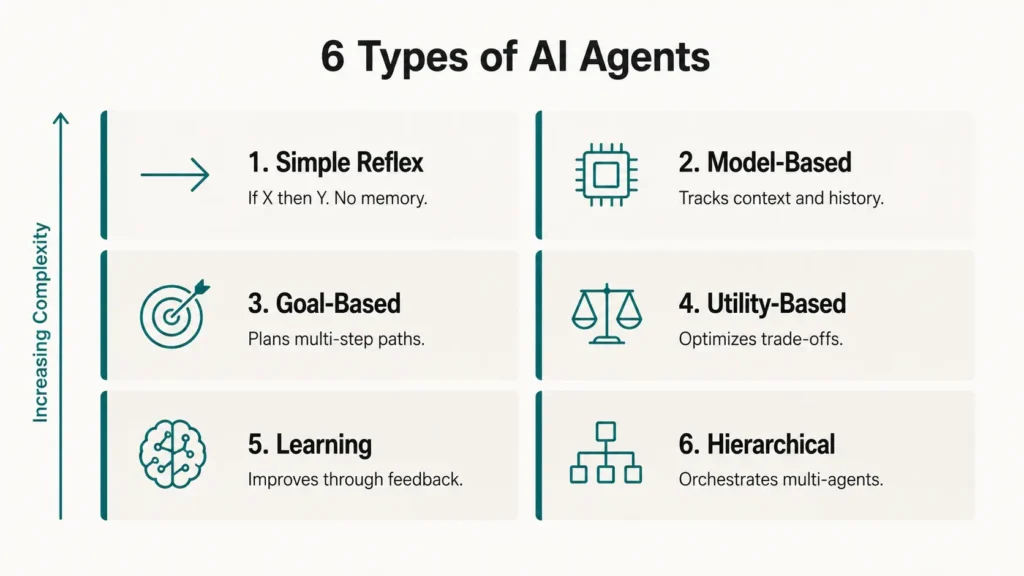
Simple reflex agents operate on direct rules. If a specific condition is true, the agent triggers a predefined action. There is no memory involved, no planning, and no awareness of anything that happened in a previous interaction.
The everyday examples are familiar: email spam filters, automatic doors, basic IT alert systems, and thermostat controls. These agents are the right fit for high-volume, low-complexity tasks where the environment is stable and the rules governing the right response are easy to define in advance. If your business problem can be fully described as “when X happens, do Y,” a simple reflex agent is not underpowered for the job — it is correctly matched to it.
Model-based agents add a layer that simple reflex agents lack entirely: context. They maintain an internal representation of the world around them, which allows the agent to react not just to the immediate input in front of it, but to what has already happened in the broader sequence of events.
GPS navigation systems, game NPCs that respond to player history, and session-aware customer service bots that remember earlier parts of a conversation are all built on this architecture. This model works well specifically when the environment changes over time and recent history meaningfully affects what the correct next action should be — a customer service interaction where the third message depends on what was said in the first two, for example.
Goal-based agents introduce genuine planning. Rather than simply reacting to the current state of the world, they evaluate multiple possible paths forward and select the one most likely to achieve a defined target outcome.
Robotic arms executing multi-step assembly tasks, automated puzzle solvers, and autonomous warehouse robots navigating to specific locations while avoiding obstacles are the standard examples. This architecture is the right fit for workflows where the task involves multiple sequential steps and the optimal path is not obvious from the starting point — the agent needs to actually reason through the sequence rather than follow a fixed script.
Utility-based agents introduce optimization on top of goal pursuit. They do not simply ask whether a given action can reach the goal. They ask which action reaches the goal best, given competing trade-offs like cost, speed, safety, or quality that have to be weighed against each other simultaneously.
Self-driving vehicles balancing speed against safety, financial trading systems weighing return against risk, logistics platforms optimizing delivery routes against cost, and healthcare diagnostic tools balancing sensitivity against false positive rates are the clearest real-world examples. In business terms, this is the architecture for any decision where multiple priorities genuinely conflict and the agent has to make a judgment call about which trade-off produces the best overall outcome.
Learning agents improve through feedback and accumulated experience rather than operating on static rules or fixed evaluation criteria. They adapt over time using evaluation signals, updated internal parameters, and ongoing experimentation with their own approach.
Siri, Google Gemini, Amazon Alexa, AlphaGo, and large-scale recommendation systems are the highest-profile examples of this category in active use. For businesses, this is the most strategically important agent type in environments where user behavior, data patterns, or operating conditions keep shifting — a learning agent that adapts to those shifts maintains its usefulness over time in ways that a static rule-based system cannot.
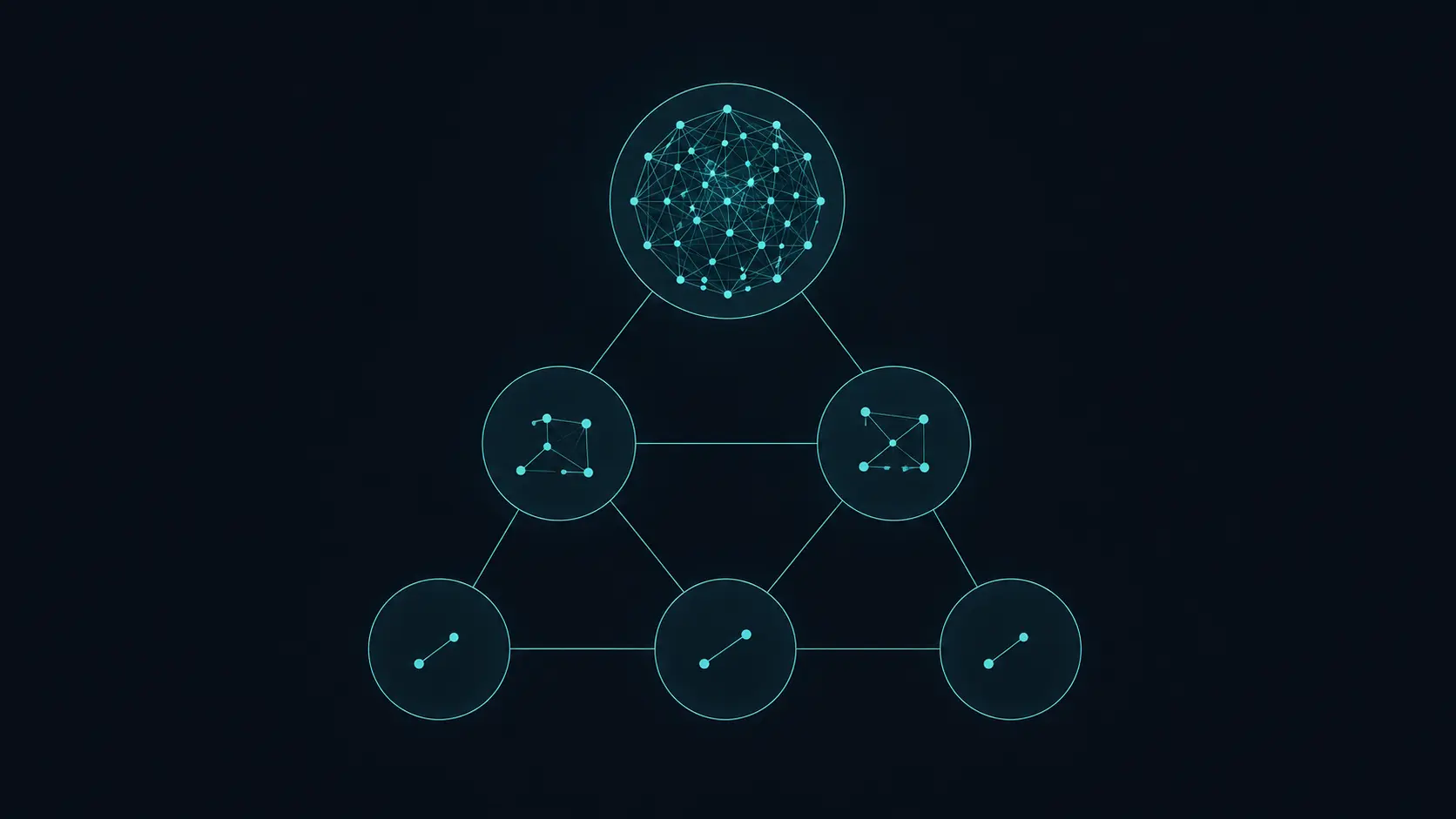
Hierarchical agents are the architecture that most closely resembles an actual organizational command structure implemented in software. Higher-level agents define overarching goals, mid-level agents translate those goals into tactical plans, and lower-level agents execute the granular individual tasks required to carry the plan out.
Autonomous drone fleets, Workday’s enterprise orchestration model, CrewAI’s multi-agent pipelines, and complex supply chain coordination systems all run on this layered structure. If a workflow in your business crosses multiple teams, multiple software systems, or layers of responsibility that currently require human coordination between them, hierarchical multi-agent architecture is usually the first place to look.
Where Agentic AI Is Already Running in Production
The theory matters less than the practical question of where this is already deployed and working at scale. Several platforms demonstrate what agentic AI looks like outside of a demo.
CrewAI is one of the leading open-source frameworks for multi-agent systems, with more than 51,000 GitHub stars as of mid-2026. Its core model assigns agents distinct roles — researcher, writer, editor, manager — and coordinates them inside a single shared workflow. This makes CrewAI especially relevant for content operations, research processes, and any sequence of work that currently requires multiple human specialists handing tasks to each other in order.
Devin by Cognition is described as a fully agentic AI software engineer rather than a code-completion assistant. It can break down an engineering goal, write modular code across multiple files, run tests, debug failures, and submit pull requests as a complete unit of work. Devin is one of the clearest production examples of goal-based and hierarchical agent design applied directly to software development.
Workday’s agentic AI strategy places autonomous agents at the center of enterprise HR and finance automation for 2026. The model is hierarchical by design: a unified orchestration layer coordinates specialized agents across HR, finance, IT, and operations, all operating inside Workday’s existing security and permissions framework. This is what makes enterprise agent deployment genuinely interesting right now — it is not just smarter assistants bolted onto existing software, but governed workflow execution inside systems businesses already trust with sensitive data.
The Model Context Protocol, or MCP, is one of the most consequential infrastructure shifts underlying this entire category. Introduced by Anthropic in late 2024 and subsequently adopted by OpenAI, Google, and the Linux Foundation’s Agentic AI Foundation, MCP functions as a standard interface layer for how agents connect to tools and data sources. The practical value is straightforward: instead of every AI vendor building custom integrations to every enterprise system individually, MCP creates a more universal connection standard that benefits the entire ecosystem rather than locking businesses into a single vendor’s integration approach.
The Security Problem Most Companies Are Underestimating
This is the section that many businesses still treat as a secondary concern when evaluating agentic AI. It should not be secondary. The same autonomy that makes these systems valuable also creates an entirely new operational risk surface that did not exist with traditional software.
The clearest evidence of the problem is the deployment gap. Nearly 79% of enterprises have adopted AI agents in some form, but only about 11% run them in production at meaningful scale. That gap between experimentation and trusted deployment is driven less by model capability than by governance, security, and unclear return on investment — companies are building agents faster than they are building the trust infrastructure required to let those agents operate with real authority.
The specific security risks are concrete, not theoretical. Prompt injection attacks manipulate an agent’s instructions through malicious input embedded in the data it processes. Tool poisoning compromises an agent through a corrupted MCP server or connected tool that the agent trusts implicitly. Data exfiltration occurs when an over-permissioned agent has access to more systems and data than its actual task requires. Privilege escalation happens when weak access separation allows an agent to take actions beyond its intended authority boundary.
A practical governance framework for managing these risks operates across three layers. The observability layer maintains full audit trails for every decision, tool call, and action an agent takes — without this, you cannot diagnose what went wrong after an incident, let alone prevent the next one. The permission layer applies role-based access controls aligned with your existing enterprise permission structure, ensuring an agent’s authority matches its actual job rather than defaulting to broad access for convenience. The escalation layer builds human-in-the-loop checkpoints for any action that exceeds a defined confidence or authority threshold — the agent does the work, but a human approves the decisions that genuinely warrant approval.
The real lesson here is that agentic AI is not primarily a model-selection problem. It is a governance architecture problem from the first day of deployment, and treating it as an afterthought is the most common reason enterprise agent projects stall between pilot and production.
Which Type of AI Agent Belongs in Your Business?
The right starting point depends far less on which agent type sounds most impressive and far more on the actual shape of the workflow you are trying to improve.
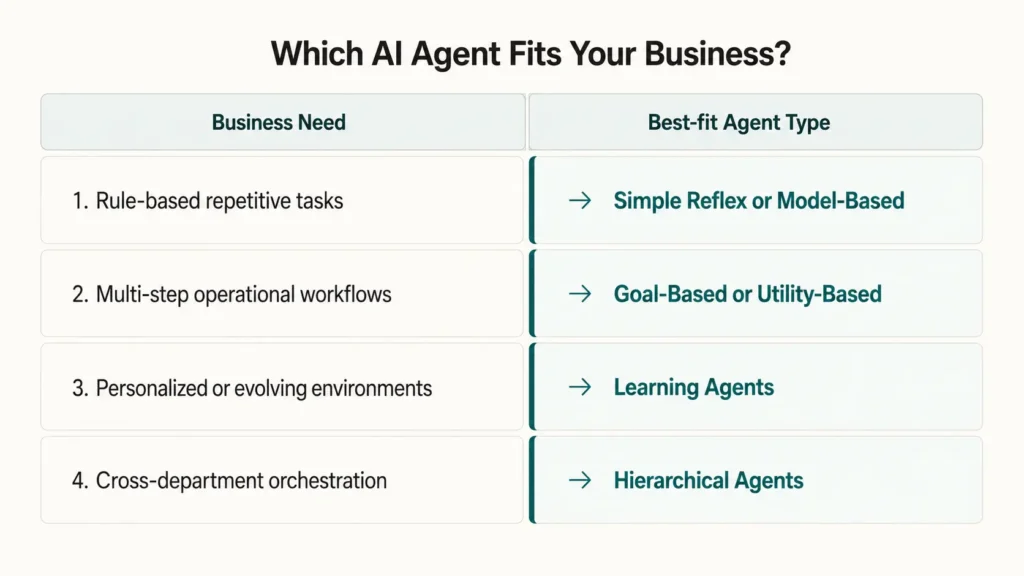
If the work is repetitive and rule-based — fraud alerts, spam filtering, threshold monitoring where the correct response is always the same given the same trigger — simple reflex or model-based agents are genuinely sufficient. There is no benefit to over-engineering a workflow that a basic rule-following system already handles correctly.
If the workflow is multi-step and operational — employee onboarding, procurement approval chains, compliance documentation, task coordination across a small team — goal-based or utility-based agents make more sense. These workflows have a path to a defined outcome, but the path involves enough steps and enough trade-offs that planning and optimization add real value.
If the environment changes continuously and feedback genuinely matters — customer behavior that shifts seasonally, recommendation systems that need to track evolving preferences, fraud patterns that adapt to new attack vectors — learning agents become the more valuable architecture, because their core advantage is improving over time rather than executing a fixed plan well.
If the use case spans multiple departments, multiple software systems, and layered responsibilities that currently require human coordinators to manage the handoffs between them, hierarchical multi-agent systems are the architecture to evaluate first.
| Business need | Best-fit agent type |
| Rule-based repetitive tasks | Simple Reflex or Model-Based |
| Multi-step operational workflows | Goal-Based or Utility-Based |
| Personalized or evolving environments | Learning Agents |
| Cross-department orchestration | Hierarchical Agents |
The companies moving fastest with agentic AI in 2026 are not necessarily the ones running the most advanced models. They are the ones correctly matching agent architecture to the actual shape of their business problem, and building governance into the deployment before scaling it — not after something goes wrong.
Frequently Asked Questions
What is agentic AI? Agentic AI refers to systems that can receive a goal, plan the steps required to achieve it, use external tools, access relevant data, and take action with limited human supervision throughout the process — rather than simply generating a response to a single prompt.
How is agentic AI different from a traditional LLM? Traditional LLMs primarily generate answers in response to individual prompts and then stop. Agentic AI systems are built to pursue outcomes across multiple sequential steps, using persistent memory, planning capability, and the ability to call external tools as part of completing the task.
What are the main types of AI agents in 2026? The six core types are simple reflex agents, model-based reflex agents, goal-based agents, utility-based agents, learning agents, and hierarchical agents — each representing an increase in planning complexity and autonomous capability over the previous category.
Which AI agent type matters most for enterprises right now? Learning agents and hierarchical systems are generally the most strategically significant for enterprise environments in 2026. Learning agents adapt to changing conditions over time, while hierarchical systems coordinate specialized functions across large, multi-department workflows that previously required human orchestration.
What is the biggest risk in deploying AI agents? Governance and security are the primary bottlenecks limiting enterprise agent deployment at scale. The most significant specific risks are prompt injection attacks, tool poisoning through compromised connections, excessive permissions granted to agents beyond their actual task requirements, and weak escalation controls that fail to route high-stakes decisions to human review.
Where should a business start with agentic AI? The most effective starting point is a narrow workflow with measurable business value, a clearly understood existing pain point, and manageable risk if something goes wrong — examples include employee onboarding, internal operations support, customer support routing, or research automation. Scale only after the governance model around that initial deployment is proven to work.
Your Action Plan: From AI Curiosity to Agentic Deployment
The useful question in 2026 is no longer whether AI agents represent the future of enterprise software. Adoption patterns, enterprise product roadmaps, and the infrastructure investment already underway have settled that question.
The better question is where an agent can remove friction in a workflow you already understand well enough to evaluate honestly. Start narrow. Pick a task with clear boundaries, measurable value, an existing human pain point, and obvious governance checkpoints before you touch anything that affects customer-facing operations or sensitive data at scale.
Then scale only after the control model around that initial deployment is actually working — not after it looks like it might be working in a demo. The businesses that benefit most from agentic AI in 2026 will not be the ones that moved fastest without discipline. They will be the ones that matched the right agent architecture to the right problem, and deployed it with enough governance built in from the start to trust the result when it matters.
For a practical breakdown of AI agent tools small businesses can deploy today, see our guide on the 4 best AI agents for small business in 2026.
Adrian Cole is a professional AI technology reviewer and creative technologist at aireviewcore.com, covering agentic AI, enterprise technology, and practical guides for businesses adopting AI infrastructure.
© 2026 aireviewcore.com — All rights reserved.