
Which Side of the Pacific Builds the Better AI Video Generator? | By Adrian Cole | aireviewcore.com
Table of Contents
The Chinese vs American AI video tools race in 2026 is no longer a niche debate. It is the question deciding which studio, agency, or solo creator gets the best output per dollar.
By April 2026, six major models compete for the same customers: native 4K output, synchronized audio, and motion quality that rivals professional production at a fraction of traditional cost. Two of the strongest names on the leaderboard are Chinese — Kling 3.0 and Seedance 2.0. Two of the strongest American names are Runway Gen-4.5 and Veo 3.1. Sora 2 still exists in the conversation, but OpenAI has already signaled it belongs to migration discussions rather than the default shortlist going forward.
This guide compares the Chinese vs American AI video tools that actually matter right now — what each one does best, what each one costs, and which side of the Pacific wins for your specific use case. No padding, no forced conclusion that one country dominates everything. The honest answer is split by task.
Why This Comparison Matters in 2026
Three years ago, Chinese AI video models were treated as curiosities — interesting demos with limited global access. That changed fast. Kling, built by Kuaishou, climbed the quality leaderboards through 2025 on the strength of motion realism trained on one of China’s largest short-video platforms. Seedance, from ByteDance, followed with a unified audio-video architecture that generates synchronized sound as part of the same process — not as a separate post-production step.
On the American side, Google’s Veo and Runway’s Gen series responded with their own leaps. Veo 3.1 added native 4K, strong prompt adherence, and advanced reference controls. Runway doubled down on professional control — camera movement, motion brushes, and a workflow built for production teams rather than one-shot consumer use.
The result is a genuine two-front competition, and the right tool depends entirely on what you are producing.
Kling 3.0 — China’s Motion and Value Leader
Kling 3.0 launched in February 2026 and quickly became the benchmark for motion quality and value. It supports up to 6 connected shots per clip with a shared audio timeline, which makes multi-shot sequences from a single prompt genuinely usable rather than a stitched-together approximation.
The pricing is where Kling separates itself in the Chinese vs American AI video conversation. At roughly $0.10 per second — about $3 per finished video — it undercuts most American competitors significantly while staying competitive on output quality. For creators who need volume and fast iteration rather than maximum polish on every single clip, Kling is consistently the value pick across independent rankings.
The honest limitation: Kling’s developer ecosystem and documentation are still maturing compared to longer-established American platforms. Physics simulation is functional but does not reach the realism ceiling of the strongest American models on complex multi-object scenes.
Seedance 2.0 — China’s Storytelling and Audio Innovation
Seedance 2.0, built by ByteDance, is the model creators are talking about most right now. Its core innovation is a unified audio-video architecture — the model generates sound as it generates motion, so a character speaking in a large room produces natural reverb, and a whisper carries the correct proximity effect, without a separate audio pass in post-production.
Seedance also leads on clip length among the major models, producing native sequences up to 15 to 20 seconds versus the 4 to 5 second outputs common elsewhere. For narrative-driven content — short films, branded storytelling, multi-scene sequences — this length advantage compounds with the multi-shot native capability that preserves character identity, clothing, and lighting across cuts.
Pricing sits around $0.30 per clip at the production tier, with ByteDance positioning Seedance as the value leader for narrative work specifically. The tradeoff is regional rollout — Seedance launched first in China, with global access expanding through 2026 rather than being universally available from day one.
Runway Gen-4.5 — America’s Professional Control Standard
Runway Gen-4.5 ranks at the top of the Video Arena leaderboard for early 2026, and it earns that position on a different axis than the Chinese models above: control, not raw benchmark score.
Motion brushes let you paint exactly which parts of a frame move and how. Camera control vocabulary lets you specify movement, trajectory, and focal behavior using actual cinematography terms rather than hoping the model interprets a vague instruction correctly. For production teams where the creative direction has to be precise rather than AI-interpreted, this is the structural reason Runway remains the professional default on the American side of this comparison.
Runway uses a credit-based subscription rather than per-second pricing — Standard at $12 to $15 per month for occasional use, Unlimited at $76 to $95 per month for power users running high volume. For teams that need predictable monthly cost rather than variable per-clip billing, this model is the more practical fit.
Veo 3.1 — America’s All-Around Safest Pick
Veo 3.1, from Google, is consistently described across independent rankings as the safest overall pick in 2026 — strong realism, good motion handling, native 4K, and synchronized audio generated as part of the same process, not bolted on afterward.
The advanced reference controls for character and style consistency are Veo’s distinguishing strength in the Chinese vs American AI video debate. For brand work where a consistent character or visual identity has to hold across multiple generated clips, Veo’s reference system performs more reliably than most competitors on either side.
Pricing starts at $0.15 per second in fast mode, accessible through Google AI Pro, Ultra, or the Gemini app, with API access available via Vertex AI for developers building production pipelines.
The Direct Comparison
| Model | Origin | Best For | Approx. Cost | Standout Feature |
|---|---|---|---|---|
| Kling 3.0 | China (Kuaishou) | Value, fast iteration, motion | ~$0.10/sec | Best ELO rating for realism |
| Seedance 2.0 | China (ByteDance) | Narrative, multi-shot storytelling | ~$0.30/clip | Native synchronized audio |
| Runway Gen-4.5 | USA | Professional control, branded work | $12-95/month | Motion brushes, camera control |
| Veo 3.1 | USA | All-around safest pick, 4K | $0.15/sec | Character/style reference consistency |
Who Wins — China or America?
There is no single winner in the Chinese vs American AI video comparison, and any guide claiming otherwise is oversimplifying.
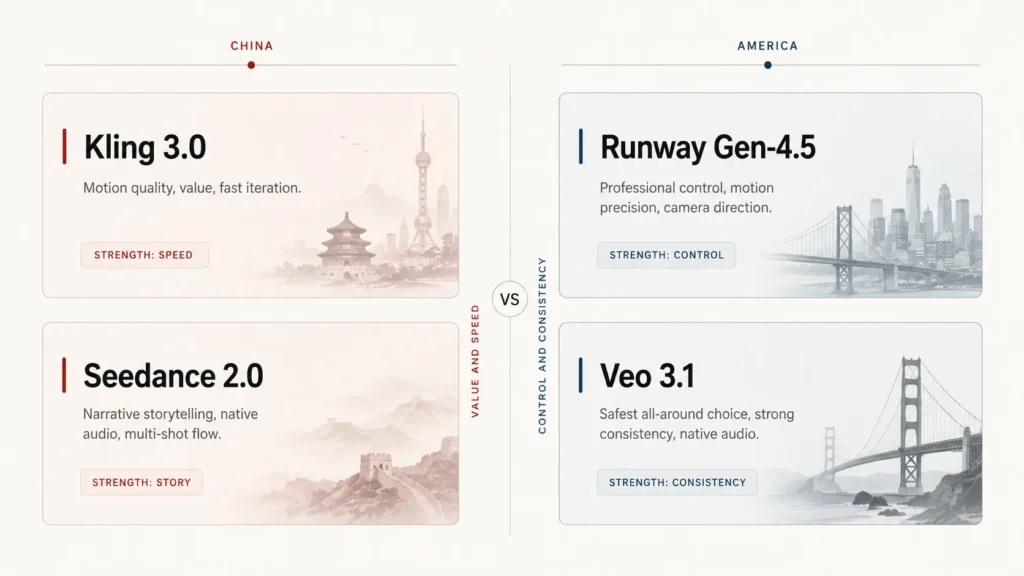
For raw value and iteration speed, China wins. Kling and Seedance both undercut American pricing significantly while matching or exceeding quality on specific tasks — motion realism and audio-native storytelling respectively.
For professional control and brand consistency, America wins. Runway’s directorial precision and Veo’s reference-based consistency serve production teams that need predictable, controllable output rather than the strongest leaderboard score on a generic benchmark.
The practical answer for most creators in 2026 is to use more than one tool. Kling or Seedance for high-volume, value-driven production. Runway when a client needs precise creative direction. Veo when 4K consistency across a campaign matters more than cost per clip.
Frequently Asked Questions
Which is better, Chinese or American AI video tools in 2026? Neither side dominates universally. Chinese models like Kling and Seedance lead on value and specific innovations — motion realism and native audio respectively. American models like Runway and Veo lead on professional control and consistency. The right choice depends on your specific production need.
Is Kling 3.0 cheaper than Runway? Yes, significantly. Kling operates at roughly $0.10 per second of output, while Runway uses a subscription model starting at $12 to $15 per month for light use and scaling to $76 to $95 per month for high-volume production.
What happened to Sora 2 in this comparison? Sora 2 remains usable but has shifted into the migration and legacy conversation among independent rankings rather than the default recommendation. Most 2026 guides now position Veo 3.1, Kling 3.0, and Seedance 2.0 as the stronger active recommendations.
Can I use Seedance 2.0 outside China? Seedance 2.0 launched first in China with global rollout expanding through 2026. Availability outside China has been increasing but should be verified directly on the platform before planning a production workflow around it.
The Bottom Line
The Chinese vs American AI video tools comparison in 2026 is not a contest with one champion. It is a map of trade-offs. Choose Kling or Seedance when value and specific technical innovation matter most. Choose Runway or Veo when professional control and brand consistency are non-negotiable.
For a deeper breakdown of how these models perform specifically on image-to-video workflows, see our complete guide on the best AI image to video tools in 2026.
Adrian Cole is a professional AI technology reviewer and creative technologist at aireviewcore.com, covering AI video generation, global AI tool comparisons, and creative production technology.
© 2026 aireviewcore.com — All rights reserved.