

How OpenClaw Became the Foundation Google, Microsoft, SpaceXAI, and Meta Are All Building On | By Adrian Cole | aireviewcore.com
Table of Contents
In November 2025, an Austrian developer named Peter Steinberger released a small open-source project called Warelay, later renamed OpenClaw. It was a free, self-hosted AI agent that could log into real apps like Slack, Discord, WhatsApp, and iMessage, and actually complete multi-step tasks inside them instead of just chatting about them.
Within three months, that side project had accumulated over 180,000 GitHub stars — a figure that kept climbing past 247,000 by March 2026 — along with acquisition interest from both Meta and OpenAI reportedly worth billions of dollars. On February 15, 2026, Sam Altman announced that OpenAI had hired Steinberger directly, while OpenClaw itself would live on as an independent open-source foundation that OpenAI continues to support.
That single event set off a chain reaction. Six months later, four of the biggest technology companies in the world are now shipping or racing to ship “always-on” personal AI agents, and at least two of them are built directly on the technology OpenClaw pioneered. This is the story of that race, what each product actually does, what it costs, and the risks that get less attention than the announcements.
How One Open-Source Project Became Industry Infrastructure
OpenClaw’s core idea was simple but different from most AI chatbots: instead of answering questions in a text window, it operates a persistent computer, signs into a user’s real accounts, and carries out full workflows autonomously, then keeps working even after the user closes their laptop.
That “always-on” quality is what made it spread so fast. Most AI assistants in 2024 and 2025 waited for a prompt and then produced a single response. OpenClaw behaved more like a digital employee with its own machine, its own login sessions, and the ability to pick up a task, work on it for hours, and report back.
Word of the project spread through developer communities, and momentum snowballed into what several outlets described as a full-blown online phenomenon — complete with community-run Moltbook, a social networking service built specifically for AI agents like OpenClaw to interact on, and competing offers from Meta and OpenAI to bring Steinberger in-house. Rather than sell the project outright, Steinberger chose to join OpenAI while keeping OpenClaw independent and open.
That decision mattered more than it might have seemed at the time. Because OpenClaw stayed open-source under a permissive MIT license, any company was free to build on top of it — and two of the industry’s largest players did exactly that within months.
The Four Companies Now Racing to Own Your Digital Agent
By August 2026, the race had split into four distinct strategies, aimed at four different audiences, running on four different technical foundations.
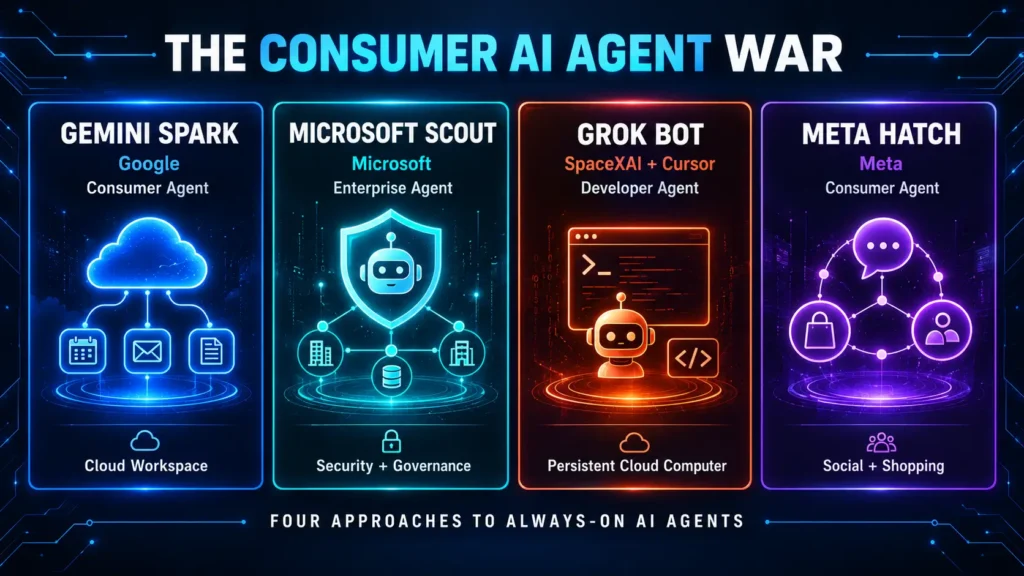
| Platform | Company | Launch | Technical Basis | Target Audience | Access & Price |
| Gemini Spark | May 19, 2026 (I/O) | Gemini 3.5 + Antigravity harness, dedicated Cloud VMs | Consumers, Workspace power users | Google AI Ultra, $99.99–$199.99/month (US) | |
| Microsoft Scout | Microsoft | June 2, 2026 (Build) | Built directly on OpenClaw + Microsoft Execution Containers | Enterprises (Frontier program) | Bundled via Microsoft 365 + Copilot enterprise plans |
| Grok Bot | SpaceXAI (formerly xAI, merging with Cursor) | August 11, 2026 (beta) | Grok models running on Cursor’s infrastructure | Developers and professionals | From $120/seat (Cursor Teams Premium) to $300/month (SuperGrok Heavy) |
| Meta Hatch | Meta | Expected late August–September 2026 | OpenClaw-inspired architecture | Consumers (WhatsApp/Instagram) | Premium tier reportedly up to $199.99/month |
Gemini Spark: Google’s Bet on the Eveayonsumer
Google unveiled Spark at I/O in May 2026 as a “24/7 AI agent that helps you navigate your digital life, takes action on your behalf, and is under your direction.” Built on Gemini 3.5 and Google’s new Antigravity agent harness, it runs continuously on a dedicated Google Cloud virtual machine rather than only activating when prompted, and can reach across Gmail, Calendar, Drive, Docs, Sheets, Maps, and the Chrome browser to complete tasks such as booking a restaurant table, placing an Instacart order, or triaging an inbox overnight and delivering a morning summary.
Google restructured its subscription tiers specifically to support Spark’s launch — cutting its top Ultra tier from $249.99 to $199.99 per month while introducing a new $99.99 entry-level Ultra plan bundling Spark with five times the standard Gemini usage limits and 20TB of storage. In the United States, Spark also became available through the cheaper $19.99 AI Pro plan, while everywhere else it remains locked to the pricier Ultra tiers. Spark connects to more than 30 third-party services through the Model Context Protocol, with Canva, OpenTable, and Instacart among its first launch partners.
Microsoft took a very different path. Rather than building a consumer-facing agent from scratch, it wrapped OpenClaw’s open-source foundation in enterprise security infrastructure and launched it as Scout at Build 2026 on June 2. Microsoft calls it an “Autopilot” — a category of always-on agents distinct from Copilot’s on-demand assistance — designed to work continuously across Teams, Outlook, OneDrive, and SharePoint.
What sets Scout apart is governance. Every Scout instance runs inside Microsoft Execution Containers on Windows, gets its own independent Entra Agent ID rather than sharing a human user’s credentials, and operates under Microsoft Purview sensitivity labels and role-based permissions. IT administrators can assign only the specific permissions an agent needs, monitor its background activity separately from human activity logs, and roll out access gradually rather than all at once. This reflects a clear acknowledgment that OpenClaw’s original design, built for individual hobbyists, was never intended to meet enterprise compliance standards on its own — Microsoft effectively productized the missing trust layer, and committed to contributing enterprise-grade policy controls back to the open-source project.
Scout launched initially to a small customer group through the company’s Frontier early-access program, with a broader enterprise rollout continuing through the rest of 2026.
Grok Bot took the most technically aggressive approach of the four. The corporate structure behind it is worth untangling precisely, because it is more layered than a single “merger.” SpaceX acquired xAI in an all-stock deal announced February 2, 2026 and finalized May 6, forming the combined entity SpaceXAI. Separately, SpaceXAI then agreed to acquire Anysphere, the company behind the AI coding tool Cursor, in a $60 billion all-stock deal announced June 16, 2026 and completed August 14.
Grok Bot itself shipped in beta on August 11 — three days before that Cursor acquisition officially closed — giving each user a persistent cloud computer that signs into their actual accounts and interfaces, not sanitized API sandboxes, and keeps working after the user closes their laptop.
Users interact with named “Bots” inside group conversations, and multiple Bots can hand off work to one another on the same task, similar to assigning subtasks to different specialists on a team. Grok Bot supports browser control, file access, terminal commands, and MCP-enabled tool connections, along with “learned routines,” where a Bot can observe a workflow once and repeat it later on a schedule.
Access is unusually fragmented for a flagship product. There is no standalone Grok Bot subscription — instead, it ships bundled into existing plans: Cursor Teams Premium at $120 per seat per month, Cursor Ultra at $200 per month, or SuperGrok Heavy at $300 per month. Notably, most of the checkout flow, pricing buttons, and plan names on SpaceXAI’s own product page belong to Cursor rather than Grok — a visible sign of how deeply the two companies’ infrastructure had already merged weeks before the acquisition formally closed.
Meta’s position is the most striking of the four, because it is largely defined by an opportunity it did not get. Multiple reports indicate Mark Zuckerberg personally engaged with the OpenClaw team early on, with Meta among the companies racing to bring Steinberger in-house before OpenAI won that competition in February.
Meta is now reportedly preparing to launch Hatch, a consumer AI agent platform inspired by OpenClaw’s architecture, expected to debut as early as late August or early September 2026 — aimed at everyday consumers through WhatsApp and Instagram rather than developers or enterprises. Unlike OpenClaw, which requires self-hosting or technical setup, Hatch is designed to run natively inside apps more than two billion people already open daily, with no installation required.
The reported feature set includes agentic shopping tied directly to Instagram Reels — letting users purchase products they see in videos without leaving the platform — along with tested integrations for services like DoorDash, Etsy, Reddit, Yelp, and Outlook. Meta is reportedly considering a premium subscription tier priced as high as $199.99 per month, and is separately building a WhatsApp feature that would let users connect with third-party AI agents built by other companies directly inside chat threads. As of this writing, Meta has not made an official product announcement, and no confirmed pricing, feature set, or launch date exists. Anything reported about Hatch should be treated as directional rather than final until Meta confirms it directly.
What These Agents Actually Do Differently From Chatbots
The distinction that matters across all four products is persistence versus responsiveness. A standard chatbot session ends the moment you close the tab. These agents are designed to keep running.
Spark continues working on a dedicated cloud VM even when a user’s own device is off, checking email, updating calendars, and surfacing decisions that need a human’s attention before they are even asked. Scout operates similarly inside its own execution container, carrying out scheduled enterprise workflows independently of whether an employee is logged in. Grok Bot explicitly advertises that jobs continue after the user closes a local laptop, and its “always-on” framing is a direct sales pitch to professionals who want overnight or parallel work completed without babysitting a session.
This is also where the products diverge most sharply in ambition. Spark and prospective Hatch target the mass consumer market with everyday tasks — reservations, shopping, inbox triage. Scout targets regulated enterprise workflows where every action needs an audit trail. Grok Bot sits in between, marketed at technical professionals who want an “AI teammate” capable of operating unpolished, API-less interfaces the way a human employee would.
The Risks That Get Less Attention Than the Launch Headlines
Every one of these products introduces a genuinely new kind of exposure that traditional chatbots did not carry, because they act with real credentials inside real accounts rather than inside a sandbox.

Grok Bot is the clearest example. Because it signs into a user’s actual interfaces rather than working through a bounded API, any bug, hallucinated action, or compromised session has the potential to touch real accounts directly, not an isolated test environment. SpaceXAI has been transparent that this is beta software with weekly usage allowances and no published cap on exactly how much autonomous action a Bot can take before a human reviews it.
Microsoft’s response to this exact problem is why Scout looks so different from a typical consumer product launch. Assigning each agent an independent Entra Agent ID, isolating its activity logs from human user logs, and requiring administrators to grant only the minimum permissions needed are not features Microsoft added for convenience. They exist because giving an always-on agent broad account access without those controls would be a serious enterprise liability — and Microsoft built Scout specifically for organizations that cannot accept that risk. Security researchers have already raised similar concerns about OpenClaw’s underlying permission model in its original consumer form, arguing that until the core architecture is rewritten for security-first isolation, home users running it unsupervised carry real exposure.
There is also a quieter access problem across the board. Despite the scale of the coverage these launches have received, none of the four products are genuinely available to an average consumer at an average price today. Spark requires at minimum a $99.99 monthly Ultra subscription outside a narrow $19.99 US exception. Grok Bot’s cheapest entry point is $120 per seat per month through a business-oriented Cursor plan. Scout is currently limited to enterprise customers inside Microsoft’s Frontier program. Meta Hatch does not exist as a shipped product yet. The “agent for everyone” narrative surrounding this launch wave is, for now, mostly a narrative about people already paying for premium software tiers.
What This Means Depending on Who You Are
If you use Microsoft 365 inside an organization, Scout’s rollout is worth tracking through your IT department rather than trying independently, since access currently depends on enterprise enrollment in Microsoft’s Frontier program and administrator-controlled permissions.
If you already use Cursor for development work, Grok Bot is the most immediately testable of the four, particularly if your team is already on Cursor Teams Premium or Cursor Ultra, since it requires no new standalone purchase beyond an existing eligible plan.
If you are a general consumer curious about Spark, the realistic entry point right now is the $99.99 Google AI Ultra tier in the US, or the cheaper $19.99 AI Pro option where available, rather than the top $199.99 tier — which mainly buys higher usage limits rather than materially different Spark functionality.
If you are waiting on Meta Hatch specifically because you want something inside WhatsApp or Instagram, there is nothing to sign up for yet, and reasonable caution says wait for Meta’s own confirmed announcement rather than any third-party leak or prediction.
One practical caution applies across all four: none of these agents should be connected to financial accounts, payment credentials, or sensitive personal data until independent third-party security reviews have had time to catch up with how new, and how fast-moving, this entire product category still is.
Frequently Asked Questions
What is OpenClaw and why does it matter? OpenClaw is an open-source, self-hosted AI agent originally released by Austrian developer Peter Steinberger in November 2025 under the name Warelay. It gained over 180,000 GitHub stars within three months by letting users run an autonomous agent that logs into real messaging and productivity apps and completes multi-step tasks without constant prompting. Its architecture has since become the technical foundation for Microsoft Scout and a stated inspiration for Meta’s Hatch.
Did xAI actually merge with Cursor? Not exactly as a single merger. SpaceX first acquired xAI in an all-stock deal finalized May 6, 2026, forming the combined entity SpaceXAI. SpaceXAI then separately agreed to acquire Anysphere, the company behind Cursor, in a $60 billion deal announced June 16, 2026 and completed August 14, 2026. Grok Bot launched in beta on August 11 — before that second deal had formally closed — already running heavily on Cursor’s infrastructure and subscription tiers.
Which of these four AI agents is available to regular consumers right now? Gemini Spark is the most broadly accessible today, available to Google AI Ultra subscribers starting at $99.99 per month, or $19.99 through the AI Pro plan in the US. Grok Bot requires a business-oriented Cursor or SuperGrok subscription starting at $120 per seat. Microsoft Scout remains limited to enterprise customers in Microsoft’s Frontier program. Meta Hatch has not launched as a shipped product.
Is it safe to connect these AI agents to my accounts? Exercise caution. Because these agents sign into real accounts and interfaces rather than operating through sandboxed APIs, a bug or compromised session can affect real data directly. Security researchers have flagged concerns about OpenClaw’s original permission model specifically, and none of the four products discussed here have completed the kind of independent, long-term security review that would typically be expected before connecting financial or highly sensitive accounts.
What happens to Cursor as a standalone brand? Industry reporting suggests the Cursor brand is likely to fold into SpaceXAI’s product line over the medium term following the completed acquisition, though as of this writing Cursor’s own website still operates under its original corporate entity, Anysphere, Inc.
The Bigger Picture
What makes this moment unusual is not that four major companies launched competing products in the same year. It is that the foundational idea — an agent that stays on, signs into real accounts, and works independently of a human’s active attention — originated from one developer working largely alone, and reached a scale within months that forced Google, Microsoft, SpaceXAI, and Meta to respond in parallel rather than in sequence.
The real competition is not over who has the flashiest demo. It is over who becomes the default layer that sits between a person and every application they use — a position that, once established, tends to be extraordinarily difficult to dislodge. Google is betting on ubiquity through its existing consumer ecosystem. Microsoft is betting on trust through enterprise-grade governance. SpaceXAI is betting on capability through raw technical power aimed at developers. Meta, for now, is simply betting on catching up.
For a broader look at how these consumer-facing launches fit into overall enterprise AI agent adoption — and why the gap between announcing an agent and actually deploying one in production remains so wide — see our full breakdown of AI agent adoption statistics in 2026. For the mechanics of why agents that look capable in a demo often struggle once they enter real multi-step workflows, read our guide on the AI agent failure rate and what 70–95% actually means.
Adrian Cole is a technology reviewer at aireviewcore.com covering AI agents, enterprise AI deployment, and breaking developments across the AI industry.
© 2026 aireviewcore.com — All rights reserved.