
The Maturity Gap Nobody Explains Clearly | By Adrian Cole | aireviewcore.com
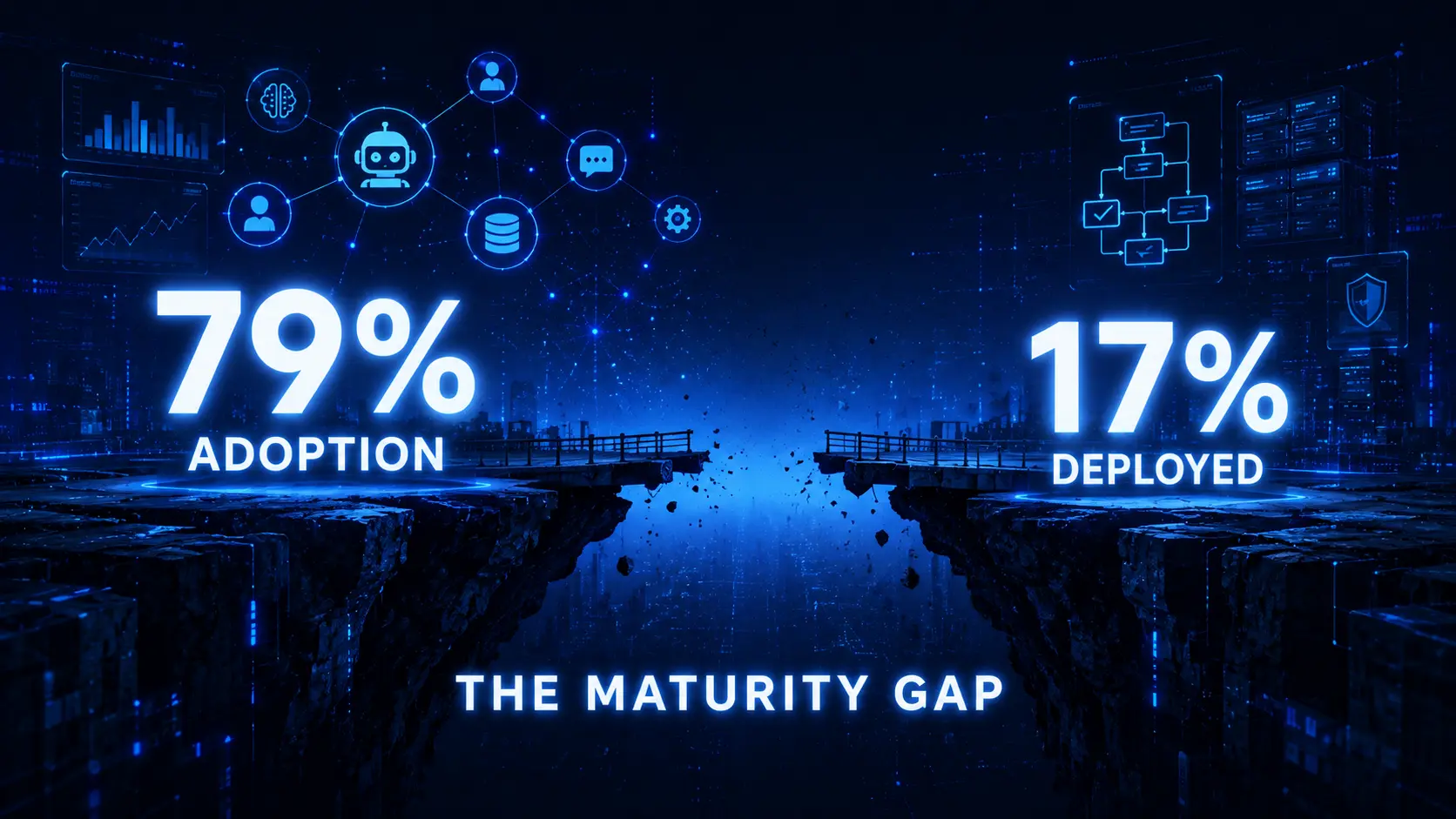
AI agent adoption statistics look contradictory at first glance. One credible survey says 79% of executives report that AI agents are being adopted in their companies. Another says only 17% of organizations have actually deployed AI agents.
Table of Contents
Both figures can be true.
They are measuring different stages of maturity. Experimenting with AI, using agent features embedded in software, running a contained pilot, deploying an agent in production, and scaling agents across the enterprise are not the same thing. The gap between those stages is the real story behind AI agent adoption in 2026.
This guide explains the most useful AI agent adoption statistics, what each number actually measures, why the numbers vary so widely, and what businesses should measure instead of treating “adoption” as a simple yes-or-no metric.
The 79% vs. 17% AI Agent Adoption Gap
The cleanest way to understand AI agent adoption statistics is to begin with two frequently cited figures.
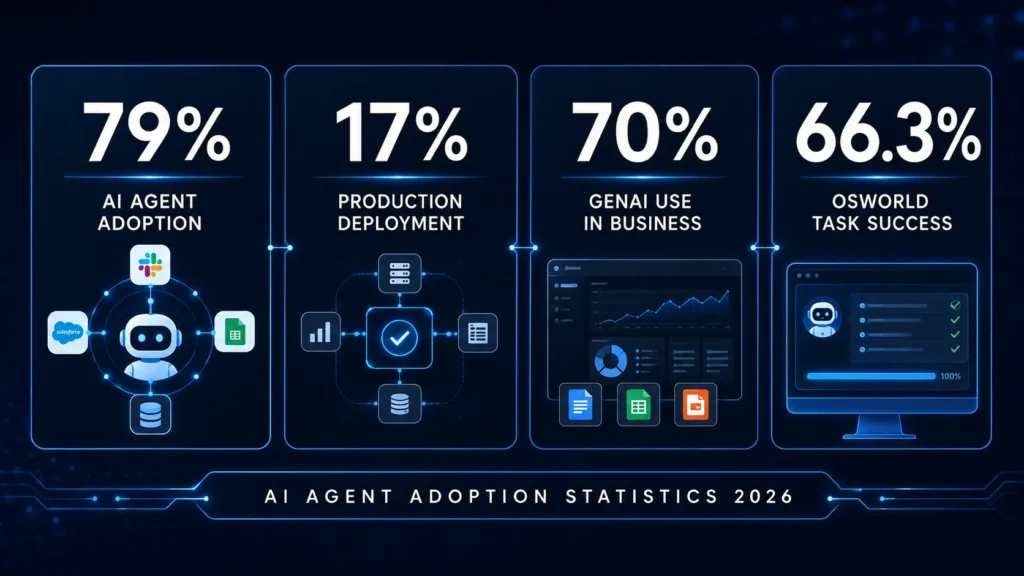
PwC’s May 2025 survey of 308 U.S. business executives found that 79% said AI agents are already being adopted in their companies. The same research found that 88% expected to increase AI-related budgets over the following 12 months because of agentic AI, and that among organizations already adopting AI agents, 66% reported measurable productivity gains, 57% reported cost savings, 55% reported faster decision-making, and 54% reported improved customer experience.
Gartner’s 2026 CIO and Technology Executive Survey uses a stricter definition. Gartner reports that only 17% of organizations have deployed AI agents to date, while more than 60% expect to deploy them within the next two years.
These figures do not prove that one survey is wrong. They show that adoption is not deployment.
An executive may reasonably describe their company as “adopting AI agents” when employees use an AI assistant built into a CRM, productivity suite, service desk, or coding environment. Gartner’s deployment measure is closer to a production test: an organization has intentionally implemented an AI agent that performs work in a live business workflow. That distinction changes the interpretation of every AI agent adoption statistic you read.
What Counts as AI Agent Adoption?
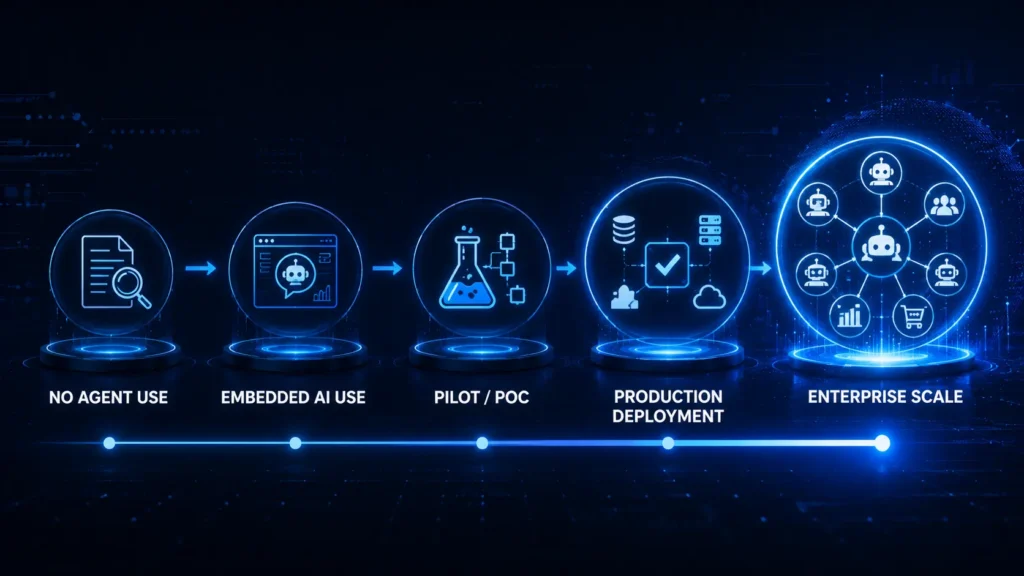
The phrase “AI agent adoption” is used to describe at least five different situations. Treating them as one category is why public statistics often appear inconsistent.
| Maturity Level | What It Actually Means | Example |
| No agent use | The organization has not begun using agentic tools | Teams are evaluating vendors or setting policy |
| Embedded AI use | Employees use agent-like features inside existing software | A CRM drafts follow-ups or a coding tool suggests fixes |
| Pilot or proof of concept | A small team tests one defined workflow | An agent classifies inbound support tickets |
| Production deployment | An agent operates in a live workflow with controls and monitoring | An agent triages tickets and routes approved cases automatically |
| Enterprise-scale orchestration | Multiple agents, systems, teams, and governance processes work together | Agents coordinate across support, sales, finance, and IT with centralized controls |
The first two levels can produce a high “adoption” number with relatively little organizational effort. The fourth and fifth levels are much harder, because they require reliable workflows, connected data, security controls, human approval design, evaluation, and clear ownership. That is why PwC’s 79% adoption result and Gartner’s 17% deployment result should be read as a maturity gap — not as a contradiction.
The AI Agent Adoption Statistics That Matter
The table below separates broad AI use, agent experimentation, deployed agents, and future intent. Each is useful, but each answers a different question.
| Statistic | What It Measures | Why It Matters |
| 79% of executives say AI agents are being adopted at their companies | Broad organizational adoption, including embedded features and early use cases | Shows strong market interest and early use |
| 88% plan to increase AI budgets because of agentic AI | Near-term investment intent | Signals continued adoption pressure, not proven production value |
| 17% of organizations have deployed AI agents | A stricter production-deployment measure | Better indicator of how many organizations moved beyond exploration |
| More than 60% expect to deploy agents within two years | Future deployment intention | Indicates a large pipeline, not a current installed base |
| 70% of organizations use generative AI in at least one business function | General generative AI use, not agent deployment specifically | Important context, but should not be labeled “AI agent adoption” |
| Agent deployment remains in the single digits across nearly all business functions | Function-level agent deployment | Shows broad AI use is well ahead of production agent use |
PwC’s own research notes that companies are increasing investment and seeing productivity gains, but that few are transforming how work actually gets done. PwC identifies mindset, change readiness, and organizational trust — not only technology — as the major barriers to deeper adoption.
Stanford’s 2026 AI Index reaches a compatible conclusion from a different direction. It reports that generative AI is used in at least one business function at 70% of organizations, while AI agent deployment remained in the single digits across nearly all functions. That is not a failure of demand. It is evidence that moving from a capable model to a dependable operating workflow remains genuinely difficult.
Why AI Agent Adoption Statistics Conflict
When you see one source say 79% and another say 17%, run the comparison through four questions before treating the numbers as comparable.
Who was surveyed? Executive surveys, CIO surveys, technology-leader polls, and employee surveys produce different results. An executive may describe a company as an adopter after a limited rollout, while an operations leader may require a measurable production workflow before applying the same label.
What does “agent” mean in the survey? Some surveys include copilots, chatbots, workflow automation, and embedded software features under the “agent” umbrella. Others reserve the term specifically for systems that can plan, call tools, make decisions within limits, and take actions across multiple steps without human input at each stage.
Does the survey count experimentation or production? A pilot that handles 100 test tickets is not equivalent to an agent that works daily inside a live customer-service system, accesses current data, logs its decisions, and has a defined human escalation path for the cases it cannot handle.
Is the result about present use or future plans? “Planning to deploy,” “testing,” “budgeting for,” “using in one function,” and “operating in production” are different points on the same journey. They should never be presented as interchangeable in a single headline statistic.
What Recent Research Says About Readiness
The technology is improving quickly, but improving capability does not remove the deployment work that sits between a capable model and a dependable operating workflow.
Stanford’s 2026 AI Index reports that agent accuracy on OSWorld, a benchmark of computer tasks across operating systems, rose from roughly 12% to 66.3% within two years — putting the top-performing agent within about six percentage points of the human baseline on this specific benchmark. That is major technical progress. Yet even the top result on this benchmark leaves roughly one in three tasks incomplete. Benchmark performance on OSWorld is not the same thing as production reliability across a real business, but it illustrates why real-world deployment still requires monitoring, fallback paths, and human escalation rather than full autonomy from day one.
In a real workflow, that gap has direct consequences. A model may be fully capable of drafting a customer response, retrieving information, or completing a basic browser task. A production agent must additionally work with current data, handle exceptions gracefully, respect permission boundaries, avoid unsafe actions, recover from failed tool calls, and route genuine uncertainty to a human rather than guessing. This is precisely why organizations can adopt AI features quickly while deploying reliable autonomous agents far more slowly.
Where Businesses Are Finding Real Value
The AI agent adoption statistics should not be read as a reason to wait indefinitely. They point toward a more useful strategy: start where the task is narrow, repetitive, measurable, and reversible.
Common early production use cases include classifying and routing support requests, retrieving internal knowledge for employees, drafting follow-up messages for sales teams before human review, summarizing calls, tickets, or documents, extracting structured information from invoices and contracts, and assisting developers with code review, testing, and documentation.
The best early use cases consistently share four characteristics: the workflow has a clear definition of success, the underlying data is available and reasonably current, mistakes are easy to review or reverse, and a person can intervene when the agent’s confidence is low. This targeted approach delivers more reliable value than attempting to deploy a general-purpose “AI employee” across several systems on day one.
Why Pilots Do Not Reach Production
A pilot can appear successful while still being fundamentally unready for production. In a demo, the data is clean, the task is predictable, and a team member is always nearby to correct mistakes before they matter. Production introduces exceptions, permission boundaries, incomplete records, changing business rules, live integrations, and real financial or customer consequences that a controlled pilot never has to face.
Gartner predicts that more than 40% of agentic AI projects will be canceled by the end of 2027 because of escalating costs, unclear business value, or inadequate risk controls. This is a forecast rather than a measurement of current failure, but it reinforces the importance of defining value and building governance before scale — not after a project has already accumulated cost without a corresponding return.
The practical barriers to reaching production usually fall into five categories: workflow design, where the task is too broad, too variable, or poorly documented for an agent to handle reliably; data readiness, where the agent cannot access accurate and current information; integration reliability, where APIs, tools, and systems of record fail or return unexpected data; governance, where permissions, audit logs, evaluation, and human approvals are simply missing; and change management, where employees do not trust the tool, do not know when to use it, or are not accountable for the outcome it produces.
What to Measure Instead of “Adoption”
A mature AI strategy should not report only whether an agent exists somewhere in the organization. It should measure whether the agent creates value safely and consistently, workflow by workflow.
| Metric | Question It Answers |
| Workflow completion rate | How often does the agent finish the task correctly? |
| Human intervention rate | How often does a person need to correct, approve, or take over? |
| Escalation accuracy | Does the agent send uncertain or high-risk cases to the right person? |
| Cost per completed task | Is the workflow economically better than the previous process? |
| Time saved | Does the system reduce handling time, cycle time, or backlog? |
| Error and reversal rate | How often does the organization need to undo the agent’s work? |
| User adoption | Are the intended employees using the workflow consistently? |
| Business outcome | Did the deployment improve revenue, retention, service levels, or risk control? |
These measures turn “AI agent adoption” from a headline statistic into an operating decision that a business can actually act on.
A Practical Path From Pilot to Production
Use this six-step sequence to avoid confusing activity with genuine progress.
- Choose one bounded workflow. Pick a frequent task with measurable outcomes, rather than starting with an open-ended autonomous assistant that touches too many systems at once.
- Define the human role explicitly. Decide in advance what the agent can do automatically, what it may recommend for review, and what requires approval before any action is taken.
- Connect verified data. Give the agent access only to the systems and records it genuinely needs, and confirm that data is current rather than assuming it is.
- Test exceptions, not just happy paths. Deliberately include missing data, unclear requests, failed tool calls, duplicate records, and conflicting instructions in your evaluation before trusting the agent with live volume.
- Instrument the workflow from day one. Log actions, tool calls, costs, completions, and human interventions from the very first deployment, not after a problem has already surfaced.
- Expand only after proving value. Scale to adjacent workflows only when the first use case has demonstrated a reliable completion rate, a controlled error rate, and a measurable business benefit.
Frequently Asked Questions
What percentage of companies are using AI agents in 2026? The answer depends entirely on the definition. PwC found that 79% of surveyed executives said AI agents are being adopted in their companies. Gartner’s stricter measure found that 17% of organizations had deployed AI agents. The first number reflects broad adoption activity; the second is closer to live production deployment.
Why are AI agent adoption statistics so different? Sources count fundamentally different things: embedded AI features, experimentation, pilots, live deployments, and enterprise-scale rollouts. They also survey different audiences and apply different definitions of what qualifies as an “agent” in the first place.
Are AI agents widely deployed in production? Not yet across most business functions. Stanford’s 2026 AI Index reports broad generative AI use organization-wide, but agent deployment in the single digits across nearly all individual functions. Gartner reports 17% of organizations have deployed AI agents using its stricter survey definition.
What is the difference between AI adoption and AI agent deployment? AI adoption can include using AI features inside existing software, exploring vendors, running pilots, or deploying a full production system — a very broad category. AI agent deployment is a narrower term: the organization has put an agent into a live workflow where it performs real work under defined controls and monitoring.
What should a company do before deploying an AI agent? Start with one bounded workflow, define success and escalation rules in advance, verify the data source is current, test edge cases deliberately, log every action from the start, and require human review for any high-risk or irreversible decision.
The Bottom Line
The most useful AI agent adoption statistic is not a single percentage. It is the distance between experimentation and dependable production.
PwC’s 79% figure shows that AI agents are already widespread as an organizational priority and an early-use category. Gartner’s 17% figure shows that production deployment remains far less common. Stanford’s data adds the technical context that completes the picture: agent capability is improving rapidly, but reliable, controlled deployment across real business functions is still at an early stage relative to the hype surrounding it.
For leaders evaluating where their own organization stands, the implication is straightforward. Do not ask only whether your company has “adopted AI agents.” Ask which workflows are actually in production, what they cost to run, how often people still need to intervene, and whether they produce a measurable business outcome that would survive a serious audit.
To understand why agents can look highly capable in a demo yet struggle once they enter multi-step production workflows, read our related guide on the AI agent failure rate and what 70–95% actually means.
Adrian Cole is a technology reviewer at aireviewcore.com covering AI agents, enterprise AI deployment, and practical guides for businesses evaluating AI infrastructure.
© 2026 aireviewcore.com — All rights reserved.