

An honest workflow guide for solo agents, team leaders, and brokerages.
The best AI tools for real estate agents are not the ones with the most features. They are the ones that remove the bottleneck currently costing you the most money: weak conversations, slow lead response, inconsistent follow-up, or time-consuming listing marketing.
That distinction matters. Subscribing to five AI products is not a strategy. An agent can use an excellent content generator and still lose leads because nobody responds quickly. A team can buy an expensive CRM and still underperform because new agents have never practiced a difficult seller objection before speaking with a live prospect.
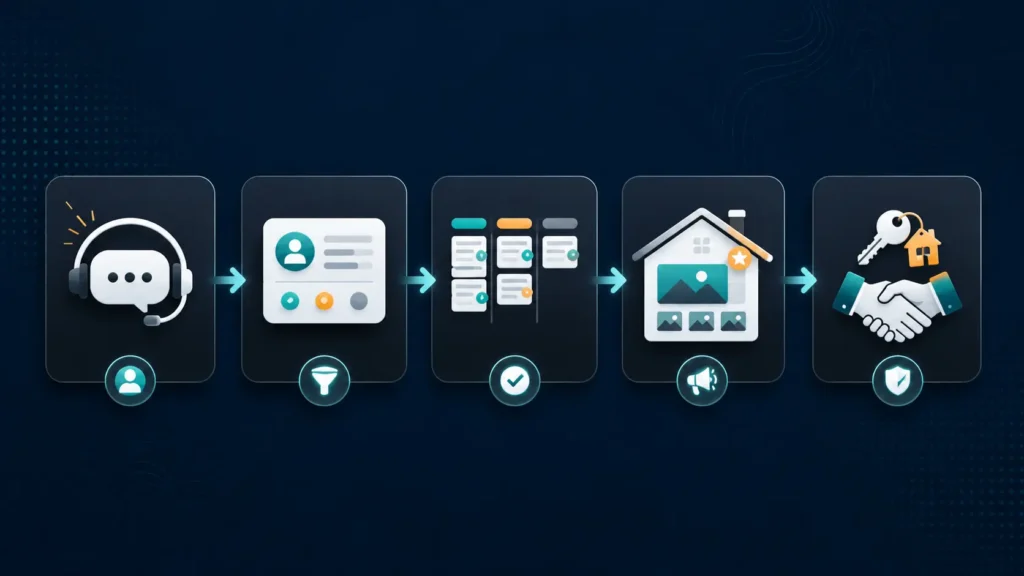
The agents getting meaningful results from AI are not necessarily using more tools. They are matching each tool to a specific stage in a working sales process.
This guide covers AI tools for real estate agent training and sales in 2026, organized by the real problem each tool solves:
- Practicing buyer and seller conversations before a live call
- Grading calls and improving objection handling
- Qualifying new leads quickly
- Keeping follow-up consistent inside a CRM
- Producing listing descriptions and visual marketing without wasting hours
Important: Results vary by market, lead quality, team process, and consistent use. Product-reported performance figures in this article are attributed to the companies that publish them; they are not guarantees.
The Real Estate AI Problem Most Agents Miss
Most real estate AI guides begin with a long list of software. That is useful only after you know what problem you are trying to solve.
A better question is: Where does your workflow break down today?
| If this is your bottleneck | Start with |
| You struggle with objections or appointment asks | AI role-play and call coaching |
| Leads sit too long before a response | AI lead qualification or a disciplined CRM workflow |
| Follow-up is inconsistent | CRM automation and daily task management |
| Listing content takes too long to create | ChatGPT or Claude plus a reusable prompt library |
| Marketing assets look inconsistent | Canva templates and a simple brand kit |
The goal is not to automate every part of a client relationship. It is to remove repetitive work and create more time for the work that still needs a human: local expertise, negotiation, trust, judgment, and service.
Part 1: AI Tools for Real Estate Agent Training

Training is the category most broad “best AI tools” lists underplay. Yet it is often the most valuable place to start.
New agents and experienced agents who have hit a plateau have a similar problem: they practice objection handling when a real commission is on the line. Traditional role-play with a manager or colleague can help, but it is often inconsistent, difficult to schedule, and too polite to simulate a skeptical prospect.
AI training tools make practice available on demand. The best ones simulate buyer and seller conversations, push back realistically, and give agents a consistent rubric for improving.
1. MaverickRE AI Sales Coach
Best for: Real estate teams and brokerages that want structured role-play, measurable coaching, and call-quality feedback.
What it does: MaverickRE’s AI Sales Coach lets agents practice calls with simulated prospects, then evaluates the session across metrics such as appointment asks, objection handling, questions asked, talk time, and follow-ups identified. MaverickRE also supports grading eligible production calls made through compatible Follow Up Boss workflows, creating a connection between practice and real performance.
MaverickRE says its AI Sales Coach includes more than 60 practice scenarios across buyer leads, seller leads, portal leads, sphere leads, and specific objections. The company reports that agents who complete around 30 coaching calls commonly improve appointment-setting performance; it also publishes conversion-lift figures from its customer base. Treat these as vendor-reported outcomes, not universal benchmarks.
Pricing: MaverickRE publicly advertises AI Sales Coach plans starting around $99 per month, while the total cost may vary by product package, team size, CRM setup, and coaching-call volume. Confirm live pricing and requirements before committing.
Strengths
- Purpose-built for real estate prospecting and objection handling
- Available 24/7 without needing a manager or colleague as a role-play partner
- Scores practice calls against a repeatable rubric
- Can support a feedback loop between role-play and eligible live-call grading
- Useful for teams that want a consistent coaching standard
Limitations
- Best value comes from regular practice, not occasional use
- Implementation may depend on Follow Up Boss calling and recording setup
- Vendor performance claims should be evaluated against your own lead mix and conversion baseline
Practical workflow: Make AI role-play a 15-minute weekly habit. New agents should complete several practice calls before receiving high-value live leads. Experienced agents should rehearse the exact objection that appeared in their most recent lost opportunity, then apply the feedback in the next week’s calls.
2. Awarathon Trinity AI Coach
Best for: Brokerages onboarding larger groups of agents who need a structured learning path and manager visibility.
What it does: Awarathon provides an AI-powered training environment built around interactive role-play. Its Trinity AI persona can simulate sales conversations and help representatives practice pitches, objections, and communication skills. For brokerages, the appeal is structured onboarding: managers can see progress across a cohort instead of relying solely on informal observation.
Pricing: Awarathon does not publish a simple self-serve real estate pricing page. Request a demo and get a quote based on team size, program scope, and implementation needs.
Strengths
- Designed for scalable training programs rather than one-off practice
- Interactive role-play format can make onboarding more consistent
- Useful when managers need visibility across a large new-agent cohort
- Supports a competency-based approach to training
Limitations
- It is a broader sales-training platform, not exclusively a real estate product
- Better suited to structured onboarding than to an individual agent looking for a lightweight tool
- Requires a manager-led rollout to achieve full value
Practical workflow: Use Awarathon during a new agent’s first 30 days. Define required scenarios—initial buyer consultation, listing lead follow-up, commission objection, and appointment ask—and set a minimum competency standard before assigning live leads without supervision.
3. Claude or ChatGPT: The Free Role-Play Alternative
Best for: Solo agents and small teams that want to practice objections before paying for a specialist sales-coaching platform.
What it does: Claude and ChatGPT can simulate buyer or seller conversations if you give them a specific scenario, desired level of resistance, and scoring criteria. They do not replace a real-estate-specific platform: they do not automatically grade live calls, integrate into a CRM, or provide standardized performance dashboards. But they are very useful for deliberate practice at little or no cost.
Pricing: Both products offer free tiers. Paid plans are commonly around $20 per month, but product limits and features change frequently.
Role-play Prompt Template
You are a skeptical homeowner who received a cold call from a real estate agent.

Context:
- You are not currently listed.
- You have spoken with two other agents this month.
- You care about commission and are unsure whether selling now is the right move.
- You are polite but resistant and will not agree to an appointment easily.

Your role:
- Stay in character.
- Raise realistic objections.
- Do not make the conversation easy.
- After the role-play ends, grade me from 1–10 on discovery questions, objection handling, value communication, and the appointment ask.
- Tell me the three exact sentences I could improve.
Practical workflow: Choose one objection each week. Run five role-play sessions, record or save your responses, and look for repeated weak points. Do not try to solve every skill at once; improve one stage of the conversation before moving to the next.
Part 2: AI Tools for Real Estate Sales by Workflow Stage
The most useful way to build a real estate AI stack is by workflow stage—not by a generic feature checklist.
Stage 1: Lead Capture and Qualification
The bottleneck: Leads lose value fast when nobody responds or when an agent spends time on conversations that are not yet qualified.

4. Structurely
Best for: Teams with dependable lead volume from portals, paid advertising, or website forms that need fast qualification and nurture at scale.
What it does: Structurely uses AI calling and texting to engage incoming leads, ask qualification questions, continue follow-up, and move qualified prospects toward an appointment or live transfer. Its purpose is to reduce the gap between a lead submitting a form and a meaningful first conversation.
Pricing: Structurely’s public site has advertised tiered plans including a Standard plan around $499 per month for a defined lead volume, with higher tiers for greater volume. Its current pricing structure may also use activity- or usage-based billing, so verify the live quote, usage terms, onboarding fees, and CRM integrations before purchase.
Strengths
- Immediate response can reduce the time between inquiry and engagement
- AI calling and texting support after-hours follow-up
- Useful for teams handling leads from several sources
- Can help agents receive a more complete lead summary before the first human conversation
Limitations
- Usually difficult to justify for a solo agent with low or inconsistent lead volume
- AI should qualify and nurture, not replace judgment on unusual client situations
- ROI depends heavily on lead source quality and the team’s ability to handle warm handoffs quickly
Practical workflow: Connect only the lead sources you can measure. Set up a clear handoff rule: when a prospect reaches a defined motivation, timeline, or budget threshold, the agent receives an alert and contacts the lead immediately. Review lead-to-appointment and appointment-to-close rates monthly; do not judge the tool by reply volume alone.
Stage 2: CRM, Follow-Up, and Accountability
The bottleneck: Many agents do not lose deals to a better competitor; they lose them to delayed responses and inconsistent follow-up.
5. Follow Up Boss
Best for: Solo agents and teams that need one place to organize leads from multiple sources, manage follow-up tasks, and improve accountability.
What it does: Follow Up Boss is a real-estate CRM that centralizes leads, action plans, communication history, routing, and team reporting. Its value is operational: it gives agents a clear next action and gives managers a way to see whether leads are being handled consistently. Depending on plan and setup, its product ecosystem also offers calling and AI-assisted features such as summaries, messages, and lead prioritization.
Pricing: Follow Up Boss Grow starts at $69 per user per month on monthly billing. Annual billing is advertised at an effective $58 per user per month. Follow Up Boss Calling is an additional $39 per user per month on monthly billing or $33 per user per month on annual billing. Pro is advertised at $499 per month, with details depending on the current plan structure. Always verify the official pricing page before making a decision.
Strengths
- Built specifically around real estate lead management
- Supports integrations with many lead sources and real-estate tools
- Helps turn follow-up into a visible daily process instead of a memory test
- Useful reporting for evaluating which lead sources actually produce closed business
Limitations
- Full value requires disciplined setup of action plans, sources, stages, and accountability
- Calling and certain AI capabilities can add meaningful cost
- A CRM does not solve weak sales conversations on its own
Practical workflow: Create a separate action plan for each major lead source. Portal leads, open-house leads, referrals, and past clients should not receive identical follow-up. Review your CRM every morning for overdue tasks and every month for source-to-close performance. If a source creates activity but few appointments, change the follow-up sequence or stop buying that source.
Stage 3: Listing Descriptions and Content Production
The bottleneck: Writing listing descriptions, captions, email campaigns, and market updates can consume time that agents should spend in conversations and appointments.
6. Claude or ChatGPT for Listing Descriptions
Best for: Every agent who writes listing copy, follow-up emails, market-update outlines, or social captions.
What it does: Claude and ChatGPT can create a structured first draft from property details, target-buyer context, and an approved brand voice. The best result is not an unedited AI paragraph. It is a faster draft that the agent improves with true local insight.
Pricing: Free tiers are enough for many agents. Paid plans can be useful during high-volume listing periods or when you need larger context, saved projects, or more frequent use.
Copy-and-Paste MLS Listing Prompt
Write a 200-word MLS listing description for a [property type] in [city/neighborhood].

Property details:
- [specific features: layout, finishes, outdoor space, upgrades]
- [location advantages]
- [any verified school, transit, park, or lifestyle details]

Target buyer: [first-time buyer / growing family / downsizer / investor].
Tone: [warm and inviting / aspirational / practical and precise].

Rules:
- Do not use “stunning,” “breathtaking,” “must-see,” or unsupported superlatives.
- Do not invent features or neighborhood facts.
- Make the description specific rather than generic.
- End with one accurate sentence about the strongest location advantage.
Practical workflow: Create three saved templates for the property types you handle most often. Then spend five to eight minutes adding the local details an AI cannot know: the feel of the block, a verified nearby amenity, a relevant buyer benefit, or a detail noticed during the showing. That human layer makes the copy useful and trustworthy.
7. Canva AI for Visual Marketing
Best for: Agents producing listing graphics, open-house promotions, market updates, and social assets without a dedicated designer.
What it does: Canva combines templates, a brand kit, image editing, and AI-assisted design features. It is not a replacement for professional photography on a premium listing, but it can reduce the time needed to create everyday marketing assets.
Pricing: Canva offers a usable free plan. Canva Pro pricing varies by region and billing cycle; verify the current plan for full brand-kit and AI-feature access.
Strengths
- Excellent for branded templates, carousels, open-house graphics, and social posts
- Free tier is useful for a new or solo agent
- A brand kit can make every asset more consistent
- Templates reduce blank-page and blank-canvas time
Limitations
- Do not use generic templates unchanged if you want distinct branding
- Not a substitute for high-quality listing photography, accurate floor plans, or professional staging when those are warranted
- AI-generated images should never misrepresent a property
Practical workflow: Build a brand kit once: colors, logo, fonts, headshot, and approved layout styles. Create repeatable templates for a new listing, price update, open house, sold property, local market update, and testimonial. Every new asset should start from a template, not from a blank canvas.
The AI Stack That Actually Works
The right stack depends on the size of your business and, more importantly, on your current bottleneck.
Configuration A: Solo Agent Starting Lean
| Workflow stage | Tool | Typical monthly cost |
| Training and practice | Claude or ChatGPT role-play | $0–$20 |
| Lead tracking | Spreadsheet, calendar, or existing CRM | $0–variable |
| Listing content | Claude or ChatGPT | $0–$20 |
| Visual marketing | Canva Free | $0 |
| Estimated total | $0–$40 |
Honest recommendation: A solo agent should not rush into expensive lead-qualification software. Begin with a repeatable objection-practice routine and a simple lead-follow-up system. Your first investment should address the exact stage where deals currently fail.
Configuration B: Active Solo Agent or Small Team
| Workflow stage | Tool | Typical monthly cost |
| Training and practice | MaverickRE AI Sales Coach or Claude/ChatGPT practice | $0–$99+/month | Variable |
| CRM and follow-up | Follow Up Boss Grow | $69/user monthly, or $58/user equivalent annually |
| Calling, if needed | Follow Up Boss Calling | +$39/user monthly, or +$33/user equivalent annually |
| Listing and content | Claude/ChatGPT + Canva | $0–$30/month |
| Estimated total | Depends on seats, calling, and training plan |
Honest recommendation: Follow Up Boss is worth considering only when you have enough lead activity to benefit from centralization, tasks, automation, and source tracking. If you receive only a handful of leads each month, improve the process before buying more software.
Configuration C: Growing Team or Brokerage
| Workflow stage | Tool | Why it belongs in the stack |
| New-agent onboarding | Awarathon or internal AI role-play program | Standardizes early training |
| Ongoing sales coaching | MaverickRE AI Sales Coach | Creates a practice-to-performance feedback loop |
| Lead qualification | Structurely | Supports immediate engagement at meaningful lead volume |
| CRM and accountability | Follow Up Boss or an equivalent real estate CRM | Keeps sources, tasks, and outcomes visible |
| Listing and marketing | Claude/ChatGPT + Canva | Speeds up repeatable content production |
Honest recommendation: At brokerage scale, training can have the largest compounding return because even a modest improvement in appointment-setting or follow-up discipline affects every agent. But do the math before buying: estimate your average commission, conversion baseline, lead volume, and the number of extra closed transactions needed to pay for the stack.
AI Tools Compared
| Tool | Category | Free tier | Best for | Main limitation |
| MaverickRE AI Sales Coach | Training and call coaching | No clear free tier | Teams improving prospecting skill and appointment-setting | Requires consistent use and compatible workflow setup |
| Awarathon | Training and onboarding | No public free tier | Brokerages onboarding cohorts | Broader sales tool, less real-estate-specific |
| Claude / ChatGPT | Role-play, listing copy, content | Yes | Solo agents and low-cost practice | Requires strong prompts and human review |
| Structurely | AI lead qualification and nurture | No public free tier | Teams with reliable lead volume | Higher cost and ROI dependence on lead flow |
| Follow Up Boss | CRM and follow-up | Trial, not a free plan | Agents and teams needing accountability | Costs rise with calling, seats, and add-ons |
| Canva | Visual marketing | Yes | Listing graphics and repeatable brand assets | Not a substitute for professional creative work on premium listings |
A Simple 30-Day AI Training and Sales Plan
Week 1: Identify one bottleneck
Choose only one:
- Objection handling
- Appointment asks
- Speed to lead
- Follow-up consistency
- Listing-content production
Measure your starting point. For example: appointment set rate, average time to first response, number of overdue CRM tasks, or time spent writing a listing.
Week 2: Build the routine
- Run five AI role-play conversations around one objection
- Create one saved listing-description prompt
- Set a daily CRM review block
- Create two Canva templates for your most common marketing needs
Week 3: Apply it to real work
- Use the improved conversation framework on live calls
- Review the calls or outcomes with a manager, coach, or your own notes
- Use the prompt template on the next listing
- Track whether follow-up tasks are completed on time
Week 4: Review the evidence
Ask:
- Did appointment asks improve?
- Did first-response time improve?
- Did I complete more follow-up tasks?
- Did marketing production take less time?
- What specific workflow should I improve next?
Only add another tool after the first tool has become part of your weekly operating rhythm.
Frequently Asked Questions
What is the best AI tool for real estate agent training?
For teams that want dedicated, real-estate-focused role-play and call-coaching workflows, MaverickRE is a strong option to evaluate. For solo agents, Claude or ChatGPT can be an effective, low-cost way to practice objections and appointment asks before committing to specialist software.
Can AI tools actually increase real estate sales?
They can improve the inputs that influence sales: faster lead response, more consistent follow-up, stronger objection handling, better preparation, and faster content production. They do not guarantee revenue. Results come from using the tool consistently, measuring the relevant metric, and applying the learning to live client conversations.
What is the best free AI tool for a new real estate agent?
Claude or ChatGPT is the best starting point for most new agents because it can support role-play, scripts, listing descriptions, email drafts, and market-update outlines without a major initial investment. Start with one use case and a saved prompt library rather than trying every feature at once.
Is Structurely worth it for a solo agent?
Usually only if the agent receives enough leads to justify the cost and can respond quickly when the AI identifies a qualified prospect. For low lead volume, a disciplined manual follow-up workflow and a lower-cost CRM are often a better first investment.
Does Follow Up Boss include AI features?
Follow Up Boss offers AI-assisted features and calling-related capabilities that vary by plan and setup. Check the official plan details before subscribing, especially if you need calling, summaries, smart messaging, or predictive prioritization.
Will AI replace real estate agents?
AI can automate or accelerate repetitive tasks, but it does not replace local knowledge, negotiation judgment, fiduciary responsibility, client trust, or the human work of guiding people through a major financial decision. The practical advantage goes to agents who use AI to spend more time on those high-value responsibilities.
The Bottom Line
The best AI tools for real estate agent training and sales in 2026 are not a shopping list. They are a workflow.
If your conversations are weak, start with role-play and coaching. If leads are going cold, fix speed to lead and follow-up. If content work is taking hours, build a prompt library and branded templates. Do not pay for a large stack until you know which bottleneck is actually limiting your income.
Start with one problem. Use one tool consistently for 30 days. Measure what changed. Then add the next layer.
That is how AI becomes a real estate operating advantage instead of another unused subscription.
Official Sources and Pricing
- Follow Up Boss pricing — pricing and calling add-on details should be checked immediately before publication.
- Follow Up Boss plan breakdown
- Structurely pricing — usage and package details may change.
- Structurely AI calling, texting, and appointment setting
- MaverickRE AI Sales Coach
- MaverickRE AI call grading
- MaverickRE published coaching and performance claims
- Awarathon AI-powered sales training