
An Honest Production Comparison — By Adrian Cole | aireviewcore.com
Published: July 2026 | Data verified from official pricing pages and independent benchmark results
The Google Veo 3.1 vs Runway Gen-4.5 question is the most important AI video decision creators are making right now.
OpenAI discontinued Sora’s consumer product in April 2026. That single event sent most professional creators and production teams searching for alternatives — and the two names that keep coming up are Google Veo 3.1 and Runway Gen-4.5.
These are not casual comparisons between two similar tools. <cite index=”20-1″>Veo 3.1 and Runway Gen-4.5 are both high-end AI video systems, but they are not optimized for the same workflow.</cite> Choosing the wrong one for your production context wastes money, time, and creative energy. Choosing the right one changes what you can produce and how fast you can produce it.
This guide cuts through the launch noise and gives you the honest production comparison: what each tool does best, what each one costs at realistic usage levels, and which one belongs in your workflow.
What Changed in AI Video in 2026 — The Context You Need
Three shifts define the AI video landscape in mid-2026.
First, <cite index=”22-1″>Sora remains an important benchmark, but it should no longer be treated as a current buyer recommendation because OpenAI has discontinued the Sora web and app experience and is winding down the API.</cite> Any workflow built on Sora needs a migration plan before September 24, 2026 — the API shutdown date.
Second, <cite index=”23-1″>Google’s Veo 3.1 became the first model to generate synchronized speech audio alongside visuals. Previous models generated ambient sound effects. Veo 3.1 creates characters that actually speak with lip-synced audio.</cite> This is not a marginal improvement — it eliminates an entire post-production step for character-driven content.
Third, <cite index=”23-1″>Runway’s Gen-4.5 model holds the number one position on the Video Arena leaderboard in early 2026, scoring highest on human preference evaluations across motion quality, instruction adherence, and visual detail.</cite> Runway also made a strategic move no competitor has matched: integrating Veo 3.1 directly into its platform alongside its own Gen-4.5 model, giving subscribers access to both from a single interface.
These three shifts define the Google Veo 3.1 vs Runway Gen-4.5 comparison in a way that was not true six months ago.
Google Veo 3.1 — Best for Native Audio and Complete Scene Generation
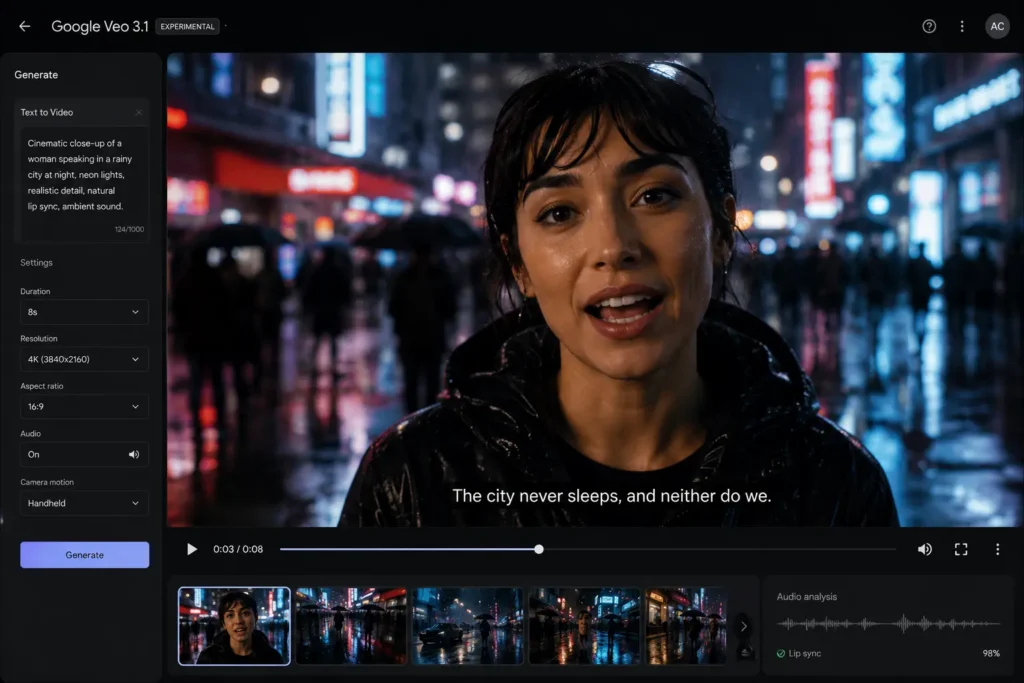
Veo 3.1 is Google’s flagship text-to-video model, accessible through Google AI Studio, Vertex AI for developers, and the Google AI Ultra subscription for consumers. It generates native 4K video with synchronized dialogue, ambient sound, and music as part of a single generation — not as a separate audio pass.
Most AI video tools generate visuals first and add audio separately. This creates a synchronization challenge: even when audio is good, it rarely feels native to the footage. <cite index=”24-1″>Veo 3.1 ships native 4K with synchronized audio.</cite> A character speaking in a scene produces natural lip-sync, correct reverb for the environment, and audio that feels like it was recorded on the same set as the visuals — because it was generated as part of the same process.
For short-form ads, product demos, and character-driven narrative content, this eliminates a production step that previously required either significant post-production work or a separate AI audio tool. In a 2026 production environment where speed is a competitive advantage, removing that step has real economic value.
<cite index=”20-1″>Veo 3.1 is strongest when the prompt describes a complete audiovisual scene: subject, action, environment, camera movement, dialogue, ambience, and sound effects.</cite> For creators who can write a complete scene description in a single prompt and want a finished, audio-complete clip as the output, Veo 3.1 is the most direct path from idea to usable video.
Prompt adherence is consistently rated as one of Veo 3.1’s strongest characteristics across independent testing. When you describe a specific shot, Veo 3.1 delivers it with less interpretation and less deviation from the intended composition than most competing models.
<cite index=”20-1″>Runway Gen-4.5 wins when the desired output is a visually controlled production asset inside a broader creative workflow.</cite> Veo 3.1 is excellent at generating a complete scene from a description. It is less suited to the iterative revision workflow that professional production teams require — where a clip goes through multiple rounds of refinement before it is approved.
Access is the other practical limitation. <cite index=”23-1″>Consumer access is included in Google AI Ultra subscription at $99.99 per month standard tier.</cite> For individual creators who want access without the Ultra tier cost, API pricing starts at <cite index=”23-1″>$0.03 per second for Veo 3.1 Lite at 720p without audio, up to $0.15 per second for full Veo 3.1 fast mode with synchronized audio.</cite> The full-capability tier carries a cost that adds up quickly at production volume.
Use Veo 3.1 for scenes where audio is part of the deliverable from day one. Write prompts that describe the complete audiovisual experience rather than just the visual component — include the dialogue, the ambient sound, the tone of the environment. Veo 3.1’s audio generation responds to specific sound descriptions with the same fidelity that its visual generation responds to visual descriptions. Generic prompts produce generic audio. Specific audiovisual descriptions produce the synchronized output the model is capable of.
For API users, <cite index=”25-1″>start with Veo 3.1 Fast for cost efficiency, and test against standard mode on quality-critical outputs before committing to standard mode for volume production.</cite> The quality difference between fast and standard is visible at the detail level but not always significant enough to justify the cost difference for every clip.
| Best for | Audio-complete scene generation, character dialogue, cinematic one-shot clips |
| Consumer access | Google AI Ultra $99.99/month |
| API pricing | $0.03/sec (Lite 720p) to $0.15/sec (Fast 4K with audio) |
| Native audio | Yes — synchronized dialogue and ambience |
| Maximum resolution | Native 4K |
| Prompt adherence | Excellent |
Expert Verdict: Veo 3.1 is the right tool when native synchronized audio is part of the deliverable and when a complete scene needs to be generated from a single prompt. <cite index=”20-1″>For creators who want an 8-second clip that already feels like a finished moment, Veo 3.1 is the more direct tool.</cite>
Runway Gen-4.5 — Best for Professional Production Workflows and Creative Control
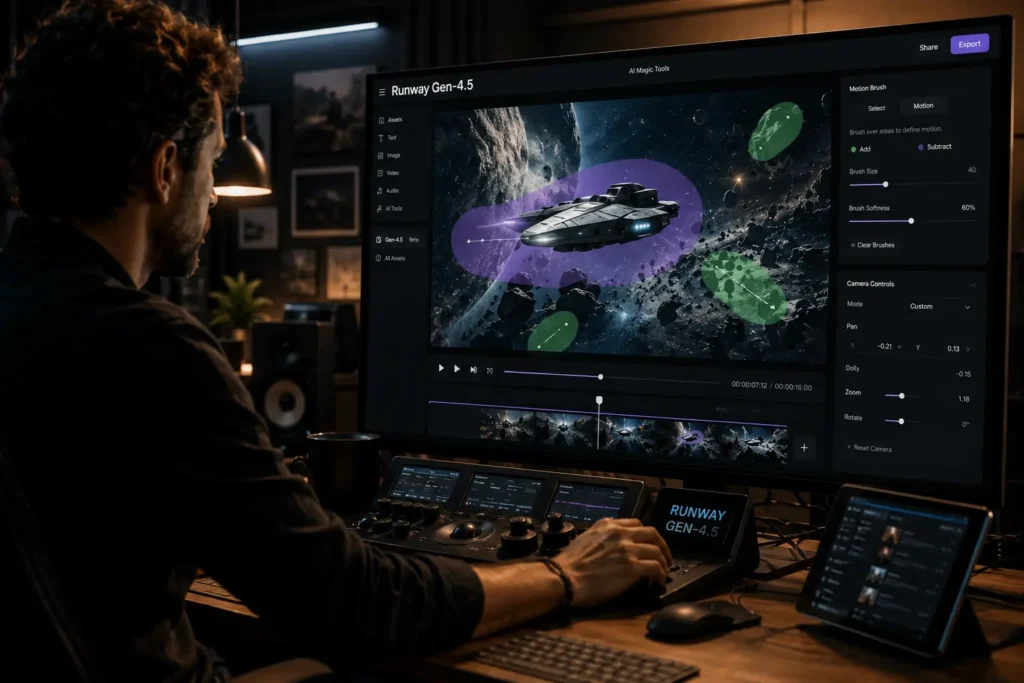
Runway Gen-4.5 is the most widely used professional AI video platform in 2026. It is not just a video generation model — it is a complete creative production environment that includes motion brushes, camera control tools, a built-in video editor, and since early 2026, access to both its own Gen-4.5 model and Google’s Veo 3.1 from the same interface.
<cite index=”21-1″>For most working creators, Runway Gen-4.5 is the better daily driver. It currently sits at the top of the Artificial Analysis text-to-video benchmark, and it produces longer clips than Veo.</cite>
The control surface is what separates Runway from every competing tool in this comparison. Motion brushes let you paint which parts of a frame should move and how — specifying that background elements stay static while a subject’s hair moves, or that a product rotates while the set around it holds still. This level of granular control over the motion layer is simply not available in Veo 3.1 or any other consumer-tier video generation tool.
Camera control vocabulary uses actual cinematography language. You do not describe movement in general terms — you specify the camera movement type, trajectory, speed, and focal behavior using the same vocabulary a director would use on a professional set. For production teams where the creative direction must be precise rather than AI-interpreted, this control surface is the structural reason Runway remains the professional default.
<cite index=”26-1″>Runway has integrated Google’s Veo 3 and Veo 3.1 directly into their platform alongside their own models.</cite> This means Runway Pro subscribers can access both Gen-4.5 and Veo 3.1 from a single interface, choosing the right model for each specific clip rather than managing two separate platform subscriptions and workflows.
For production teams that need audio-complete scenes for some clips and fine-grained visual control for others, this model flexibility makes Runway the more practical production infrastructure than either tool used in isolation.
<cite index=”22-1″>Runway is better if you care most about editing flexibility, creative workflow, and repeatable production.</cite> If your primary need is native synchronized audio on a specific clip, Veo 3.1 accessed directly produces audio output with more fidelity than Veo 3.1 accessed through Runway’s interface — the model is the same, but the native platform gives you more direct control over the audio parameters.
The credit-based subscription model creates cost unpredictability for teams running variable production volume. A month with high clip generation consumes credits faster than planned. Teams that need predictable monthly costs and run consistent production volume will find the unlimited tier worth evaluating.
<cite index=”20-1″>Runway Gen-4.5 is strongest when the video is part of a broader creative pipeline.</cite> Use motion brushes for every generation rather than relying on text prompts alone for motion specification. The visual painting interface takes 30 seconds to configure and consistently produces more precise results than equivalent text descriptions. Start by masking the areas you want to remain static, then paint the motion direction and intensity on the elements you want to move.
Use Runway as your production hub rather than a single-model tool. Route audio-complete scene generation through Veo 3.1 within Runway. Route clips requiring precise visual control through Gen-4.5. Using the model routing capability from a single interface is the workflow that most experienced production teams have settled on in 2026.
| Best for | Professional production pipelines, precise creative control, repeatable branded content |
| Free plan | 125 one-time credits |
| Paid plans | Standard $15/month · Pro $28/month · Unlimited $76/month |
| API pricing | ~$0.20/second |
| Native audio | No — via Veo 3.1 integration |
| Control features | Motion brushes, camera control vocabulary, built-in editor |
| Model access | Gen-4.5 + Veo 3.1 on paid plans |
Expert Verdict: <cite index=”22-1″>Runway Gen-4.5 is the safest production pick for teams that need editing control as much as raw model quality.</cite> Its control surface, production workflow tools, and multi-model access make it the strongest production infrastructure for AI video at professional volume in 2026.
The Direct Comparison
| Google Veo 3.1 | Runway Gen-4.5 | |
|---|---|---|
| Best for | Audio-complete scene generation | Production control and iteration |
| Native audio | Yes — synchronized dialogue | Via Veo 3.1 integration |
| Camera control | Good | Excellent — motion brushes + vocabulary |
| Longest clip | 8 seconds standard | Longer clips available |
| Resolution | Native 4K | High resolution |
| Consumer pricing | $99.99/month (Ultra) | From $15/month |
| API pricing | $0.03–0.15/second | ~$0.20/second |
| Model flexibility | Single model | Gen-4.5 + Veo 3.1 |
| Benchmark position | Strong prompt adherence | #1 Video Arena leaderboard |
| Best use case | Solo creators, audio-first content | Teams, agencies, branded production |
Which Tool Should You Choose?
The Google Veo 3.1 vs Runway Gen-4.5 decision comes down to two questions.
Does your content require native synchronized audio as part of the generation? If yes, Veo 3.1 is the starting point. Its audio generation is genuinely unique in the market, and no other tool produces dialogue and ambience with the same native synchronization. Access it directly through Google AI Studio for individual use, or through Runway if you need both audio-complete generation and production control tools from a single interface.
Does your workflow involve iterative revision, precise creative direction, and production at consistent volume? If yes, Runway Gen-4.5 is the right infrastructure. The motion brush control, camera vocabulary, and multi-model flexibility make it the platform that reduces total production time across a sustained creative pipeline rather than per-clip generation time.
<cite index=”25-1″>For most production use cases, the honest answer is: start with Veo 3.1 Fast for cost efficiency on audio-first content, and test Runway Gen-4.5 for quality-critical outputs that require revision and creative control.</cite>
If you can use both — and Runway’s Pro plan gives you access to both Gen-4.5 and Veo 3.1 — the optimal workflow is Veo 3.1 for audio-complete scene generation and Runway Gen-4.5 for visually controlled production assets. These tools are not competitors competing for the same workflow. They are complementary tools solving different production problems.
Frequently Asked Questions
Is Google Veo 3.1 better than Runway Gen-4.5? Neither tool is universally better. <cite index=”20-1″>If you are a solo creator making social videos, ads, educational clips, or narrative tests with sound, start with Veo 3.1. If you are a filmmaker, agency, or brand team building a repeatable AI video pipeline, test Runway Gen-4.5 seriously.</cite> The right answer depends on your production workflow.
Can I access Veo 3.1 without the Google AI Ultra subscription? Yes. Veo 3.1 is accessible via API through Google AI Studio and Vertex AI, with pricing starting at $0.03 per second for the Lite 720p tier. The Ultra subscription at $99.99 per month provides consumer access without API configuration.
Does Runway Gen-4.5 have native audio like Veo 3.1? Runway Gen-4.5 does not generate native synchronized audio. However, Runway’s platform integrates Veo 3.1, which does — so Runway Pro subscribers can access Veo 3.1’s audio generation from within the Runway interface.
What happened to Sora and why is it not in this comparison? OpenAI discontinued the Sora consumer product in April 2026. The Sora API is scheduled for shutdown on September 24, 2026. Any workflow currently built on Sora requires migration. Veo 3.1 and Runway Gen-4.5 are the two primary alternatives.
How much does it cost to produce a 30-second video with each tool? At API rates, a 30-second clip costs approximately $4.50 with Veo 3.1 Fast mode ($0.15/sec × 30) and approximately $6.00 with Runway Gen-4.5 (~$0.20/sec × 30). Subscription users pay the monthly fee rather than per-second costs, making the per-clip cost dependent on total monthly volume.
The Bottom Line
The Google Veo 3.1 vs Runway Gen-4.5 comparison does not have a single winner because these tools are not trying to win the same race. Veo 3.1 is the strongest tool when native audio is the primary requirement. Runway Gen-4.5 is the strongest production infrastructure when creative control and revision cycles are the primary requirement.
For most professional creators and production teams in 2026, the practical answer is to use both — either by subscribing to Runway Pro for access to Gen-4.5 and Veo 3.1 from a single interface, or by maintaining separate access for different content categories. The total path from idea to usable video is shorter when you match the tool to the task rather than forcing every task through a single tool.
For a breakdown of how Veo 3.1 compares to Kling AI 3.0 and Seedance 2.0 for image-to-video specifically, see our guide on the best AI image to video tools in 2026.
All pricing data verified from official platform pages as of July 2026. Benchmark data sourced from Artificial Analysis Video Arena and independent testing published by Context Rankings and DIY AI.
Adrian Cole is a technology reviewer at aireviewcore.com covering AI video tools, model comparisons, and practical production guides.
© 2026 aireviewcore.com — All rights reserved.