
Real Strategies, Best Platforms, Risk Management & The Mistakes That Wipe Out Most Beginners — By Adrian Cole | aireviewcore.com
Table of Contents
The Uncomfortable Truth About AI Trading 2026 Nobody Tells You Upfront
AI trading 2026 has fundamentally changed how individual traders compete in financial markets.Imagine spending months building a trading bot, watching it slowly turn profitable — and then realizing that neither you nor the bot fully understands why it works. That is not a hypothetical. That is the lived reality of thousands of retail traders who entered AI trading in 2026 without a clear framework for what they were actually building.
AI-powered trading is no longer a privilege reserved for hedge funds like Renaissance Technologies or billion-dollar Wall Street firms. Individual traders are now using machine learning models, sentiment analysis tools, and automated bots to compete in markets that once seemed structurally inaccessible. But the truth that most guides skip is this: AI is a power multiplier, not a magic wand. It amplifies the skill of a disciplined trader — and amplifies the losses of a reckless one with equal efficiency.
This guide gives you everything you need to approach AI trading in 2026 with intellectual honesty: how it actually works under the hood, the best platforms available right now, real strategies that traders are actively deploying, what hardware you actually need, and — most critically — how to protect yourself from the mistakes that eliminate most beginners before they have a chance to learn.
AI Trading vs Algorithmic Trading — The Distinction That Changes Everything
Most people use these terms interchangeably. They represent two fundamentally different philosophies, and conflating them leads to serious misunderstandings about what AI trading in 2026 actually involves.
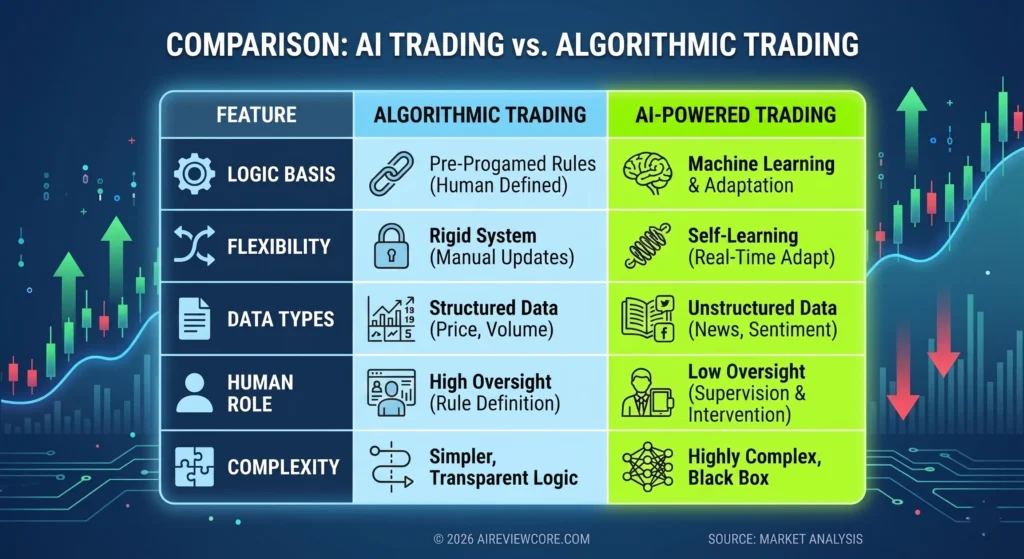
Algorithmic trading executes trades based on pre-programmed rules written by a human. If the 50-day EMA crosses above the 200-day EMA, buy. If RSI exceeds 70, sell. The logic is transparent, predictable, and entirely human-defined. You always know exactly why a trade was made.
AI trading is a self-learning system. It does not follow rules you wrote — it discovers its own rules by analyzing massive datasets. It processes unstructured information like news articles, earnings call transcripts, and social media sentiment. And critically, it adapts in real time to changing market conditions without requiring manual reprogramming.
| Feature | Algorithmic Trading | AI Trading |
|---|---|---|
| Logic basis | Human-written if/then rules | Pattern inference from data |
| Flexibility | Rigid — requires manual updates | Self-adapting to new data |
| Human involvement | High — human sets all parameters | Low — system leads, human supervises |
| Data types handled | Structured price/volume data | Unstructured: news, sentiment, audio |
| Execution speed | High (milliseconds) | Very high + predictive capability |
The key shift is from automation to autonomy. Traditional algorithms contribute roughly 80% of trade execution mechanics — but AI systems take over nearly the entire decision-making pipeline, including real-time strategy adjustment with minimal human intervention.
That said, AI is not infallible. In unprecedented market events — geopolitical shocks, pandemics, sudden regulatory changes — AI systems have no historical precedent to learn from. This makes human oversight not just useful, but strategically essential for any serious AI trading operation in 2026.
How AI Trading 2026 Actually Works :The Technology Behind the Bot
Understanding the engine beneath AI trading helps you make smarter decisions about which tools to trust and how to evaluate their outputs.
Machine Learning: The Three Core Approaches
Supervised Learning trains models on labeled historical data to predict future price movements. The model learns correlations between specific inputs — volume spikes, moving average crossovers, earnings surprises — and price outcomes. It is the most commonly used approach in retail AI trading tools available in 2026.
Unsupervised Learning finds hidden patterns in market data without predefined labels. It is particularly useful for clustering assets with similar behavioral profiles — helping traders build portfolios that are genuinely diversified rather than ones that look diversified on paper but crash together in a market shock.
Reinforcement Learning is the most sophisticated approach. An autonomous agent learns to trade by trial and error inside a simulated market environment, being rewarded for profitable decisions and penalized for losses across thousands of simulation runs. It is how the most advanced institutional systems develop strategies that no human explicitly designed.
Deep Learning and Neural Networks in AI Trading
Advanced AI trading systems use deep learning architectures — particularly LSTM and RNN — to forecast time-series data. These models excel at recognizing long-range dependencies in price sequences, understanding that what happened three months ago may be directly relevant to what happens tomorrow.
| Model | Trading Application | Performance Edge |
|---|---|---|
| RNN / LSTM | Price trend forecasting | Outperforms classical statistical models |
| Random Forest | Buy/sell signal classification | Handles large variable sets accurately |
| Transformers | Financial text analysis | State-of-the-art NLP understanding |
| GANs | Market scenario simulation | Effective for tail-risk estimation |
Natural Language Processing — Reading the Market’s Mind
Perhaps the most powerful competitive advantage AI trading offers retail traders in 2026 is NLP — the ability to process unstructured information at machine speed. Systems powered by FinBERT can scan thousands of news articles, SEC filings, earnings call transcripts, and social media posts simultaneously, converting sentiment signals into quantitative trading inputs.
By the time a human analyst reads a single earnings report, an NLP-powered system has already processed it, scored its sentiment, cross-referenced it against historical reactions to similar language, and generated a trade signal. This is not a marginal speed advantage — it is a structural one that defines the competitive landscape of AI trading in 2026.
4 Real AI Trading Strategies Traders Are Actively Using in 2026
Theory is useful. Real-world application is better. Here are four strategies that traders have successfully deployed — with the expert workflow for each.
Strategy 1: The Momentum Scalper Bot
One of the most replicated approaches in AI trading combines multiple technical indicators into a single AI-driven entry system: EMA stack + VWAP crossover + MACD histogram cross + RSI + ADX + volume surge + Bollinger Squeeze breakout. The AI component is not replacing technical analysis — it is synthesizing these signals simultaneously and filtering out low-probability setups faster than any human could manage manually.
Expert Workflow:
- Configure your indicator stack with the AI system and run a minimum 90-day backtest on out-of-sample data before live deployment
- Set ADX threshold at 25+ to confirm trend strength before any entry signal is acted on
- Use volume surge as the final confirmation filter — no entry without volume confirmation
- Paper trade the system for at least 30 days before committing real capital
Strategy 2: The Earnings IV Crush Strategy
Some traders use AI to identify overpriced options in the days before earnings announcements, then execute a short straddle position to profit from the implied volatility collapse that follows the announcement. One documented approach using this method achieved returns of 84.74% — not because the AI predicted the earnings outcome, but because it systematically identified when options were statistically overpriced relative to historical volatility patterns.
Expert Workflow:
- Use your AI system to scan for stocks where current IV rank exceeds 70 in the week before earnings
- Cross-reference with historical IV crush data to identify stocks with consistent post-earnings volatility compression
- Size positions at no more than 3% of portfolio per earnings play given the binary risk profile
- Always define maximum loss at entry — never hold a short straddle through an unexpected earnings gap
Strategy 3: The Insider Trading Tracker
AI tools like Xynth monitor SEC Form 4 filings in real time to identify clustered, non-routine insider purchases in small-cap stocks — particularly large positional entries by company executives buying common stock. The thesis is straightforward: when multiple insiders buy simultaneously without it being a scheduled compensation event, it often precedes significant price movement.
Expert Workflow:
- Filter for purchases above $100,000 by executives (CEO, CFO, COO) to exclude token compensation purchases
- Require minimum two insiders buying within the same 30-day window before treating the signal as actionable
- Cross-reference against any upcoming earnings or scheduled events that might explain the buying
- Set a 90-day holding window as your baseline timeframe — insider signals operate on longer timescales than technical setups
Strategy 4: The Adaptive Entry Bot
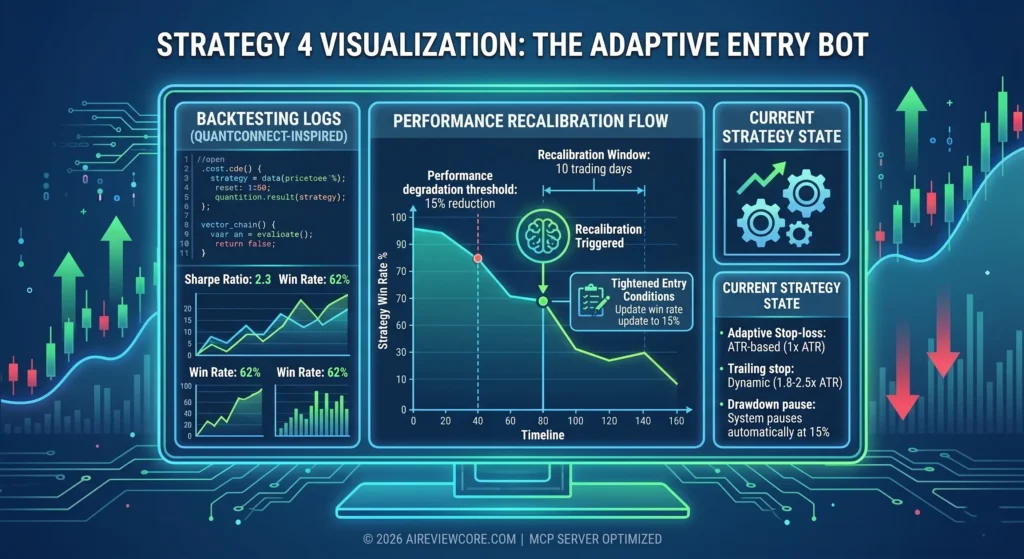
Rather than using fixed entry thresholds, this approach deploys AI to continuously recalibrate entry criteria based on rolling win rates. If the bot’s performance degrades over a two-week window, it automatically tightens its entry conditions. This self-correction mechanism addresses one of the most fundamental weaknesses of static algorithmic systems — their inability to adapt when market dynamics shift.
Expert Workflow:
- Set your performance evaluation window at 10 trading days — short enough to catch regime changes, long enough to avoid noise-driven recalibration
- Define the performance degradation threshold that triggers recalibration — a 15% reduction in win rate is a reasonable starting point
- Log every recalibration event with the market conditions that triggered it — this data becomes your most valuable training resource over time
- Build a manual override into the system — never allow the bot to recalibrate without your review during high-volatility market periods
Best AI Trading Platforms in 2026: The Honest Breakdown
The platform ecosystem has matured significantly. Here are the tools worth serious attention for AI trading in 2026:
| Platform | AI Engine | Best For | Key Feature |
|---|---|---|---|
| Trade Ideas | Holly AI | Day traders | 70+ algorithms, top 5-8 daily setups |
| TrendSpider | Sidekick AI | Technical analysts | Automated trendline drawing, multi-timeframe scanning |
| Tickeron | Financial Learning Models | Individual investors | Probabilistic predictions, smart portfolio builder |
| QuantConnect | MCP Server | Quant developers | Institutional-grade infrastructure, multi-language support |
| Capitalise. ai | NLP Engine | Automation beginners | Plain-English commands to executable strategies |
| Alpaca API | — | Paper trading | Free API, ideal for risk-free strategy testing |
| Tradepal.co | Predictive models | Options traders | Price target probabilities for options positioning |
The beginner’s recommended path for AI trading in 2026: Start with Alpaca’s paper trading environment. It mirrors real market conditions without real capital at risk. Once your strategy shows consistent results across at least three months of simulated trading, then consider live deployment.
What Hardware Do You Actually Need for AI Trading in 2026?
This is one of the most misunderstood questions in the retail AI trading community. The honest answer: far less than most guides suggest.
The hardware requirement depends entirely on what you are asking the AI to do:
| Use Case | Required Hardware | Beginner-Friendly? |
|---|---|---|
| Sentiment analysis using pre-trained models | Modern CPU or mid-range GPU (RTX 3060Ti) | ✅ Yes |
| Training your own custom language model | High-end GPU: RTX 3090, A6000, or A100 | ❌ Not necessary for most |
| Real-time news processing | Smart architecture with async queues and cache | ⚠️ Needs development knowledge |
For most retail traders — especially those learning and experimenting with AI trading in 2026 — a Ryzen or i7 CPU with 16 to 32GB of RAM is entirely sufficient. A mid-range GPU is helpful but not a prerequisite.
The more important insight: it is not about raw computing power. It is about understanding your pipeline. Working with libraries like backtrader, vectorbt, or freqtrade will teach you more about how AI trading actually behaves than training any massive neural network. Focus on understanding when the bot enters, why it exits, and how it measures risk. Every change you make to the code, and every resulting change in bot behavior, is a lesson more valuable than any hardware upgrade.
Risk Management for AI Trading in 2026: The System That Separates Professionals from Gamblers
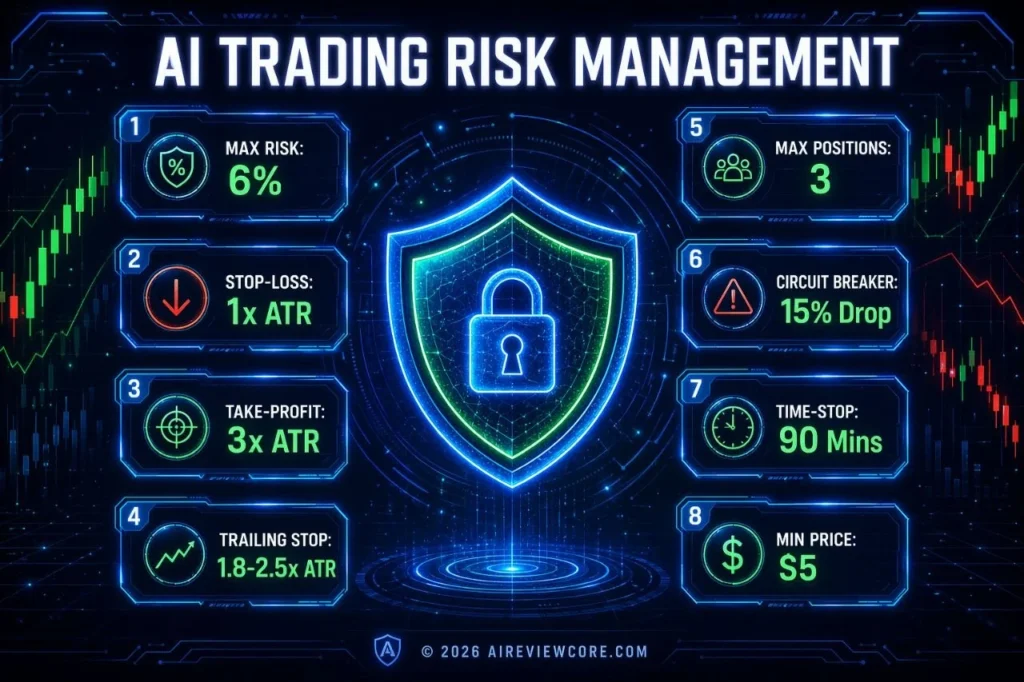
The single biggest reason AI trading bots blow up accounts is not bad AI. It is the absence of a disciplined risk management framework. Here is a professional-grade system you can adapt immediately:
- Portfolio risk per trade: Maximum 6% of total capital
- Stop-loss: ATR-based (1× ATR), adapting to current market volatility
- Trailing stop: Dynamic, between 1.8 and 2.5× ATR depending on volatility regime
- Take-profit target: 3× ATR
- Maximum concurrent positions: 3 open positions at any time
- Drawdown circuit breaker: System pauses automatically at 15% portfolio drawdown
- Time-stop: Any position open for 90 minutes without movement is automatically closed
- Price filter: Minimum $5 stock price to avoid penny stock exposure
This risk architecture addresses the most powerful behavioral advantage AI trading offers: the system has no emotions. It does not hold onto a losing position because of ego. It does not revenge-trade after a bad day. That behavioral discipline, embedded into the system’s rules, is where most of the real edge in AI trading lives — not in the sophistication of the model itself.
The 5 Mistakes That Destroy Most AI Traders in 2026
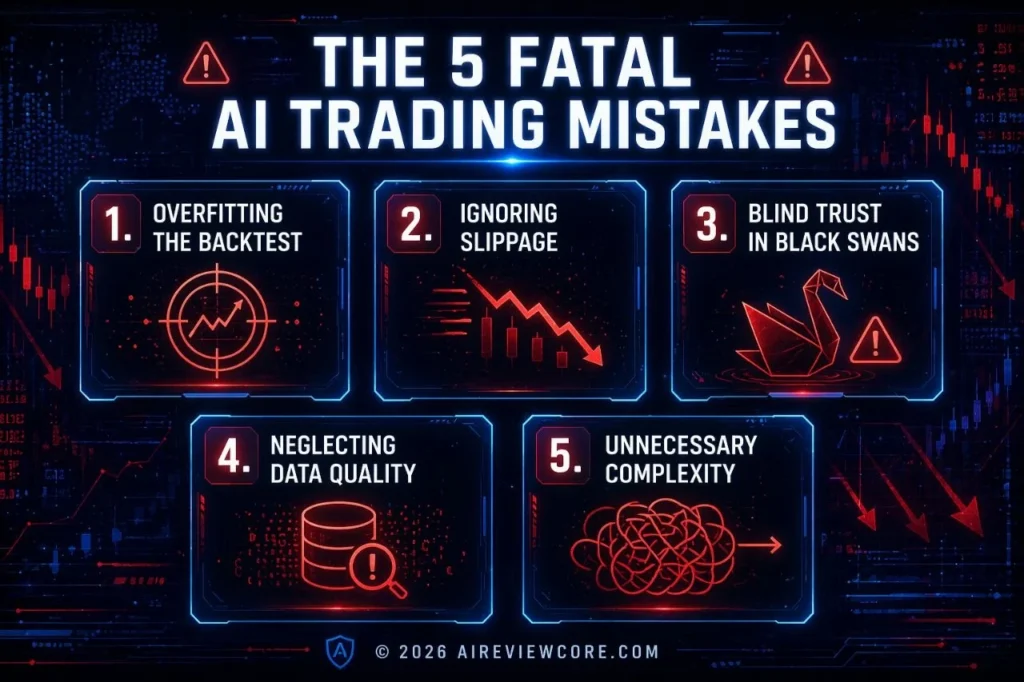
1. Overfitting the Backtest
Your model achieves 95% accuracy on historical data and then loses money immediately in live trading. This is overfitting — the model memorized past noise instead of learning genuine market patterns. Always validate your model on out-of-sample data it has never seen before trusting any backtest result. A backtest that looks perfect is a warning sign, not a green light.
2. Ignoring Slippage
Paper trading fills look clean. Real market fills do not. Slippage — the difference between your intended execution price and your actual fill — can turn a theoretically profitable AI trading strategy into a consistently losing one, especially at higher trade frequencies. Always model realistic slippage into your backtests before any live deployment.
3. Blind Trust During Black Swan Events
AI systems have no experience with events that have never happened before. During unprecedented market shocks — a surprise rate decision, a geopolitical escalation, a market circuit breaker — models trained on historical data can generate wildly inappropriate signals. Human override capability is not optional in any serious AI trading system. It is a core architectural requirement.
4. Neglecting Data Quality
Most edge in AI trading comes from data quality, feature design, and risk management — not from the model itself. This is one of the most important truths in quantitative finance. Feeding a sophisticated model bad data produces sophisticated bad predictions at machine speed. Garbage in, garbage out — faster and at larger scale than any human trader could manage.
5. Complexity for Its Own Sake
Many beginners in AI trading assume that a more complex model equals better performance. In practice, simpler models with high-quality features frequently outperform elaborate deep learning architectures that overfit to noise. Start simple. Add complexity only when simpler approaches demonstrably fail — and when you understand exactly why they are failing.
The Regulatory Landscape for AI Trading in 2026
Regulators globally are moving quickly to address AI in financial markets. The U.S. CFTC has issued explicit warnings: AI will not turn trading bots into money machines, cautioning retail investors against platforms making exaggerated performance claims that no systematic strategy can reliably deliver.
The emerging global regulatory standard is Explainable AI (XAI) — the requirement that AI systems used in financial decisions must be able to articulate why they made a specific recommendation. Black-box models that produce outputs no human can interpret are facing increasing regulatory scrutiny. If you are using or building AI trading tools professionally in 2026, explainability is not a nice-to-have — it is becoming a compliance requirement in regulated markets.
Frequently Asked Questions About AI Trading in 2026
Is AI trading profitable for beginners in 2026?
It can be, but profitability depends far more on risk management discipline and data quality than on the sophistication of the AI model. Most beginners who lose money do so because they skip proper backtesting or ignore position sizing — not because their AI was not advanced enough.
What is the best AI trading platform in 2026?
For day traders, Trade Ideas with Holly AI offers the most comprehensive real-time scanning. For developers and quant traders, QuantConnect provides institutional-grade infrastructure. For absolute beginners testing AI trading in 2026 without capital risk, Alpaca API’s paper trading environment is the ideal starting point.
Do I need coding skills for AI trading?
Not necessarily. Platforms like Capitalise.ai allow you to create automated strategies using plain English commands. However, basic Python knowledge significantly expands your capabilities and gives you meaningful control over your strategy’s behavior that no-code platforms cannot match.
Can AI trading bots lose all my money?
Yes — without proper risk management, any trading system can produce catastrophic losses. A circuit breaker that automatically shuts down the system at a defined drawdown level is a non-negotiable safeguard for any automated AI trading operation.
What hardware do I need to start AI trading in 2026?
For most retail traders using pre-trained models and existing platforms, a modern CPU with 16 to 32GB of RAM is sufficient. A mid-range GPU is helpful but not required to begin experimenting with AI trading strategies.
How long should I paper trade before going live?
A minimum of three months of consistent paper trading results across varied market conditions. One month of good results in a trending market does not validate a strategy — you need to see how it behaves across different volatility regimes before deploying real capital.
Beyond optimizing your trading portfolio, automating your daily tasks is just as crucial. If you want to streamline your workflow outside the markets, explore our top-rated AI Productivity tools and systems.
Your Action Plan: Starting AI Trading in 2026 the Right Way
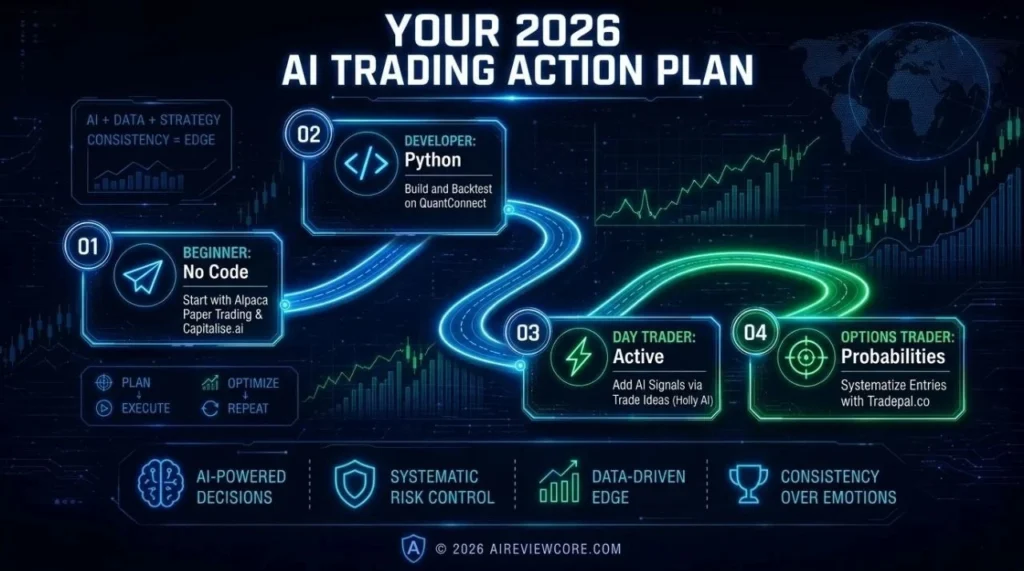
AI trading in 2026 rewards those who approach it with intellectual honesty. The traders succeeding with these tools are not the ones with the most powerful hardware or the most complex models. They are the ones who understand that the model is only as good as the data feeding it, the risk management system protecting it, and the human judgment overseeing it.
Here is the decision framework for where to start:
- Complete beginner with no coding background? Start with Alpaca paper trading and Capitalise.ai’s plain-English strategy builder. Learn how automated trading behaves before writing a single line of code.
- Some Python knowledge and ready to build? Use QuantConnect’s backtesting infrastructure to develop and validate a strategy on historical data. Do not deploy live until three months of out-of-sample testing supports it.
- Active day trader looking to add AI signals? Trade Ideas with Holly AI provides the fastest path to AI-generated setups without requiring you to build anything from scratch.
- Options trader looking to systematize entries? Tradepal.co’s probability-based targeting gives you a structured AI layer on top of your existing options workflow without requiring a full system rebuild.
The future of trading belongs to those who can combine algorithmic speed with human wisdom — using the machine’s ability to process data at scale while retaining the human capacity to understand context, recognize unprecedented conditions, and override the system when the market behaves in ways no historical dataset could have predicted.
Start small. Paper trade first. Build your risk framework before you build your strategy. And remember: the goal of AI trading in 2026 is not to remove yourself from the equation — it is to become a better, more disciplined version of yourself as a trader, with AI as your most powerful tool.
Adrian Cole is a professional AI technology reviewer and creative technologist at aireviewcore.com, covering AI trading tools, language models, and practical workflow technology for traders and investors.
© 2026 aireviewcore.com — All rights reserved.