
Updated: September 2, 2026
AI can make content work faster, but speed alone does not create useful articles, trusted recommendations, or lasting search visibility. The strongest workflow uses AI for research support, structure, and early drafts—then uses human judgment for evidence, experience, accuracy, and a clear point of view.
This guide explains the Crumbs Method: a practical way to create AI-assisted content one section at a time instead of asking a model to generate an entire article in a single prompt. You will learn how to research search intent, build a better outline, create original value, verify claims, and prepare content for both traditional search and AI-powered discovery.
Quick answer: The Crumbs Method is a section-by-section AI writing workflow. You research the topic first, create a complete outline, prompt for one focused section at a time, add human evidence and experience, verify all factual claims, and optimize the finished article for readers—not just search engines.
Why AI Content Writing Changed
AI has made it easier to produce a first draft. It has not made it easier to produce content people trust.
Search still matters, and so do AI-powered answer experiences. Readers may discover an article through a traditional result, an AI Overview, an AI assistant, a social post, or a direct recommendation. The practical implication is not that traditional SEO has disappeared. It is that a useful content strategy now needs to satisfy both human readers and multiple discovery surfaces.
Google’s guidance has stayed consistent on the central point: content should be created to help people, not primarily to manipulate rankings. AI can support research and drafting, but publishing large volumes of low-value pages without original insight, useful evidence, or careful review remains a poor strategy.
The advantage in 2026 is not simply generating more text. It is producing content with:
- A clear answer to the reader’s question
- Reliable and current sources
- First-hand experience or original analysis where it matters
- Examples that make the advice usable
- Honest limitations and tradeoffs
- A structure that readers can scan and understand
That is where the Crumbs Method helps.
The Crumbs Method Explained
The Crumbs Method means creating an article in small, deliberate stages rather than accepting a single full-length output from AI.
A full-article prompt can be useful for a rough starting point, but it often makes repetition, weak transitions, missing evidence, and generic advice harder to spot. When you work section by section, you can improve the article while it is being built instead of trying to repair a long draft at the end.
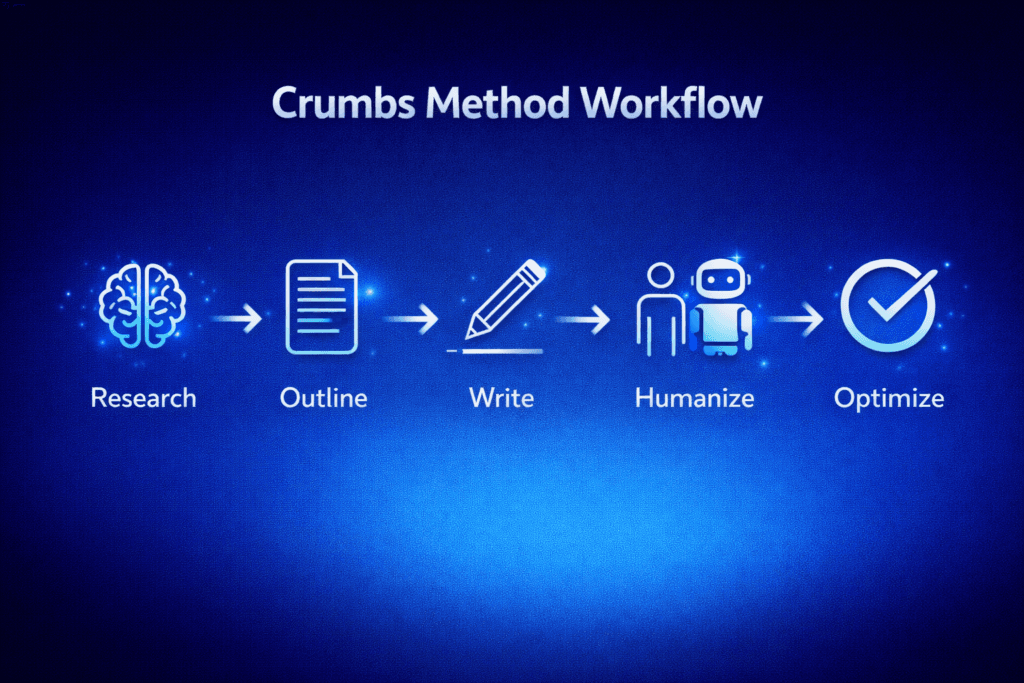
The workflow has five parts:
- Research the topic, search intent, and credible sources
- Build a complete outline before drafting
- Generate one focused section at a time
- Add human experience, evidence, and information gain
- Edit, verify, and optimize before publishing
Use the workflow as a quality-control system, not as a way to publish faster at any cost.
Phase 1: Research Search Intent and Topic Gaps
Before asking AI to write, understand what the reader wants and what the existing content fails to explain.
Identify the Search Intent
Search intent is the purpose behind a query. Most searches fit one or more of these categories:
| Search intent | What the reader wants | Example |
| Informational | To learn or understand | “How to use AI for content writing” |
| Navigational | To reach a specific product or website | “Claude writing assistant” |
| Commercial | To compare options before choosing | “Best AI writing tools” |
| Transactional | To take an action or buy | “AI writing tool pricing” |
For an AI content writing guide, the main intent is informational: readers want a process they can apply. But a complete guide can also support commercial intent by explaining how to evaluate tools without turning the article into an unhelpful list of affiliate links.
Review the Search Results Yourself
Use AI as an assistant, not as a substitute for research. Search your target topic and review the most relevant ranking pages yourself.
Look for:
- Repeated headings and common advice
- Questions readers still need answered
- Missing practical examples
- Outdated screenshots, tools, or pricing
- Claims without sources
- Areas where articles give instructions but do not explain the reasoning
Then create a simple coverage sheet. List the major subtopics in one column and the competing pages across the top. Mark which page covers each topic well, poorly, or not at all. This makes real content gaps visible.
Use AI to Expand Your Topic Map
AI can help you brainstorm related concepts, reader questions, use cases, objections, and entities connected to a subject. For AI content writing, related concepts may include prompt design, source verification, editorial review, search intent, content structure, topical authority, internal linking, structured data, and content quality.
Treat these as a starting map, not a list to force into an article. Validate the suggestions against credible sources, real search results, and your audience’s needs. Good topical coverage comes from answering the right questions clearly, not from inserting every related phrase an AI generates.
Phase 2: Build the Outline Before You Draft
A strong outline prevents a weak AI draft from becoming the structure of your article.
Before generating any paragraphs, decide:
- Who is the reader?
- What decision or task should the article help them complete?
- What must they understand by the end?
- What evidence, examples, or experience can only you provide?
- Which sections need sources or product verification?
For this article, the reader wants a repeatable process for using AI without producing generic, untrustworthy content. The outline therefore needs research, drafting, editing, verification, and technical publishing—not only prompts.
Create Direct Answer Sections
Start major sections with a concise answer before adding detail. This improves clarity for readers and makes the article easier to understand when it is summarized or quoted by search tools.
For example:
What is information gain? Information gain is the additional value an article provides beyond what readers can find in existing results. It can come from original research, practical testing, first-hand experience, clear comparisons, unique examples, or a better explanation of a difficult topic.
Do not write answer blocks only for algorithms. Write them because a reader should not need to read five paragraphs to understand the point.
Phase 3: Draft One Section at a Time

This is the core of the Crumbs Method.
Instead of prompting: “Write a 3,000-word article on AI content writing,” ask AI to write one specific section with a defined purpose, audience, evidence requirement, and place in the article.
A section-by-section workflow looks like this:
- Write every H2 and H3 in your outline.
- Give the model the article goal and intended reader.
- Ask for the first section only.
- Review the draft for accuracy, repetition, tone, and missing evidence.
- Add your examples, observations, and sources.
- Tell the model what the previous section covered before generating the next one.
- Repeat until the complete draft is assembled.
This approach gives you more editorial control. It also makes it easier to stop an article from drifting into generic language or unsupported claims.
Why Full-Article Prompts Often Create Weak Content
A single prompt is not always wrong, but it creates predictable problems in long-form writing:
- Important points may be repeated in multiple sections
- The model may use broad claims instead of evidence
- The article can lose focus as the draft grows
- Transitions can sound artificial or repetitive
- The structure may reflect the model’s default pattern instead of the reader’s needs
- It becomes harder to verify every fact after the draft is complete
The solution is not to avoid AI. The solution is to break the work into smaller editorial decisions.
Phase 4: Add Information Gain and Human Judgment
AI can summarize existing material quickly. That means your article needs value that does not come from rewriting the same sources everyone else has already used.
What Information Gain Looks Like
Information gain can include:
- A real test with a clear method and honest results
- A first-hand workflow you actually use
- An original spreadsheet, template, checklist, or framework
- A small survey with its methodology and limitations explained
- A comparison that defines the criteria before judging products
- A specific example that makes an abstract concept practical
- An expert explanation of tradeoffs that other pages ignore
Original value does not require a large research team. It requires honesty and specificity.
If you say you tested a tool, explain what you tested, when you tested it, what criteria you used, and what did not work. If you publish a survey, state the sample size, how participants were selected, and why readers should not treat it as a representative study. If you use a hypothetical example to explain a process, label it clearly as hypothetical.
Add Experience Without Inventing It
Experience is valuable only when it is real.
Do not invent personal experiments, client outcomes, survey results, rankings, traffic figures, or product tests. Specificity can support trust when it is truthful, but fabricated specificity damages trust quickly when readers cannot verify it.
A credible first-hand sentence looks like this:
“When I use AI for a product comparison, I ask it to create a draft table first, then I verify every feature and price against each company’s current documentation before publishing.”
A credible limitation looks like this:
“This workflow is efficient for research and drafting, but it still requires manual review for product claims, legal information, pricing, and performance data.”
That is more useful than a dramatic claim about ranking speed or a promise that a method will produce a guaranteed result.
Use AI to Challenge Your Draft
After drafting a section, use a second prompt to identify weaknesses. Ask the model to find vague statements, unsupported facts, missing counterarguments, unclear transitions, and claims that need a source.
Then review the suggestions yourself. AI is useful as an editorial sparring partner, but it should not approve its own work without human judgment.
Phase 5: Verify Before You Publish
This phase is non-negotiable.
AI can generate plausible but false citations, outdated prices, invented product features, incorrect statistics, and misleading summaries. A polished paragraph is not evidence that the information is correct.
Verify every factual claim that could affect a reader’s decision, especially:
- Product features and availability
- Pricing, subscriptions, and free-plan limits
- Performance benchmarks and test results
- Statistics and survey data
- Legal, financial, medical, or security guidance
- Quotes, dates, company announcements, and policy changes
- Links, including internal links on your own website
Use primary sources whenever possible: official product documentation, company announcements, government sources, original research, or the full study—not a blog that repeats a blog that repeats a press release.
A Simple Fact-Checking Workflow
- Highlight every number, date, quote, product claim, and comparison in your draft.
- Find the original source for each claim.
- Open the source and read the surrounding context, not only a search snippet.
- Confirm the claim still applies on the publication date.
- Link to the source where it improves reader trust.
- Remove the claim if you cannot verify it.
For content that may affect money, security, health, or legal decisions, ask a qualified professional to review it when appropriate. An AI writing tool is not a substitute for subject-matter expertise.
SEO and AI Search Visibility
Traditional SEO and AI discovery work best together. The goal is not to chase a secret trick for citations. The goal is to publish the clearest, most reliable page for the reader’s question.
Use Semantic Coverage Naturally
Search engines need enough context to understand what an article covers. For AI content writing, a useful article may naturally discuss prompt design, search intent, editing, fact-checking, content quality, structured data, topical clusters, internal links, and publishing workflow.
Do not use terms because an optimization score tells you to. Use them when they improve the explanation. A reader should never feel that words were inserted only to influence a machine.
Use Structured Data Correctly
Structured data can help search platforms understand the type of content on a page. Depending on your page, relevant options can include:
- Article schema for the article title, author, image, and dates
- FAQ schema for genuine questions and answers visible on the page
- HowTo schema for a real step-by-step process where the markup follows current search-engine guidelines
Schema is not a guarantee of higher rankings or AI citations. It is a way to describe content accurately. Use it only when the visible page genuinely contains the information you mark up.
Build Useful Internal Links
Internal links help readers discover related work and help search engines understand your content structure. Link where the next page genuinely adds context.
For an AI content writing guide, helpful related topics may include:
- AI writing tool reviews
- Prompt-writing guides
- AI agent safety and browser automation
- Content optimization workflows
- Internal-linking strategy
Avoid forcing a fixed number of links into every article. One useful link is better than five irrelevant ones.
Choosing AI Writing Tools by Workflow
Tool features, models, and prices change frequently. Instead of treating one product as the best option for every task, choose tools based on the stage of work and verify current capabilities before making a decision.
| Workflow stage | Useful tool type | What to evaluate |
| Topic research | Search tools, research assistants, source databases | Source quality, freshness, citations, export options |
| Planning and outlining | Reasoning model or writing assistant | Structure, clarity, ability to follow constraints |
| Section drafting | Long-context writing model | Tone control, editability, context retention |
| Editing and review | Grammar editor, style tool, second AI reviewer | Clarity, repetition, claim detection, brand voice |
| SEO and publishing | SEO suite, analytics, Search Console | Intent coverage, internal links, technical checks |
The strongest workflow is usually not a single-tool workflow. Use the tools that fit the job, then keep one accountable human responsible for the final result.
Five Copy-and-Paste Prompts
1. Research Prompt
I am creating an article about [TOPIC] for [AUDIENCE].
Help me plan research without inventing facts. Identify:
1. The likely search intent behind [PRIMARY KEYWORD]
2. Common questions readers may have
3. Subtopics that should be covered for a complete answer
4. Claims that would require primary-source verification
5. Possible original angles, examples, templates, or tests I could add
Do not claim you reviewed live search results unless I provide them. Separate suggestions from verified facts.
2. Outline Prompt
Create a detailed outline for an article about [TOPIC].
Primary keyword: [KEYWORD]
Audience: [AUDIENCE]
Reader goal: [WHAT THE READER NEEDS TO DO OR DECIDE]
Include clear H2 and H3 headings. Start each H2 with the direct answer the reader needs, then add supporting detail. Include places where I should add first-hand experience, sources, examples, or a checklist.
Avoid filler headings and do not invent statistics or product claims.
3. Section-by-Section Writing Prompt
Write only the section titled: [SECTION TITLE]
Article topic: [TOPIC]
Audience: [AUDIENCE]
Section goal: [WHAT THE SECTION MUST HELP THE READER UNDERSTAND]
Previous section summary: [SUMMARY]
Requirements:
– Start with a direct answer
– Use a clear, conversational, professional tone
– Include only facts I have provided or mark unverified claims clearly
– Avoid generic phrases and repeated conclusions
– Suggest where a source, example, or personal observation would strengthen the section
– Do not write the next section
4. Human Review Prompt
Review the following draft as a rigorous editor.
Identify:
1. Claims that need a source or verification
2. Vague, repetitive, or generic language
3. Missing tradeoffs or limitations
4. Places where first-hand experience or a practical example would help
5. Sentences that sound overly certain without evidence
Do not rewrite facts or invent examples. Give precise revision suggestions.
[DRAFT]
5. Optimization Prompt
Review this article section for reader usefulness and search clarity.
Check:
1. Whether it directly answers the likely search intent
2. Whether headings accurately describe the content
3. Missing related concepts that would improve understanding
4. Opportunities for a useful FAQ or checklist
5. Natural internal-link opportunities, with suggested anchor text
6. Whether any structured data would accurately match visible content
Prioritize clarity and accuracy over keyword repetition.
[SECTION]
Common Mistakes to Avoid
Publishing the first AI output
A first draft is a starting point. Edit it for evidence, clarity, relevance, and voice before publishing.
Inventing proof of experience
Do not create fictional tests, surveys, case studies, screenshots, rankings, traffic results, or client stories. If you cannot verify it, do not present it as a result.
Treating AI citations as a ranking guarantee
No formatting method can guarantee that an AI Overview or an AI assistant will cite your page. Clear answers, strong sources, original value, and topical relevance can improve usefulness, but outcomes vary by query and platform.
Optimizing only for keywords
Keywords help you understand demand, but a good article must solve the reader’s problem. Write for the task behind the query, not merely the phrase itself.
Using old product information
AI products change quickly. Recheck model names, plans, features, prices, screenshots, and policy statements before publishing or updating a guide.
Overusing AI-detection language
The objective is not to “beat” an AI detector. The objective is to publish content that is accurate, original, useful, and responsibly reviewed.
Frequently Asked Questions
Is AI content allowed in Google Search?
AI-assisted content can appear in Google Search. Google’s guidance emphasizes helpful, reliable, people-first content and warns against using automation primarily to create low-value pages for rankings. The quality and purpose of the content matter more than whether AI helped create an early draft.
Does AI content hurt SEO?
AI content can hurt performance if it is inaccurate, repetitive, unoriginal, or created primarily to manipulate rankings. AI-assisted content can be useful when a human verifies facts, adds meaningful expertise, and makes the article genuinely helpful.
What is the Crumbs Method?
The Crumbs Method is a section-by-section AI writing process: research first, plan the full outline, draft one section at a time, add human evidence and experience, verify claims, and optimize the completed article for readers.
How do I avoid AI-generated content mistakes?
Never publish the first output without review. Verify all facts, links, prices, dates, quotes, and product claims. Add real examples, label hypothetical scenarios clearly, and remove anything you cannot support with evidence.
Do I need a human editor if I use AI?
Yes. A human editor is responsible for accuracy, relevance, judgment, brand voice, legal or ethical considerations, and the final decision to publish. AI can accelerate parts of the process, but it cannot assume accountability for the result.
Does schema guarantee AI Overview visibility?
No. Structured data helps search platforms interpret your page, but it does not guarantee rankings, rich results, citations, or inclusion in AI-generated answers. Use schema accurately because it describes useful content, not as a shortcut.
A Practical Three-Step Plan
Step 1: Audit Your Current Workflow
Identify where content creation slows down or loses quality. Research, outlining, drafting, editing, fact-checking, and publishing are different tasks. Decide where AI can save time without removing the human review that protects accuracy.
Step 2: Try the Crumbs Method on One Article
Choose one upcoming article. Build the outline before prompting, generate one section at a time, and keep a list of every claim that needs verification. Compare the finished article with your usual process based on clarity, usefulness, originality, and time spent editing—not only speed.
Step 3: Improve Your Publishing System
Create a reusable pre-publication checklist. Include source checks, link checks, image alt text, visible FAQs where relevant, accurate structured data, and internal links that help readers continue learning.
AI has made basic text inexpensive. That makes careful research, clear judgment, genuine experience, and editorial standards more valuable—not less.
Use AI to remove repetitive work. Keep humans responsible for the information you publish.
If you have questions about our AI content strategy, contact us.